
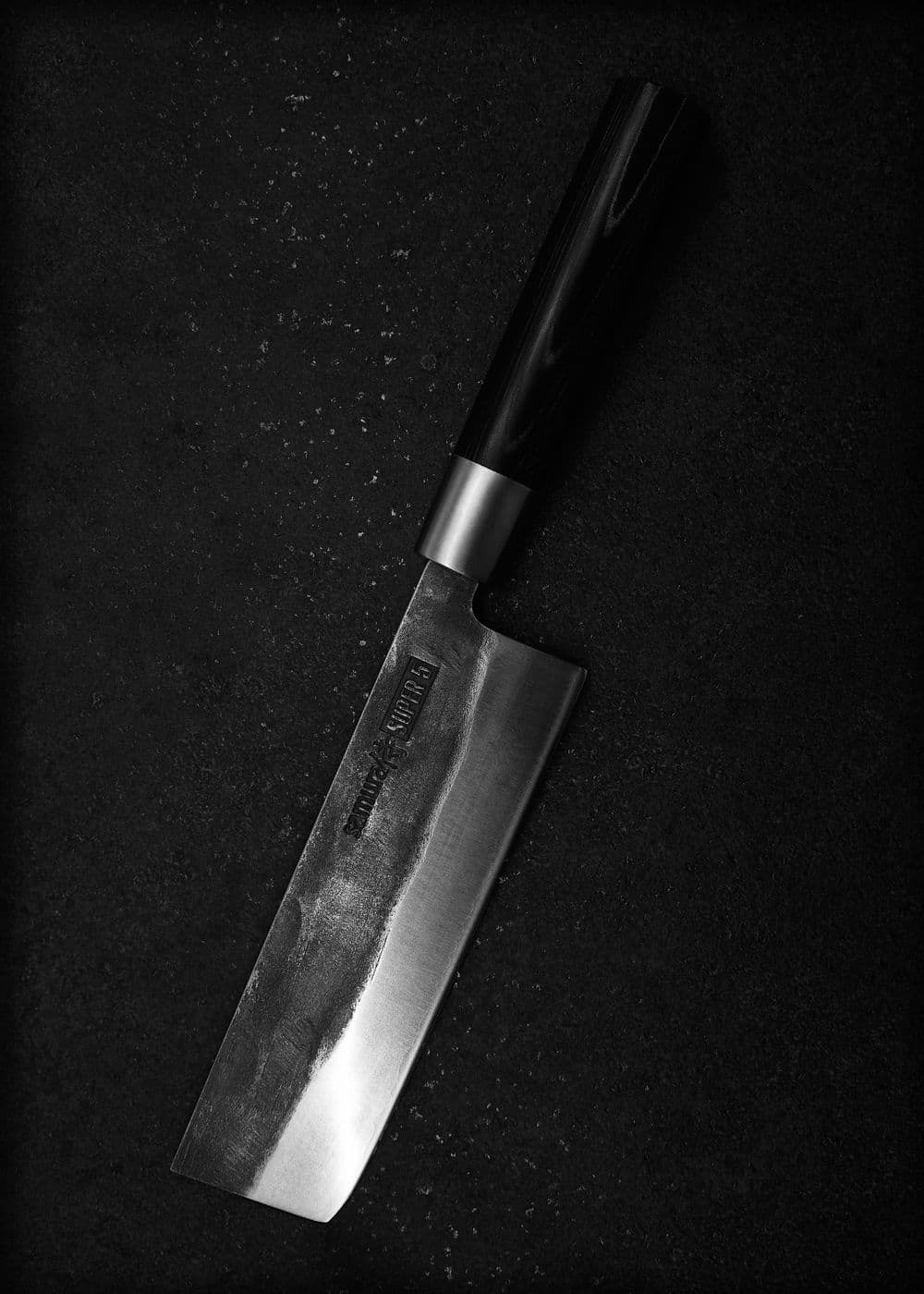
What is a santoku?
A santoku is a general-purpose Japanese kitchen knife. The name means "three virtues", usually explained as the three foods it handles — meat, fish and vegetables — and sometimes as the three cuts it makes: slicing, dicing and mincing. Both readings describe the same idea: one knife for most everyday cooking.
It became the standard knife in Japanese home kitchens in the 20th century, taking over from the separate vegetable knife (nakiri) and fish knife (deba) that households had used before. Today it is also made by Western brands, and it is one of the most searched-for knife shapes in the English-speaking world.
The shape, part by part
- Flat edge. Most of the edge is nearly straight, with only a small curve near the tip. That means the whole edge meets the board in a straight chop, so slices come apart cleanly instead of staying joined at the bottom.
- Tall heel. The blade is roughly as tall as a nakiri's at the heel, which keeps your knuckles clear of the board and lets you scoop chopped food into the pan.
- Sheepsfoot tip. The spine curves down to meet the edge, so the tip is rounded rather than pointed. It is sturdier and less likely to snag, but it does not pierce.
- Short blade. At 165–180 mm it is 30–45 mm shorter than a typical 210 mm gyuto, which makes it quicker to control on a small board.
The names of every part (hira, shinogi, kissaki, ago) are in our Japanese knife anatomy guide.
What a santoku is good (and bad) at
Good at
- Slicing and dicing onions, carrots, peppers and potatoes
- Mincing herbs, garlic and ginger
- Cutting boneless chicken, pork and beef
- Portioning fish fillets
- Thin, even slices for stir-fries and salads
Not for
- Bones, joints and frozen food
- Hard winter squash and very large melons
- Piercing or trimming with the tip
- Long carving strokes on large roasts
- Bread with a hard crust
For bone work use a honesuki or a cleaver; see why thin Japanese knives chip on bone. For carving, a sujihiki is the right tool, and for crusty bread a bread knife.
How to cut with a santoku
- Hold it with a pinch grip. Pinch the blade just in front of the handle between thumb and the side of your index finger, with the other fingers around the handle. This gives far more control than holding only the handle.
- Push-cut forward and down. Start with the tip area on the food and move the knife forward and down in one stroke, finishing near the heel. This is the santoku's natural motion and slices cleanly with little pressure.
- Or chop straight down. For quick work on small items, lift and drop the blade straight down. The flat edge meets the board all along its length.
- Guide with a claw. Curl the fingertips of your other hand under and let the flat of the blade rest against your knuckles. The tall heel makes this easy.
- Don't scrape with the edge. Turn the knife over and use the spine to move food across the board; scraping with the edge dulls it quickly.
Santoku vs chef's knife, nakiri and bunka
| Santoku | Gyuto / chef's knife | Nakiri | Bunka | |
|---|---|---|---|---|
| Length | 165–180 mm | 180–240 mm | 165–180 mm | 165–180 mm |
| Edge profile | Flat, small curve | Curved belly | Dead flat | Flat |
| Tip | Rounded (sheepsfoot) | Pointed | Square | Angled k-tip |
| Main motion | Push-cut, chop | Rock, push, slice | Chop | Push-cut, chop |
| Meat & fish | Yes (boneless) | Yes (boneless) | No | Yes (boneless) |
| Tip work | Limited | Good | None | Good |
- Santoku vs gyuto: the gyuto is longer, pointed and rocks; the santoku is shorter and flatter. The full comparison is in gyuto vs santoku.
- Santoku vs nakiri: the nakiri is a vegetable-only specialist with a square tip. The santoku does vegetables almost as well and also handles meat and fish.
- Santoku vs bunka: the bunka is the same size and profile with an angled point instead of a rounded one — pick it if you want santoku handling plus a usable tip.
Japanese vs Western-made santoku
Many Western brands sell a santoku, and it looks much like a Japanese one. The difference is in how the blade is made, and it changes how the knife cuts and how you look after it.
| Typical Japanese-made | Typical Western-made | |
|---|---|---|
| Hardness | ~60 HRC and above | ~56–58 HRC |
| Edge angle | ~15° per side | ~20° per side |
| Blade | Thinner behind the edge | Thicker, heavier |
| Feel | Keener, less effort | Tougher, more forgiving |
| Weak point | Can chip on bone or twisting | Dulls sooner |
These are typical ranges, not rules — some Japanese makers run softer steel and some Western lines are made in Japan. Check the stated hardness and where the line is made. Our brand guide lists where major brands actually produce their knives, and Japanese vs German knives explains the trade-off in detail.
How to choose a santoku
- Size: 165 mm for small boards and hands, 180 mm for more reach. Either is fine for most kitchens. See the size guide for inch conversions.
- Steel: stainless (VG10, Ginsan, SG2) for easy care; carbon (Shirogami, Aogami) for a keener edge that needs drying and develops a patina. Compare them in the steel chart.
- Handle: a light wooden wa handle moves the balance forward; a riveted Western yo handle feels heavier and more familiar. See wa vs yo handles.
- Finish: dimples, hammered (tsuchime) or damascus finishes mostly affect looks and a little food release, not cutting quality. The core steel matters more — see san mai & damascus.
- Bevel: almost all santoku are double-bevel, so they work in either hand. If a listing says single-bevel, check that it matches your hand.
Care and sharpening
Hand-wash and dry it straight away (never the dishwasher), use a wooden or soft plastic board, and store it so the edge does not touch other metal. Sharpen on a whetstone at about 15° per side for a Japanese-made santoku, following our step-by-step sharpening guide. Avoid pull-through sharpeners, which can chip hard steel.
The bottom line
A santoku is the easy, nimble all-rounder: short, flat and forgiving to use. If you chop more than you rock and want one knife for everyday cooking, it is hard to beat.
Still deciding between a santoku and a gyuto? Try the 4-question knife finder or put them side by side in the comparison tool.
Frequently asked questions
What is a santoku knife used for?
A santoku is an everyday all-purpose kitchen knife. It slices, dices and minces vegetables, cuts boneless meat and fish, and handles herbs, onions and garlic. Its flat edge suits a straight up-and-down chop or a forward push-cut. It is not meant for bones, frozen food or hard winter squash, and its rounded tip is not built for piercing or fine point work.
What does santoku mean?
Santoku (三徳) means "three virtues". The three are usually explained as the three foods it handles — meat, fish and vegetables — and sometimes as the three cuts it makes — slicing, dicing and mincing. Either way, the name describes a knife meant to do most jobs in a home kitchen.
Is a santoku better than a chef's knife?
Neither is better; they suit different cooks. A santoku is shorter, lighter and flatter, so it is easy to control and good at straight chopping. A chef's knife (or a Japanese gyuto) is longer with a curved belly and a pointed tip, so it rocks, reaches across big produce and does tip work. If you rock-chop or cut a lot of large items, choose the chef's knife; if you want a nimble knife for everyday prep, choose the santoku.
What size santoku should I buy?
165–180 mm (about 6½–7 inches) suits almost everyone. 165 mm is the classic Japanese home size and the easiest to control; 180 mm gives a little more reach for larger vegetables and bigger boards. Smaller santoku around 130–150 mm exist and behave more like a petty knife.
Why does a santoku have dimples?
The oval hollows along some santoku blades are a granton (or hollow) edge. They reduce the contact between blade and food so thin, wet slices of potato or cucumber are a little less likely to cling. It is a convenience feature, not a sign of quality, and many excellent santoku have a plain blade.
Can you rock a santoku?
Only a little. A santoku's edge is much flatter than a chef's knife, so a full rocking motion lifts most of the edge off the board. It works best with a straight chop or a push-cut, where the whole flat edge meets the board. If rocking is your habit, a gyuto will feel more natural.
What is the difference between a Japanese santoku and a German santoku?
The shape is similar, but the blade is built differently. Japanese-made santoku are usually harder (around 60 HRC or more), thinner behind the edge and sharpened to about 15° per side, so they cut with less effort but chip more easily. Western-made santoku are usually softer (around 56–58 HRC), thicker and sharpened nearer 20°, so they are tougher and more forgiving but need sharpening more often.
Is a santoku good for beginners?
Yes. A stainless, double-bevel santoku of 165–180 mm is one of the easiest first Japanese knives: short enough to control, flat enough for a simple chop, and not fussy about care. The other common first choice is a 210 mm gyuto, which suits cooks who already rock-chop with a Western chef's knife.
Not sure which knife suits you?
Tell us how you cook and we'll suggest a shape, size and steel — free, by email. Our curated shelf opens soon; join the waitlist.
Ask for advice →