
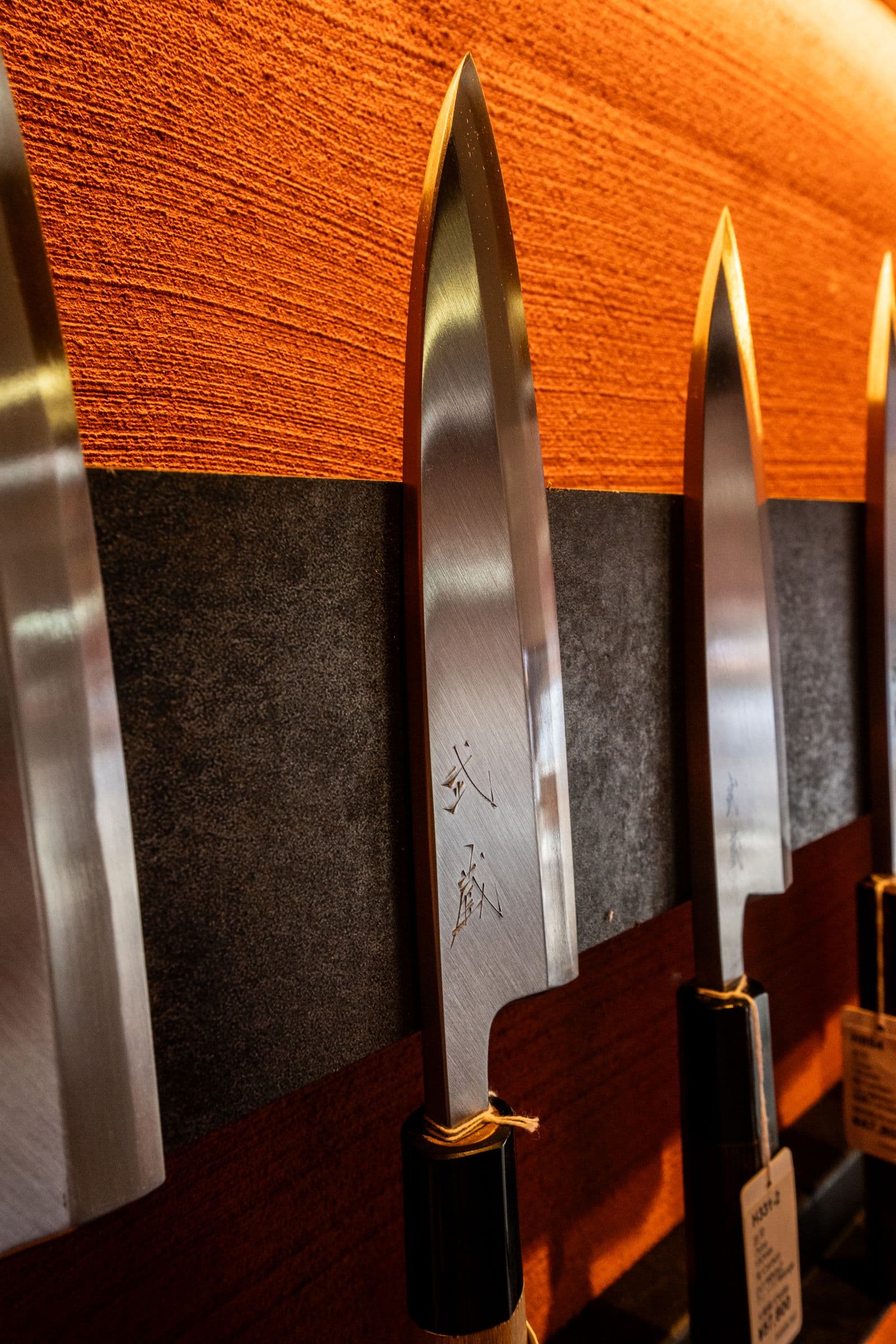
The blade, part by part
These terms apply to every Japanese kitchen knife, single- or double-bevel. Two are worth reading twice: the mine, because spine thickness is the single best predictor of how a knife feels in food, and the hira, because how the maker ground that face is what separates a knife that releases cleanly from one everything sticks to.
| Term | Japanese | English | What it does |
|---|---|---|---|
| Kissaki | 切先 | Tip | The point. Does the fine work — scoring, detail cuts, opening up a joint. |
| Hasaki | 刃先 | Edge | The cutting edge itself. What you sharpen; the only part that actually cuts. |
| Mine (or se) | 峰 | Spine | The blunt back. Its thickness sets how much the blade wedges through food. |
| Hira | 平 | Blade face | The flat side. How it is ground here decides whether food sticks or releases. |
| Hara | 腹 | Belly | The curved section of the edge. More curve means more rocking, less flat contact. |
| Ago | 顎 | Heel | The rear corner of the edge. Used for tougher cuts where you want weight behind it. |
| Hamoto | 刃元 | Base of the edge | The area just forward of the heel — the strongest part of the edge. |
| Machi | 区 | Notch | The step where the blade stops and the tang begins. On a wa knife it sits against the ferrule. |
| Nakago | 中子 | Tang | The unsharpened portion inside the handle. On wa knives it is usually a hidden rat-tail. |
| Mei | 銘 | Signature | The maker's name, chiselled or stamped into the blade face. Often the smith or the brand. |
Single-bevel parts
A single-bevel knife — a yanagiba, deba or usuba — has a vocabulary of its own, because the geometry is genuinely different rather than just asymmetric. The back is not simply flat: it is dished.
| Term | Japanese | English | What it does |
|---|---|---|---|
| Shinogi | 鎬 | Bevel ridge | The hard line where the wide bevel meets the flat face. Keeping it straight is the whole skill of sharpening a single bevel. |
| Kireha | 切刃 | Bevel face | The broad ground face between the shinogi and the edge. On a double-bevel knife this is a few millimetres; here it is most of the blade. |
| Ura | 裏 | Back | The reverse side, which is flat rather than ground — this is what lets the knife cut straight along a bone or a katsuramuki sheet. |
| Uraoshi | 裏押し | Back rim | The narrow flat band around the hollow. You maintain it with a few light strokes, never a full grind. |
| Urasuki | 裏スキ | Back hollow | The shallow concave dish in the back. It reduces friction and means only the rim needs flattening. |
How to tell a right-handed single bevel from a left-handed one: hold it edge down, tip away from you. If the wide bevel faces right and the hollow back faces you, it is right-handed. You cannot convert one by sharpening — the hollow is ground into the opposite face. See left-handed Japanese knives.
The handle
Japanese handles are built on a different principle from Western ones. A wa handle is a block of wood with a burnt-in socket that the tang is driven into, finished with a horn kuchigane. There are no rivets and usually no bolster, which is why wa-handled knives are lighter and blade-forward — and why the handle can be replaced when it wears out, which a riveted Western handle cannot.
| Term | Japanese | English | What it does |
|---|---|---|---|
| Tsuka (or e) | 柄 | Handle | Wa handles are usually octagonal, D-shaped or oval wood, glued onto the tang rather than riveted. |
| Kuchigane | 口金 | Ferrule | The collar between handle and blade, classically buffalo horn. Stops the wood splitting and keeps water out. |
| Bolster | — | Bolster | Western only: the thick collar of steel between blade and handle. Adds weight and a finger guard; makes full sharpening harder. |
| Rivets | — | Rivets | Western only: pins holding the two handle scales onto a full tang. |
| Scales | — | Scales | Western only: the two handle halves sandwiching the tang. |
Which to choose is a question of feel rather than quality; the wa vs yo comparison covers the trade-off properly.
Tip shapes, named
The tip — the kissaki — is where Japanese knives differ most visibly, and the shape is a good shortcut to what a knife is for. A point means detail and piercing work; a square end means the knife was never meant to need one. The "small kite-shaped" or "angled-tip" knife people search for is almost always a bunka or a kiritsuke with a kengata tip.
Pointed
Gyuto, petty, sujihiki, yanagiba
Sheepsfoot
Santoku
K-tip (reverse tanto)
剣型 kengata
Bunka, kiritsuke, kiritsuke-gyuto
Square
角型 kakugata
Nakiri, Kanto-style usuba, takohiki
Sickle
鎌型 kamagata
Kansai-style usuba
| Term | Japanese | English | What it does |
|---|---|---|---|
| Pointed tip | — | Pointed | A true point where the curved edge meets the spine. Found on the gyuto, petty, sujihiki and yanagiba; the tip does fine work and piercing. |
| Sheepsfoot tip | — | Sheepsfoot | The spine curves down to meet a nearly flat edge, leaving a rounded, blunt-feeling tip. The santoku's shape: safe and good for push-cutting, weak for tip work. |
| Kengata | 剣型 | K-tip (reverse tanto) | An angled, straight line from spine to tip, like a sword point. Found on the bunka and kiritsuke; combines a flat edge with a usable, reinforced point. |
| Kakugata | 角型 | Square tip | A blunt, squared-off end. Found on the nakiri, the Kanto-style usuba and the takohiki; vegetable and slicing work that never needs a point. |
| Kamagata | 鎌型 | Sickle tip | The spine sweeps down in a curve to meet the edge at the tip. The Kansai-style usuba; gives a fine point for decorative cuts on a vegetable knife. |
Which parts actually change your purchase
Most of this vocabulary is useful for reading listings and talking to sellers. Four parts change what you should actually buy.
| Part | Why it decides the purchase |
|---|---|
| Mine (spine) | A thick spine wedges; a thin one glides. This matters more than the steel name for how the knife feels. |
| Shinogi | If it is present and wide, you are buying a single bevel — a different sharpening skill and a handed knife. |
| Ago (heel) | A knife with a bolster wrapped around the heel cannot be fully sharpened for its whole life. |
| Kuchigane | A loose or cracked ferrule on a used knife means water has been getting into the handle. |
For the wider vocabulary — steels, construction, finishes and sharpening terms — the glossary covers what this page does not. If you want to see how the blade is built up in layers rather than how it is shaped, read san mai and damascus construction, and for steel choice the steel comparison table.
Frequently asked questions
What are the parts of a Japanese knife called?
From the front: kissaki (tip), hasaki (edge), hara (belly), mine or se (spine), hira (the flat blade face), ago (heel) and machi (the notch where the blade meets the handle). Inside the handle is the nakago (tang), and the maker's signature chiselled into the face is the mei. A wa handle adds the kuchigane, the ferrule between wood and blade.
What is the shinogi line on a Japanese knife?
The shinogi is the ridge where the wide bevel face meets the flat side of the blade. It is most obvious on single-bevel knives such as a yanagiba, deba or usuba, where the bevel covers most of the blade. Keeping that line straight and at a consistent height is the central skill in sharpening a single-bevel knife — a wandering shinogi is the usual sign of a knife sharpened badly.
What is urasuki?
Urasuki is the shallow concave hollow ground into the back of a single-bevel Japanese knife. It does two things: it reduces suction and friction so slices release cleanly, and it means you only have to flatten the narrow rim around it (the uraoshi) rather than the whole face. If you grind the back flat you destroy the urasuki permanently, which is why single-bevel knives are sharpened almost entirely from the bevel side.
How do I tell if a single-bevel knife is right or left handed?
Hold the knife with the edge down and the tip pointing away from you. On a right-handed knife the wide bevel face is on the right side and the hollow-ground back is on the left, facing your body. Left-handed knives are the mirror image and must be made that way — you cannot convert one by sharpening, because the urasuki is ground into the opposite face.
What is the mei on a Japanese knife?
The mei is the maker's signature, chiselled or stamped into the blade face — traditionally on the side that faces up when a right-handed user holds the knife. It may be the smith's name, the sharpener's, or the brand's, and on production knives it is often the brand rather than an individual. It is a name, not a certificate: it tells you who to ask about the knife, not that the knife is good.
Do Japanese knives have a bolster?
Traditional wa-handled knives do not — they have a kuchigane ferrule instead, which is decorative and protective rather than structural. Western-handled (yo) Japanese knives sometimes have a bolster. A full bolster that wraps the heel is generally a disadvantage on a knife you intend to sharpen for years, because it stops you thinning the heel and eventually leaves a step in the edge.
What are the tip shapes of Japanese knives called?
Five cover almost everything: a pointed tip (gyuto, petty, yanagiba), the rounded sheepsfoot of the santoku, the angled k-tip or kengata of the bunka and kiritsuke, the square kakugata of the nakiri and Kanto-style usuba, and the curved kamagata of the Kansai-style usuba. The shape tells you whether the knife is meant for tip work at all.
Reading a listing and unsure?
Our curated shelf opens soon — join the waitlist to hear first.
Browse the knife types →