
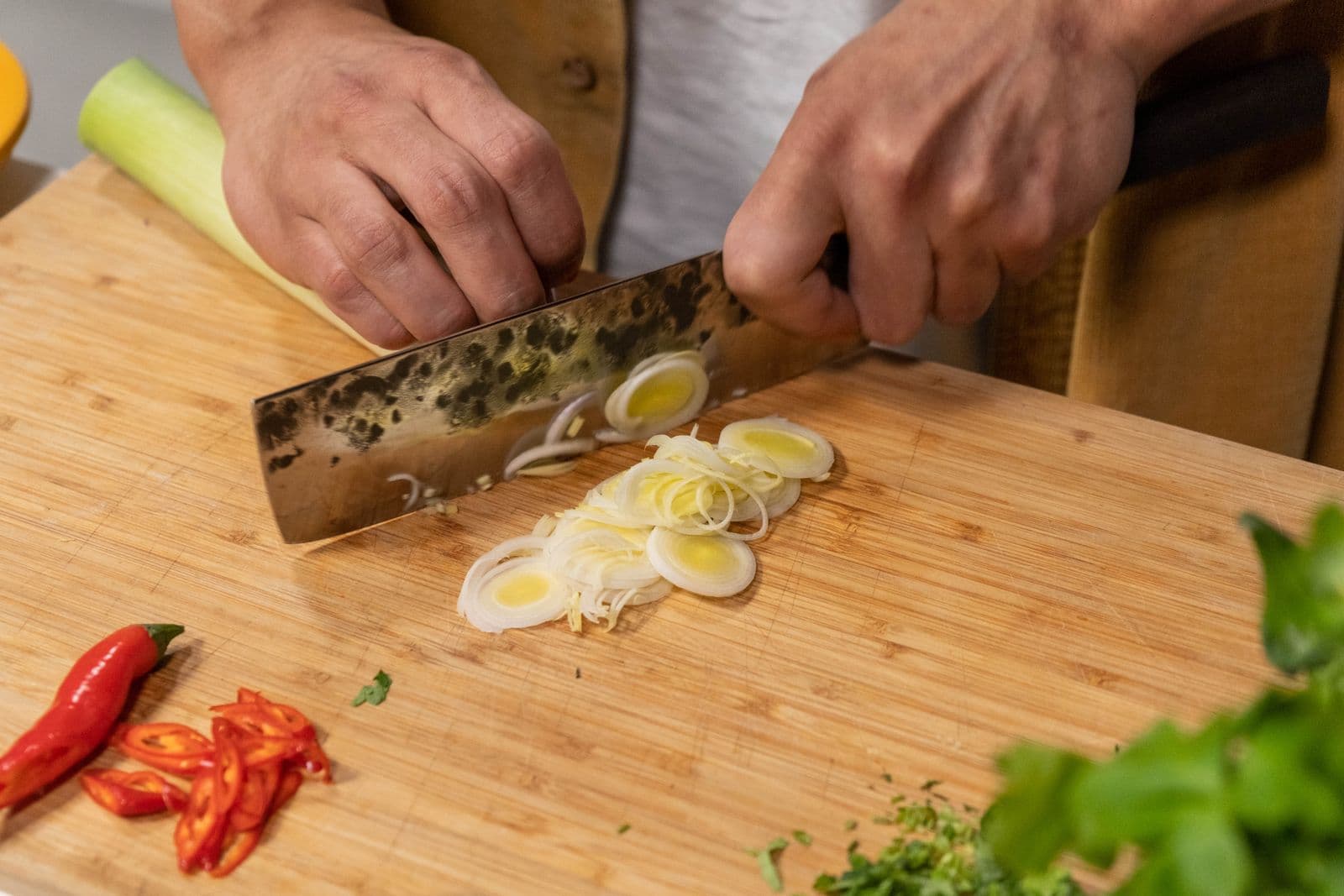
What is a nakiri?
A nakiri (菜切, literally "vegetable cutter") is a Japanese knife made for one thing: vegetables. Its blade is tall (often 45–55 mm), flat along the whole edge, and ends in a squared-off or gently rounded tip rather than a point. There's no curved belly and no fine tip — every millimetre of the edge is there to meet the board.
That height does two useful things: it keeps your knuckles well clear of the board, and it gives you a broad face to scoop chopped vegetables straight into the pan. It's a double-bevel knife, so it handles and sharpens just like a gyuto or santoku — no special technique required.
How it cuts: pure straight-down chopping
Because the edge is dead flat, the nakiri is built for a simple up-and-down chop (or a short push), not the rocking motion of a curved chef's knife. The whole edge lands on the board at once, so you never get those annoying half-cut connections left behind when a curved blade only touches in the middle. Line up an onion, a stack of carrots or a pile of herbs and the nakiri walks through them in clean, even slices.
It excels at precise, repetitive vegetable work: thin planks, fine juliennes, even dice. What it can't do is pierce, trim around a bone, or handle detail work that needs a tip — that's a job for a gyuto or a petty.
Nakiri vs santoku
The nakiri and santoku look related, but they're built for different jobs. The santoku is a compact all-rounder with a slight curve and a rounded tip; the nakiri is a vegetable specialist that's taller, flatter and squared-off.
| Nakiri 菜切 | Santoku 三徳 | |
|---|---|---|
| Blade profile | Tall, dead flat | Slightly curved |
| Tip | Squared / blunt | Rounded "sheepsfoot" |
| Best at | Vegetables, straight chop | All-round everyday |
| Rocking | No | A little |
| Meat / detail | No | Boneless meat, some detail |
| Length | 165–180 mm | 165–180 mm |
| Bevel | Double | Double |
If you want one do-most-things knife, the santoku (or a gyuto) wins. If you already have a main knife and want the best possible vegetable tool, the nakiri wins.
Nakiri vs usuba: double vs single bevel
The nakiri's traditional cousin is the usuba (薄刃) — also tall and flat, but ground on one side only. That single bevel takes an even thinner, cleaner cut and is used for professional techniques like katsuramuki (peeling a vegetable into one continuous sheet), but it's handed, harder to use and much harder to sharpen. The nakiri is the double-bevel, everyday answer: nearly all the vegetable-cutting pleasure, none of the specialist difficulty.
Do you need a nakiri?
Get one if
- You cook a lot of vegetables
- You love fast, precise straight-down chopping
- You already have a gyuto or santoku as your main knife
- You want a taller blade for knuckle clearance and scooping
Skip it if
- You want one knife that does everything
- You cook a lot of meat and fish
- You often need a pointed tip for detail work
- You're buying your very first Japanese knife
For a first and only knife, start with a gyuto or santoku. Add a nakiri later as the vegetable specialist in a two- or three-knife kit.
Size, steel and care
165–180 mm covers almost everyone — 165 mm for nimble control, 180 mm for a little more blade. On steel, the same rules apply as any double-bevel knife: stainless (VG10) for low maintenance, carbon (Aogami, Shirogami) for a keener edge with a little care. Sharpen it on a whetstone at about 15° per side, keep it off bones and hard squash, and it'll chop cleanly for years.
Why a nakiri is rectangular
The shape looks crude next to a gyuto, but every part of it is there for a reason — and knowing the reasons tells you whether a nakiri suits the way you cook.
- The flat edge meets the board along its whole length. A straight push-cut goes cleanly through, instead of leaving the "accordion" of slices still joined at the bottom that a curved belly produces.
- The tall blade gives your knuckles clearance above the board and works as a scoop to carry chopped vegetables to the pan.
- The square tip exists because vegetable work never needs a point. Without one the blade is sturdier at the end and safer in a crowded drawer.
The trade-off is the same flatness: a nakiri cannot rock, and it cannot pierce or do fine tip work. If you rock-chop, or you want one knife for meat as well, a gyuto or santoku suits you better.
The bottom line
A nakiri won't replace your chef's knife — it out-chops it. If you cook vegetables often and already own a main knife, it's one of the most satisfying second knives you can buy.
Tall, flat and single-minded, the nakiri does one job beautifully. Match it to a gyuto or santoku and you've got a kit that covers almost everything a home kitchen throws at you.
Frequently asked questions
What is a nakiri knife used for?
A nakiri is a vegetable knife. Its tall, perfectly flat blade is built for clean, straight-down chopping — slicing, dicing and fine juliennes of vegetables in one motion, with the whole edge meeting the board so nothing is left half-cut. It's not meant for meat, bone or fine tip work; it's a vegetable specialist.
Nakiri vs santoku — which should I get?
Choose a nakiri if you cook a lot of vegetables and love fast, precise straight-down chopping — its flat, tall blade does that better than anything. Choose a santoku if you want one knife that also handles boneless proteins and everyday all-round work, thanks to its slight curve and rounded tip. Many cooks own a gyuto or santoku as their main knife and add a nakiri purely for vegetables.
Is a nakiri single or double bevel?
A nakiri is double-bevel — sharpened on both sides like a Western knife — so it cuts straight, works in either hand and is easy to sharpen. The single-bevel traditional vegetable knife is the usuba, which is a specialist, professional tool. For home cooking, the nakiri is the practical vegetable knife.
What's the difference between a nakiri and an usuba?
Both are tall, flat Japanese vegetable knives, but the nakiri is double-bevel and the usuba is single-bevel. The usuba takes an even thinner, cleaner cut and is used for professional techniques like katsuramuki (rotary peeling), but it's handed, harder to use and much harder to sharpen. The nakiri gives you most of the vegetable-cutting joy with none of that difficulty.
Do I need a nakiri if I already have a gyuto or santoku?
You don't need one, but it's a lovely second knife if you cook a lot of vegetables. A gyuto or santoku already handles veg well; a nakiri simply does it better and more comfortably — the tall blade clears your knuckles, scoops chopped veg off the board, and the flat edge never leaves those annoying half-cut connections. Think of it as an upgrade for a specific job you do often.
What size nakiri should I buy?
165–180 mm suits almost everyone. A 165 mm nakiri is nimble and easy to control; 180 mm gives a little more blade for larger produce and bigger boards. They don't really need to be longer, because the nakiri's job is precise chopping, not reach.
Can left-handed cooks use a nakiri?
Yes. A nakiri is double-bevel — sharpened symmetrically on both sides — so it works the same in either hand. That is one of the practical differences from the usuba, the professional single-bevel vegetable knife, which is made for one hand only and has to be bought in a left-handed version.
Why is a nakiri rectangular?
Each part of the shape does a job. The dead-flat edge meets the board along its whole length, so a straight push-cut goes all the way through instead of leaving slices joined at the bottom. The tall blade gives your knuckles clearance and doubles as a scoop for carrying chopped vegetables to the pan. And vegetable work never needs a point, so the square tip is simply sturdier and safer.
Building your knife kit?
Our curated shelf — gyuto, santoku, nakiri and more — opens soon. Join the waitlist to hear first.
Explore the shelf →