
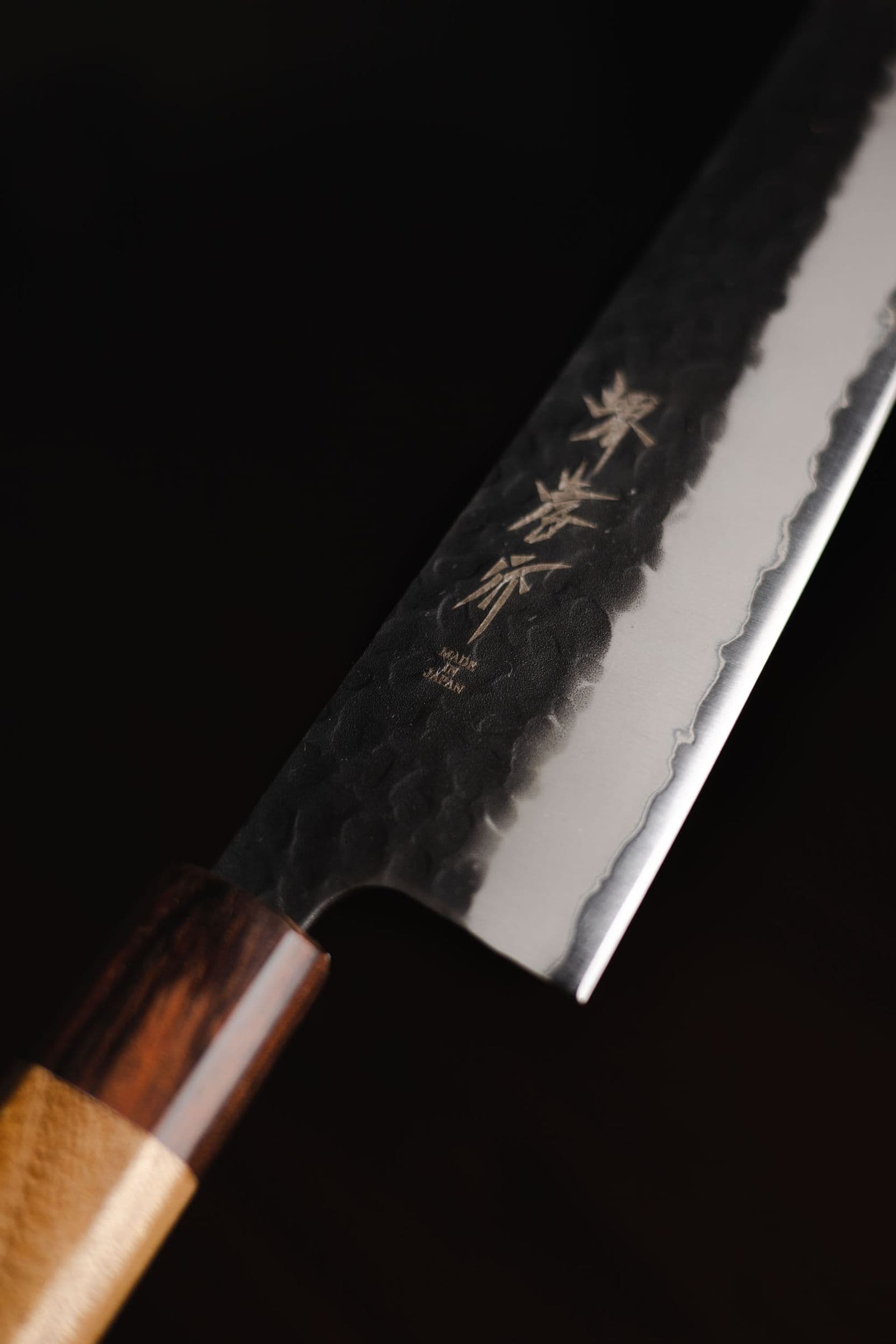
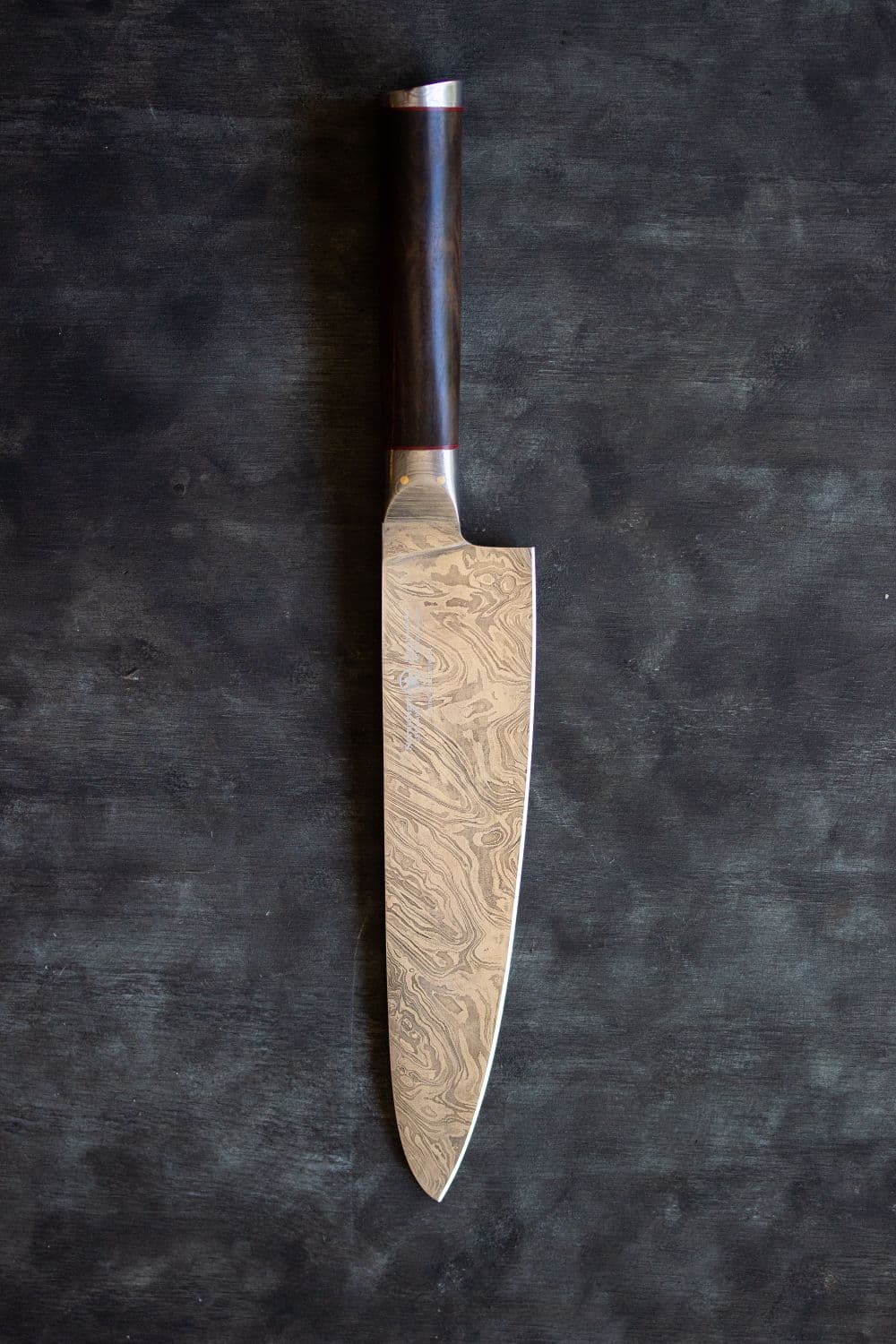
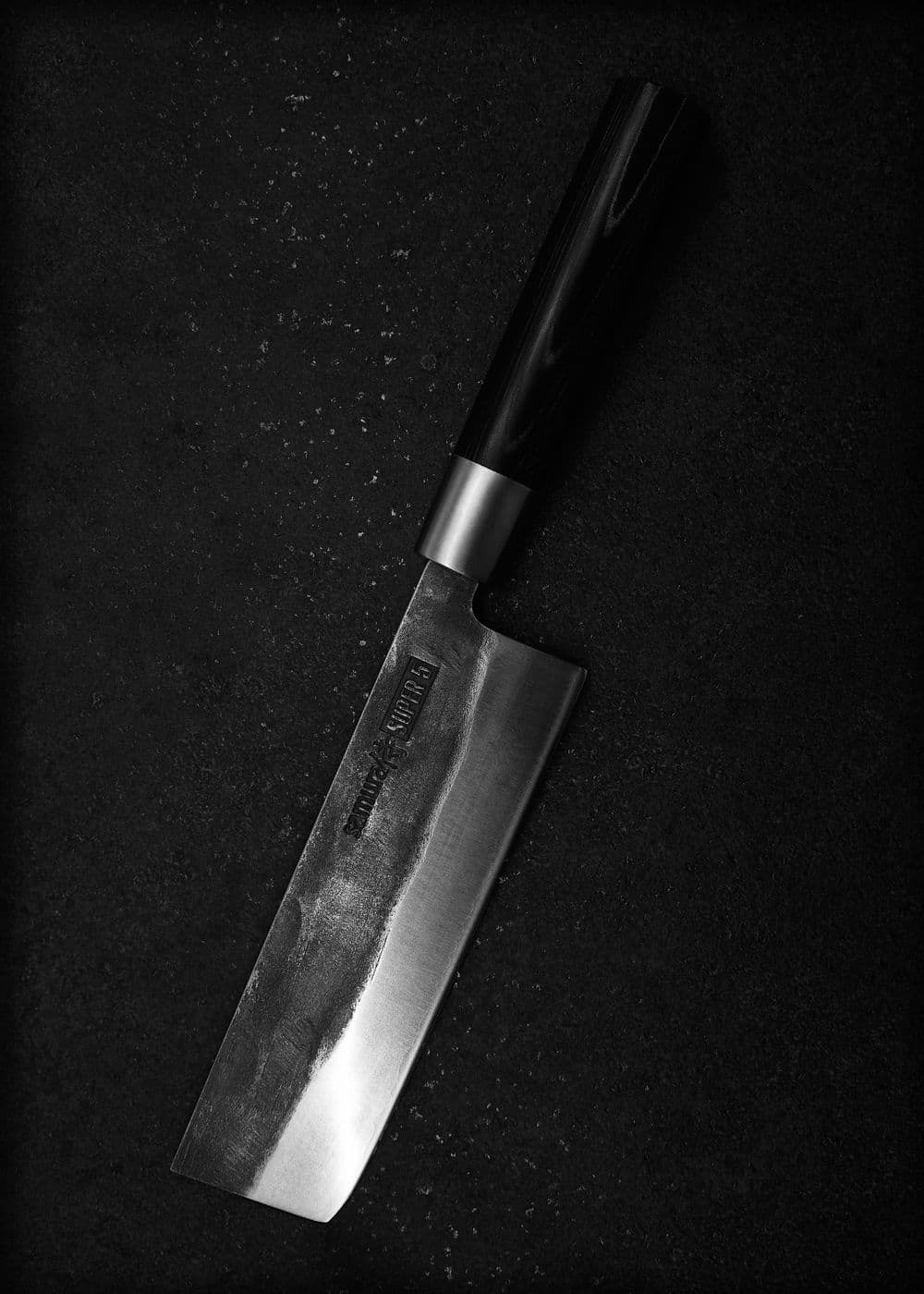
What is a gyuto?
A gyuto (牛刀, literally "beef sword") is the Japanese take on the Western chef's knife. It has a long blade — most commonly 210 mm, with 180 mm and 240 mm close behind — a pointed tip, and a gently curved belly that lets you rock the blade through herbs and garlic. Compared with a heavy German chef's knife, a gyuto is usually lighter, thinner behind the edge, made from harder steel, and sharpened to a finer angle. The result is a knife that feels fast and precise, and that stays sharp longer between sharpenings.
Because it's long and pointed, the gyuto is the most versatile single knife in most kitchens: it breaks down proteins, powers through large vegetables, and its tip handles detail work a santoku can't. Sizes, grinds and how to choose one are in our full gyuto guide.
What is a santoku?
A santoku (三徳, "three virtues" — meat, fish and vegetables) is Japan's home-kitchen all-rounder. It's shorter (typically 165–180 mm), a little taller at the heel, and has a much flatter edge that ends in a rounded "sheepsfoot" tip rather than a point. That flat profile is built for a straight up-and-down chop rather than a rocking motion.
The santoku's shorter length makes it wonderfully nimble and easy to control — a big reason it's so popular with home cooks and in smaller kitchens. Many santoku also have a row of dimples (a granton edge) to stop thin, wet slices from sticking to the blade. For its uses, cutting technique and how to choose one, see the full santoku guide.
Neither knife is better — they're built for different hands, different boards, and different ways of moving.
Gyuto vs santoku: the key differences
| Gyuto 牛刀 | Santoku 三徳 | |
|---|---|---|
| Typical length | 180–270 mm (210 mm most popular) | 160–180 mm (165–180 typical) |
| Tip | Pointed, slightly upswept | Rounded "sheepsfoot" (no point) |
| Blade profile | Curved belly | Flatter, straighter |
| Cutting motion | Rock & push | Push / up-and-down chop |
| Best for | Proteins, large veg, all-round prep | Vegetables, precise slicing, everyday |
| Tip / detail work | Yes — pointed tip | Limited — no point |
| Feel | Longer reach, more knife | Nimble, easy in small kitchens |
| Edge | Double bevel (両刃) | Double bevel (両刃) |
How they cut: rock vs chop
The single most useful difference isn't the shape on paper — it's the motion each knife wants you to use.
- Gyuto — rock & push. The curved belly lets you keep the tip on the board and rock the blade back and forth, or push forward through the cut. It suits cooks who came up on a Western chef's knife.
- Santoku — chop. The flat edge meets the board along its whole length, so a clean up-and-down chop (or a short push) does the work. It feels precise and controlled, and it's very easy to learn.
If you naturally rock-chop, you'll love a gyuto. If you tap-tap-tap straight down, a santoku will feel like it was made for you.
Quick test: watch your wrist. If it wants to keep the tip on the board and rock, choose a gyuto. If it lifts and taps straight down, choose a santoku.
Which should you choose?
Choose a gyuto if
- You want one knife that does almost everything
- You cook a lot of meat and fish, or large vegetables
- You rock-chop, or come from a Western chef's knife
- You have the counter and board space for a longer blade
Choose a santoku if
- You cook mostly vegetables and everyday meals
- You have a smaller kitchen, board, or hands
- You prefer a straight up-and-down chop
- You want the most beginner-friendly knife to control
If you can only buy one, a 210 mm gyuto is the more versatile pick for most people. If you can have two, a gyuto and a santoku is a classic, complementary pair — the gyuto for reach and proteins, the santoku for nimble vegetable work. Plenty of serious cooks own both and reach for each without thinking.
Where the bunka fits
The question people ask next is almost always the same: what about the bunka? It is the third shape in this family and it exists precisely because the gyuto/santoku choice forces a trade nobody enjoys making — the santoku is nimble but has no point, the gyuto has a point but is longer.
A bunka is santoku-sized, around 165–180 mm, with a santoku's flat profile — but instead of a rounded sheepsfoot tip it has an angled, reverse-tanto point. You get the compact length and the push-cutting flatness of a santoku with a usable tip for detail work.
| Gyuto 牛刀 | Santoku 三徳 | Bunka 文化 | |
|---|---|---|---|
| Typical length | 210 mm | 165–180 mm | 165–180 mm |
| Tip | Pointed, upswept | Rounded, no point | Angled reverse-tanto point |
| Profile | Curved belly | Flat | Flat |
| Motion | Rock and push | Push / chop | Push / chop |
| Detail work | Yes | Limited | Yes |
| Large produce | Best | Limited by length | Limited by length |
| Availability | Everywhere | Everywhere | Fewer models, mostly enthusiast makers |
Choose a bunka if you were leaning santoku but keep wishing it had a tip. Do not choose one as a first Japanese knife: the range is narrower, it is harder to find in a shop to hold, and the angled tip is more exposed to chipping than a rounded one. It is the knife you buy second, once you know you prefer a flat profile.
What size should you get?
For a gyuto, 210 mm (about 8 inches) is the sweet spot for most kitchens. Choose 180 mm for smaller hands or boards, or 240 mm if you do a lot of prep and have the space. For a santoku, 165–180 mm suits almost everyone — they don't really come much longer, because length isn't the point of the knife.
A note on steel and edge
Both knives are almost always double-bevel (sharpened on both sides, like a Western knife), so either is easy to adapt to — you don't need to learn single-bevel technique. The bigger long-term decision is the steel: stainless (like VG10) is low-maintenance, while carbon steels (like Aogami or Shirogami) take a keener edge but need drying and care. We cover that in the guides.
The bottom line
Buy the knife that matches your motion. Rock-chopper and want one blade for everything? Gyuto. Straight-down chopper, veg-heavy, smaller kitchen? Santoku.
Neither is better — they're built for different hands and different boards. Get the one that fits how you actually cook, keep it sharp, and it'll serve you for decades.
Frequently asked questions
Is a gyuto or santoku better for beginners?
Both are beginner-friendly double-bevel knives. A santoku is often the easier starting point: it's shorter, lighter, and its flat profile suits a simple up-and-down chop. If you already cook with a Western chef's knife and rock-chop, a gyuto will feel more natural. Neither is a wrong first knife.
What size gyuto or santoku should I buy?
For a gyuto, 210 mm (about 8 inches) is the most popular all-round size — drop to 180 mm for smaller hands or boards, or go 240 mm for lots of prep. For a santoku, 165–180 mm covers almost everyone. When in doubt: a 210 mm gyuto or a 170 mm santoku is a safe choice.
Can a santoku replace a chef's knife?
For most home cooking — vegetables, boneless proteins and everyday slicing — yes. Its limits show with very large produce (watermelon, big squash) and tasks that need a pointed tip, where a longer gyuto or chef's knife is easier.
Why does a santoku have dimples along the blade?
Those hollows are a granton edge. They trap tiny pockets of air to reduce suction, so thin, moist slices like cucumber or potato are less likely to stick to the blade. It's a convenience feature, not a mark of quality — many excellent santoku have no dimples at all.
Gyuto vs santoku vs bunka — what's the difference?
A gyuto is the long all-rounder (around 210 mm) with a pointed, upswept tip and a curved belly for rocking. A santoku is shorter (165-180 mm) with a flat profile and a rounded tip, made for push-cutting. A bunka is the same length as a santoku with the same flat profile, but swaps the rounded tip for an angled reverse-tanto point — so it gives you santoku handling with a usable tip. Choose a gyuto for reach and versatility, a santoku for compact everyday work, a bunka if you want santoku size with a point.
Is a gyuto the same as a chef's knife?
A gyuto is the Japanese interpretation of the Western chef's knife. It does the same jobs but is usually lighter, thinner behind the edge, harder, and sharpened to a finer angle — so it feels more precise, but rewards a little more care.
Gyuto or santoku for cutting meat?
For boneless meat and fish, both work well. The gyuto's length and pointed tip give it the edge for larger cuts, trimming and any piercing work. Neither is meant for bone — use a dedicated bone knife or cleaver for that.
Ready to choose your knife?
Our tight, curated shelf of gyuto, santoku and more opens soon — join the waitlist to hear first.
Explore the shelf →