
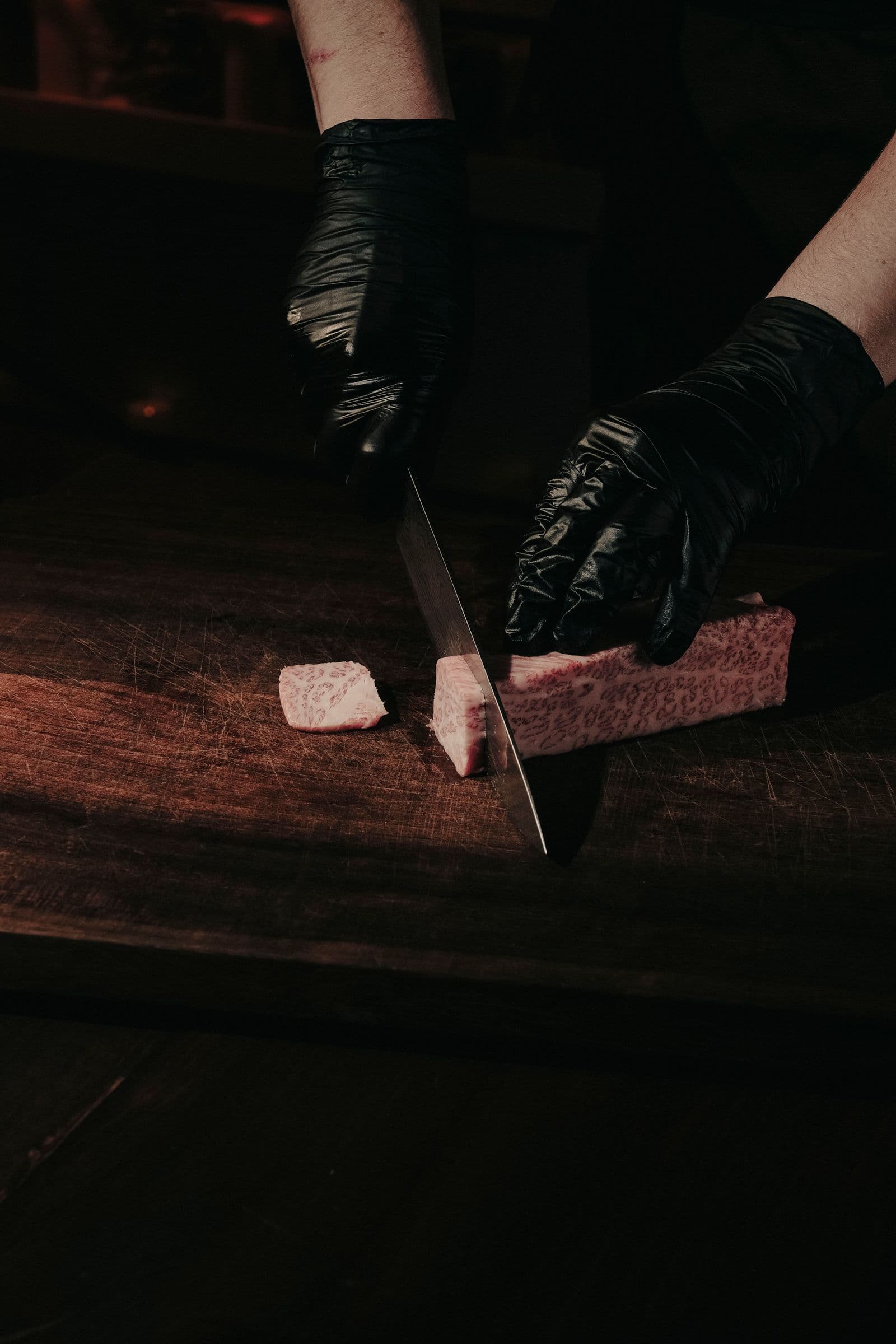
What is a sujihiki?
A sujihiki (筋引, roughly "sinew slicer") is the Japanese take on a Western carving or slicing knife. It's long (240–300 mm, with 270 mm the common size), narrow, and ground on both sides like a Western knife — so, unlike a yanagiba, it works in either hand and sharpens conventionally.
Its job is slicing proteins cleanly: carving a roast, portioning a brisket, cutting ham, skinning a fillet, or slicing raw fish. The thin, low blade is the opposite of a tall all-rounder like a gyuto — it's built to glide through a single long cut, not to chop on a board.
How it cuts: one long draw
Like any good slicer, a sujihiki works in a single, smooth drawing stroke — pulling the full length of the blade through the food rather than sawing. A sawing motion tears meat fibres and roughens the surface; one long draw leaves a clean, even face. The narrow blade means very little metal drags against the cut, so slices release cleanly instead of sticking.
That same narrowness is why it isn't a board knife: the low height leaves little knuckle clearance, so it's poor at chopping or dicing. Use it for slicing and carving, and keep a gyuto or nakiri for everything on the cutting board.
Sizes by job: 240, 270 or 300 mm
Sujihiki are sold by blade length, measured from the heel of the edge to the tip. The three common sizes cover almost every job; the inch figures below are rounded conversions (mm ÷ 25.4).
| Length | ≈ Inches | Best suited to |
|---|---|---|
| 240 mm | ≈ 9½" | Home roasts, pork loin, chicken and fish fillets; smaller boards and kitchens |
| 270 mm | ≈ 10½" | The versatile default — most roasts, brisket, ham and larger fish |
| 300 mm | ≈ 11¾" | Big briskets, whole hams and large roasts; professional carving counters |
Rule of thumb: choose a blade noticeably longer than the widest thing you slice, so a single pull from heel to tip finishes the cut. If the blade runs out mid-slice you end up sawing back and forth, which is exactly what a slicer is meant to avoid. For brisket, 270 mm handles most home cooks' briskets; 300 mm gives extra margin on a large whole packer brisket. Longer blades are harder to store and to sharpen evenly, so there is no benefit in going longer than you need. Our knife size guide covers sizes for every type.
Sujihiki vs yanagiba
The sujihiki and the yanagiba are the two long Japanese slicers, and choosing between them comes down to versatility vs specialisation. The sujihiki is the double-bevel generalist; the yanagiba is the single-bevel sashimi specialist.
| Sujihiki 筋引 | Yanagiba 柳刃 | |
|---|---|---|
| Bevel | Double | Single |
| Made for | Meat, fish, all slicing | Raw fish, sashimi |
| Handed | Either hand | Yes (right or left) |
| Length | 240–300 mm | 240–330 mm |
| Edge | Very keen | Exceptionally keen |
| Sharpening | ~15° both sides | Bevel + light back (uraoshi) |
| Learning curve | Easy | Steeper |
Choose the sujihiki if you want one easy slicer for meat and fish alike; choose the yanagiba if you're committed to traditional sashimi and the cleanest possible cut.
Sujihiki for sashimi and fish
Yes — a sharp sujihiki slices raw fish well. Its long, narrow blade lets you cut each piece of sashimi or sushi topping in one pull, which is the key to a smooth, glossy cut face. It also trims and skins fillets and portions cooked fish neatly.
What it gives up against a yanagiba is a little refinement. A single-bevel yanagiba has a flat back that rides against the fish, so it tends to leave a slightly cleaner, flatter cut face and is traditional in sushi kitchens. The sujihiki's double-bevel edge is easier to use and sharpen, works in either hand, and doubles as a meat slicer. If raw fish is only part of what you slice, the sujihiki is the practical choice; if sashimi is the main job, a yanagiba — or the square-tipped takohiki — is the specialist tool. Either way, the technique is the same: see how to slice sashimi.
Sujihiki vs Western carving or slicing knife
A sujihiki does the same job as a Western carving knife or long slicer — including the round-tipped, dimpled (granton-edge) "brisket slicers" common in barbecue. The differences are in how the blade is made. The figures below are typical, not rules; individual knives vary, so check the stated hardness and angle.
| Sujihiki (typical) | Western carving / slicer (typical) | |
|---|---|---|
| Hardness | ~60 HRC and above | ~56–58 HRC |
| Thickness | Thinner, especially behind the edge | Thicker, more robust |
| Edge angle | ~15° per side | ~20° per side |
| Height | Low and narrow | Also low and narrow; varies by model |
| Tip | Pointed | Pointed on carving knives; often rounded on slicers |
| Flexibility | Mostly stiff | Slicers often have some flex |
| Best at | Very clean slices with little effort; raw fish too | Tough, forgiving use; bumps against bone and platters |
In practice the sujihiki cuts with less effort and leaves a cleaner face, but its harder, thinner edge is more likely to chip if it hits bone, a carving fork or a ceramic platter. A Western slicer is softer and shrugs off rough treatment, but dulls sooner and needs more frequent touch-ups. The dimples on a granton edge can help slices release a little; the thin, narrow sujihiki relies on its low drag instead. For the broader trade-off, see Japanese vs German knives and knife hardness (HRC).
Sujihiki vs gyuto: do you need both?
Reach for the gyuto
- Chopping, dicing and rocking on a board
- Everyday cooking — veg, meat, all-round
- You want one knife to do most things
- Knuckle clearance matters
Reach for the sujihiki
- Long, clean slices of cooked meat or fish
- Carving roasts, brisket, ham
- Slices where a tall blade drags or sticks
- You already have a board knife
For most home cooks a gyuto alone is enough — it will carve in a pinch. The sujihiki is a second knife you add when you slice proteins often and want the cleaner, easier cut a dedicated slicer gives.
How to carve with a sujihiki
- Rest the meat first. Carving straight off the heat lets juices run out and the meat can shred. A rested roast or brisket is firmer and slices more cleanly.
- Steady it without touching the edge. Hold the meat with a carving fork, tongs or a flat hand on top, and keep the fork away from the blade's path — steel on steel can chip a hard edge.
- Find the grain and slice across it. Look for the direction the muscle fibres run and cut at right angles to them, so each slice has short fibres and eats tender. On a brisket, the grain runs in different directions in the flat and the point, so many cooks separate the two, or turn the brisket as they reach the point, to keep slicing across the grain.
- Start at the heel and pull. Set the heel of the blade on the far side of the meat and draw the knife toward you in one long stroke, finishing near the tip. Use the whole length of the blade.
- Let the blade do the work. Use light downward pressure and let the length and sharpness make the cut. If you need to push hard or saw, the knife is dull or too short for the cut.
- Steer around bone. Cut meat off the bone rather than through it; a thin, hard edge is not built for bone. See why thin Japanese blades chip on bone.
Carve on a wooden or soft plastic cutting board, never directly on a ceramic platter, slate or glass.
Sharpening a sujihiki
A sujihiki sharpens like any double-bevel Japanese knife — the only extra challenge is its length, which is usually longer than the stone. Our step-by-step whetstone guide covers the basics; for a long slicer, add these points:
- Work in sections. Sharpen the heel, the middle and the tip section in turn, moving the pressure point along the blade, rather than trying to cover the whole edge in one stroke.
- Keep the angle constant. Hold roughly 15° per side (or whatever angle the knife already has) on both sides. An angle that drifts between sections leaves an uneven edge.
- Lift slightly for the tip. Where the edge curves up toward the tip, raise the handle a little so the curved part stays in contact with the stone.
- Check the burr everywhere. Before switching sides, feel for a burr along the full length, heel to tip. Missed spots show up as sections that snag or tear on the next roast.
- Finish and deburr. A few light alternating strokes on a finer stone, then a light strop, remove the burr cleanly.
A longer stone makes the job easier; see which whetstone to buy. Avoid pull-through sharpeners — they can chip hard Japanese steel and tend to grind an uneven edge on a long blade. Between sharpenings, keep the edge keen with gentle honing or stropping rather than a hard steel rod.
How to choose a sujihiki
- Length: 270 mm for most people; 240 mm for smaller kitchens and fish; 300 mm if you regularly carve large briskets or hams (see sizes by job).
- Steel: a slicer spends a lot of time in wet, salty or acidic meat juices, and barbecue use often means humid outdoor conditions — so many cooks prefer stainless such as VG10 or SG2. Carbon steel takes a very keen edge but needs wiping dry during use; a stainless-clad carbon blade is a middle ground. Compare them in the steel chart.
- Handle: a light wooden wa handle shifts the balance toward the blade; a riveted Western yo handle feels heavier and more familiar. See wa vs yo handles.
- Height & stiffness: a slightly taller or stiffer blade tends to track straighter through a big roast and gives a little more knuckle clearance; a thinner, lower blade drags less. Most sujihiki are fairly stiff — true flexibility is more of a Western slicer trait.
- Bevel: virtually all sujihiki are double-bevel, so they suit left- and right-handed cooks alike.
- Storage: a long, thin edge needs protecting — a saya (sheath) or a magnetic strip long enough for the blade. See how to store Japanese knives.
Do you need a sujihiki?
Get one if
- You carve roasts or slice brisket and ham
- You portion proteins and want clean faces
- You want a sashimi-capable slicer that's easy to use
- You already own a board knife
Skip it if
- You need one do-everything knife — get a gyuto
- You rarely slice large cuts of meat
- You want a board knife for chopping
- Your gyuto already carves well enough for you
The bottom line
The sujihiki is the easy answer to "how do I slice this cleanly?" — a double-bevel slicer that carves meat and portions fish without the single-bevel commitment of a yanagiba.
It's a considered second knife, not a first purchase. If you're still building your kit, start with an everyday blade — see the best Japanese knife for beginners — and add the slicer later.
Frequently asked questions
What is a sujihiki used for?
A sujihiki is a slicing knife for proteins — carving roasts, slicing brisket and ham, portioning cooked meat and fish, and skinning or trimming fillets. Its long, thin, narrow blade slices in one clean draw, so it leaves a smooth face and releases food easily instead of tearing it. Think of it as the Japanese take on a Western carving or slicing knife.
Sujihiki vs yanagiba — what's the difference?
Both are long slicers. The sujihiki is double-bevel and Western-style: it works in either hand, sharpens like any double-bevel knife, and slices meat as happily as fish. The yanagiba is single-bevel and traditional, made specifically for raw fish, and gives an even cleaner cut on sashimi at the cost of being handed and harder to sharpen. For an easy, versatile slicer choose the sujihiki; for dedicated sashimi work choose the yanagiba.
Sujihiki vs gyuto — do I need both?
They overlap but solve different problems. A gyuto is a tall all-rounder for board work — chopping, dicing, rocking — with the height to keep your knuckles clear. A sujihiki is a narrow specialist for long, clean slices where a gyuto's height and belly get in the way. Most home cooks are well served by a gyuto alone; add a sujihiki when you carve roasts or slice proteins often and want a cleaner, easier cut.
What size sujihiki should I buy?
270 mm (about 10½ inches) is the versatile all-round size. A 240 mm (about 9½ inches) is easier to store and handle and suits home roasts and fish fillets, while 300 mm (about 11¾ inches) suits big briskets, hams and large roasts. Choose a blade noticeably longer than the widest thing you slice, so one pull finishes the cut instead of sawing.
What length sujihiki is best for brisket?
For most home briskets a 270 mm (about 10½ inch) sujihiki is enough; a 300 mm (about 11¾ inch) blade gives extra margin on a large whole packer brisket. The aim is a blade clearly longer than the width of the slice, so you can cut each slice in one long pull from heel to tip. Slice across the grain, and remember the grain runs differently in the flat and the point.
Sujihiki vs carving knife — what's the difference?
They do the same job. A sujihiki is typically harder (around 60 HRC or more), thinner and sharpened to about 15° per side, so it slices with less effort and leaves a cleaner face. A Western carving knife or brisket slicer is typically softer (around 56–58 HRC), thicker and sharpened nearer 20°, often with a rounded tip and a dimpled granton edge — tougher and more forgiving, but it dulls sooner. These are typical figures, and individual knives vary.
How do you sharpen a sujihiki?
On a whetstone, like any double-bevel Japanese knife, at about 15° per side. Because the blade is longer than the stone, sharpen it in sections — heel, middle and tip — keeping the same angle throughout, and lift the handle slightly to follow the curve at the tip. Check for a burr along the full length before switching sides, then finish on a finer stone and strop. Avoid pull-through sharpeners, which can chip hard steel.
Stainless or carbon steel for a sujihiki?
Stainless is the easier choice for most people, because a slicer spends a lot of time in wet, salty meat juices and barbecue use is often humid. Carbon steel takes a very keen edge but will rust or discolour if not wiped dry during use. A stainless-clad carbon blade is a middle ground: carbon at the edge, easier-care stainless on the body.
Can you slice sashimi with a sujihiki?
Yes. A sharp sujihiki slices sashimi very well and is a far more forgiving starting point than a single-bevel yanagiba — it's double-bevel, works in either hand, and sharpens conventionally. A yanagiba will give a slightly keener, more traditional cut, but for most home cooks a good sujihiki covers raw fish and cooked meat both.
Why is a sujihiki so narrow?
A narrow, thin blade means less surface dragging against what you're slicing, so the food releases cleanly and the cut face stays smooth. The trade-off is that the low blade height gives little knuckle clearance, which is why a sujihiki isn't meant for chopping on a board — it's built for slicing, not board work.
Building a Japanese knife kit?
Our curated shelf — everyday all-rounders and specialist slicers alike — opens soon. Join the waitlist.
Browse knife types →