
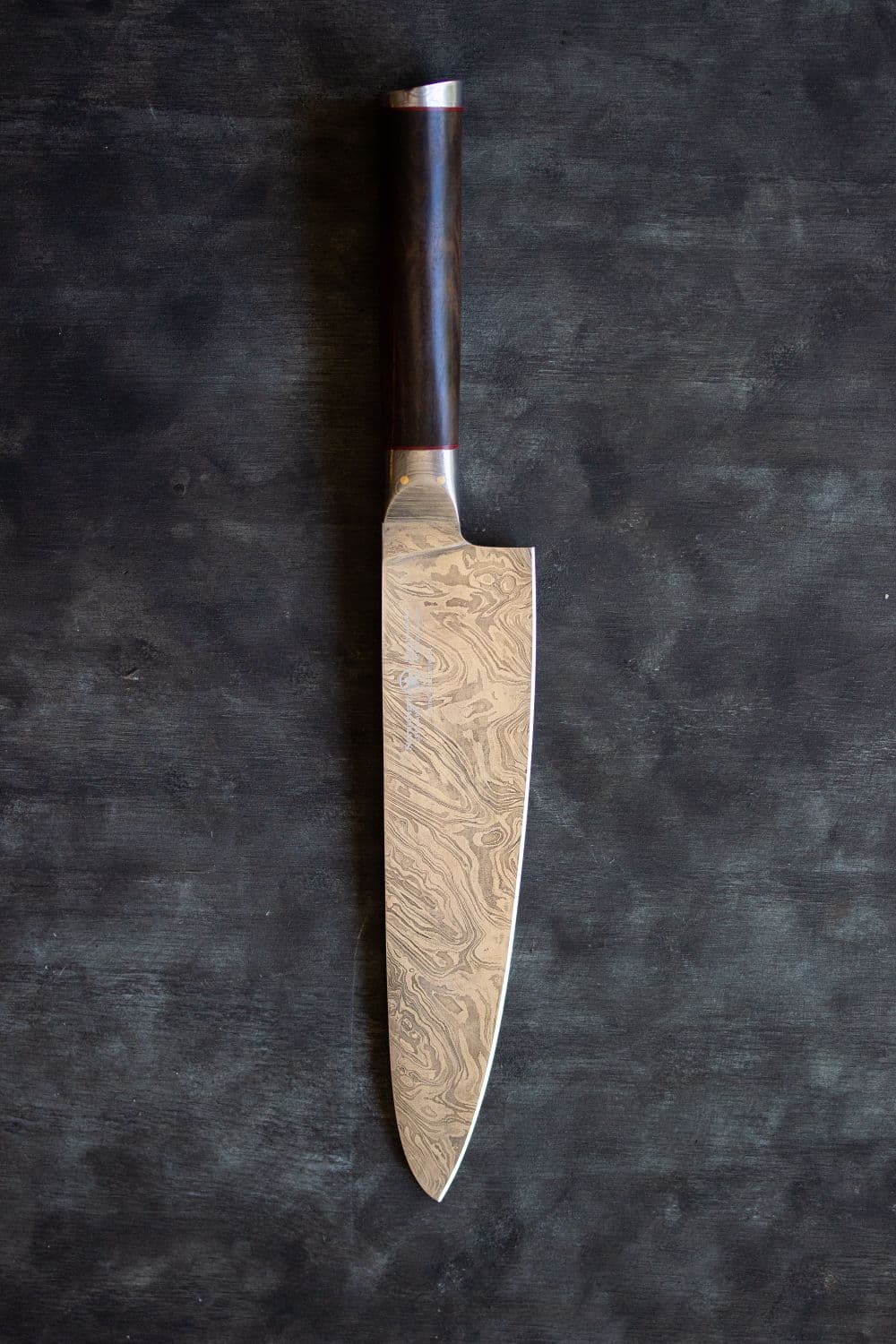
Steel and hardness — the root of everything
Nearly every difference flows from one number: hardness. Japanese knives are made from harder steel, typically 60–64 HRC, while German knives sit around 56–58 HRC. Harder steel holds a finer edge for longer and can be sharpened more acutely — but it's also less flexible and a little more prone to chipping. Softer German steel is the opposite: it won't take quite as keen an edge or hold it as long, but it's tough, forgiving, and quick to realign on a steel. If you want the full picture of Japanese steels, see VG10 vs Aogami vs Shirogami.
Weight, thickness and edge angle
Pick up one of each and you feel it instantly. A German knife is heavier and thicker, often with a full bolster, built to power through work with momentum. A Japanese knife is lighter and thinner, sharpened to about 15° per side (versus roughly 20° on a German edge), so it feels fast, precise and almost effortless through vegetables and proteins. Neither is "right" — heft suits some hands, nimbleness suits others.
How they cut
- German — rock & power. The curved belly and weight favour a rocking motion, and the mass helps drive the blade. Comfortable, familiar, unfussy.
- Japanese — glide & precision. Thin, hard and keen, it slips through food with very little force and leaves cleaner cut faces. It rewards a lighter touch and good technique.
Japanese vs German: side by side
| Japanese 和 | German 洋 | |
|---|---|---|
| Steel hardness | ~60–64 HRC (harder) | ~56–58 HRC (softer) |
| Edge angle | ~15° per side (finer) | ~20° per side |
| Weight | Lighter, thinner | Heavier, thicker |
| Sharpness | Keener out of the box | Sharp, less extreme |
| Edge retention | Holds longer | Dulls sooner |
| Toughness | More chip-prone if abused | Very forgiving |
| Maintenance | Whetstone | Honing steel + occasional stone |
| Cutting style | Push / precise glide | Rock & power |
| Examples | Gyuto, santoku, petty | Wüsthof, Zwilling, Henckels |
Durability and care
This is where honesty matters. A German knife will forgive things a Japanese knife won't: a stray bone, a frozen edge, a glass board, the occasional dishwasher trip (still a bad idea, but survivable). A Japanese knife asks for a little discipline — a wood or plastic board, no bones or frozen food, hand-washing, and sharpening on a whetstone rather than a steel. Give it that, and it stays sharper for longer with less total effort. Abuse it, and the same hardness that makes it keen makes it chip.
The line is blurrier than it used to be
Treat this as a spectrum, not a rivalry. German brands now offer harder steels and Japanese-style santoku; Japanese makers offer Western-handled gyuto and stainless, low-maintenance steels. Many kitchens happily run both — a tough German knife for rough jobs, a keen Japanese knife for precise ones. You're choosing a balance of sharpness vs forgiveness, not joining a team.
Which brands are which
This is where the comparison usually goes wrong, because the nationality of the brand and the nationality of the knife are not the same thing. The clearest example: Zwilling J.A. Henckels is German and owns Miyabi, which is made in Seki, Japan. If you are weighing "a Zwilling or a Japanese knife", Zwilling will happily sell you either — and the two behave nothing alike.
| Brand | Owned by | Made in | Behaves like |
|---|---|---|---|
| Wüsthof | German | Solingen, Germany | German — tough, softer, thicker |
| Zwilling | German | Solingen, Germany | German — tough, softer, thicker |
| Miyabi | German (Zwilling) | Seki, Japan | Japanese — hard, thin, keen |
| Shun | Japanese (KAI) | Seki, Japan | Japanese |
| Global | Japanese (Yoshikin) | Tsubame-Sanjo, Japan | In between — Japanese made, softer steel |
| Tojiro | Japanese | Tsubame-Sanjo, Japan | Japanese |
Two lessons fall out of that table. First, judge the knife, not the flag — the hardness and the grind decide how it cuts, and a German-owned Japanese-made knife is a Japanese knife in every way that matters at the board. Second, Global is the genuine middle case: made in Japan, but run around 56–58 HRC, which is German territory. Full ownership and origin for every brand is in who actually makes each brand.
Which should you choose?
Choose Japanese if
- You want the sharpest, most precise edge
- You like a light, nimble knife
- You'll use a wood/plastic board and treat it well
- You're happy to learn the whetstone
Choose German if
- You want a tough, forgiving workhorse
- You prefer weight and a rocking motion
- You want low-fuss upkeep with a honing steel
- Your knife takes the occasional rough job
If the Japanese side appeals, the two easiest starting points are a gyuto or a santoku in stainless steel — see the best Japanese knife for beginners for a no-regret first buy.
The bottom line
Japanese for sharpness and precision, German for toughness and forgiveness. Match the blade to how you cook — and how kindly you treat your tools — and either will serve you for decades.
There's no universal winner, only the right fit. If you value a keen, effortless edge and will give it a little care, a Japanese knife is hard to beat. If you want something you never have to think about, a German knife earns its keep.
Frequently asked questions
Are Japanese knives sharper than German knives?
Generally yes. Japanese knives use harder steel (around 60–64 HRC vs 56–58 for German) and are sharpened to a finer angle (roughly 15° per side vs 20°), so they take and hold a keener edge. The trade-off is that a harder, thinner edge is a little more brittle — it rewards good technique and dislikes bones, frozen food and hard boards.
Are Japanese knives more fragile than German ones?
More prone to chipping if abused, yes — the hard, thin edge can chip on bone, frozen food or a glass board in a way a soft German blade would just survive. But in normal use, on a wood or plastic board, a Japanese knife is perfectly durable and will last decades. German knives are simply more forgiving of rough treatment.
Can I sharpen a Japanese knife with a honing steel?
Not really. A honing steel realigns the softer edge of a German knife between sharpenings, but the hard edge of a Japanese knife is better maintained on a whetstone — a steel or pull-through can chip it. If you switch to Japanese knives, plan to learn the whetstone; it's a simple, calm skill. See our guide to sharpening on a whetstone.
Is a santoku a Japanese or German knife?
The santoku is Japanese — a home-kitchen all-rounder with a flatter profile and rounded tip. It's become so popular that German brands like Wüsthof and Zwilling now make their own santoku models in softer Western steel. So you'll see 'santoku' on both sides; the shape is Japanese, but the steel and feel depend on who made it.
Which lasts longer, a Japanese or German knife?
Both can last a lifetime with care. A Japanese knife holds its edge longer between sharpenings, so it stays sharp with less frequent maintenance; a German knife is tougher against accidental abuse but dulls sooner and needs honing more often. Longevity comes down to care, not country.
Is Zwilling a German or Japanese knife brand?
Zwilling J.A. Henckels is German, founded in Solingen in 1731 — but it also owns Miyabi, which is made in Seki, Japan, and behaves like a Japanese knife rather than a German one. So the brand name alone does not tell you what you are buying. Check where the specific line is made and what hardness it runs at: German lines are typically 54-58 HRC, Miyabi and other Japanese lines 60 HRC and above.
Which is better for a beginner?
A German knife is more forgiving of mistakes, which some beginners prefer. But a stainless Japanese knife (such as VG10) is also very beginner-friendly and noticeably sharper — as long as you use a wood or plastic board and keep it off bones. If you want the Japanese edge, start with a stainless double-bevel gyuto or santoku.
Curious about the Japanese edge?
Our curated shelf of keen, precise Japanese knives opens soon — join the waitlist to hear first.
Explore the shelf →