
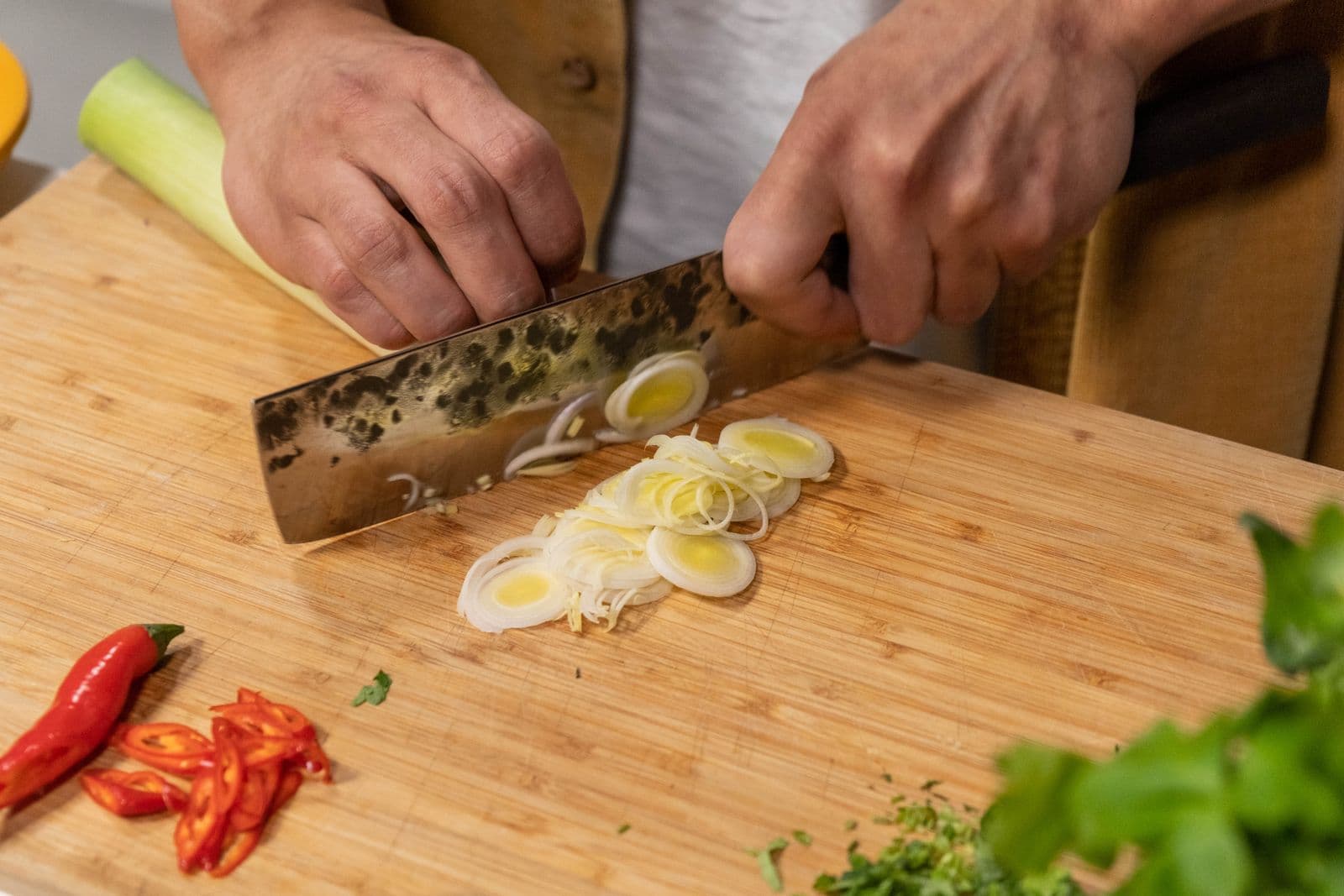
Why the board matters
Every cut ends with the edge meeting the board. A hard, thin Japanese edge is easily dulled or chipped by a hard surface, so a board that gives slightly protects it while a hard one wears it down fast. Choosing the right board is one of the highest-impact things you can do for edge life — right up there with how you sharpen and store the knife.
The best surfaces
The kindest board is end-grain wood: the blade slips between the standing wood fibres, which close back over the cut, so it's gentle and self-healing. A good edge-grain wooden board is also excellent. Japanese kitchens favour hinoki (cypress) for its soft, antibacterial, knife-friendly surface. If you want low maintenance, a soft polyethylene (HDPE) board is gentle enough and dishwasher-safe.
What to avoid
Never cut on glass, stone, marble, granite or ceramic — they're far harder than steel and dull or chip an edge almost instantly. And skip bamboo: despite being sold everywhere as eco-friendly, it's hard, abrasive and often glued in strips, so it wears edges faster than real hardwood. Countertops and plates count too — always use a proper soft board.
Wood vs plastic
| Wood (end-grain) | Soft poly (HDPE) | |
|---|---|---|
| Kind to edge | Kindest, self-healing | Gentle enough |
| Maintenance | Oil, hand-wash, no soaking | Low, dishwasher-safe |
| Longevity | Decades if cared for | Scores over time |
| Feel | Premium, solid | Practical |
| Price | Higher | Lower |
For the kindest surface and the nicest experience, end-grain wood; for convenience and a budget, a soft poly board. Both are fine for a Japanese knife — the enemy is hardness, not the material itself.
Caring for a wooden board
A wooden board wants the same respect as a good knife: hand-wash it (never the dishwasher), don't leave it soaking or lying flat in water, dry it upright so both faces breathe, and oil it periodically with food-safe mineral or board oil to keep it from drying and cracking. Do that and it'll outlast most of your kitchen.
The bottom line
Cut on something soft — end-grain wood or soft poly — and keep your edge off glass, stone and bamboo. The right board is cheap insurance for a knife you sharpened with care.
Board sorted? Round out the routine with how to store Japanese knives.
Frequently asked questions
What is the best cutting board for Japanese knives?
A soft surface that's gentle on a hard, thin edge — the best choices are end-grain wood, a good edge-grain wooden board, or a soft polyethylene (HDPE) board. Japanese cooks prize hinoki (cypress). What matters is that the surface gives slightly under the edge rather than resisting it, which protects the blade from dulling and chipping.
Why does the cutting board matter for a Japanese knife?
Because a hard, thin Japanese edge is easily dulled or chipped by a hard surface. Every time the edge lands on the board, a soft board cushions it while a hard one hammers it. Using the right board is one of the biggest things you can do to keep a Japanese knife sharp — it matters as much as how you sharpen and store it.
Are glass or stone cutting boards bad for knives?
Yes — avoid them entirely. Glass, stone, marble, granite and ceramic are far harder than knife steel, so they dull and chip the edge almost immediately. They're among the worst things you can cut on. The same goes for cutting on countertops or plates.
Is bamboo good for Japanese knives?
No, despite its popularity. Bamboo is very hard and abrasive — harder than most hardwoods — so it dulls edges faster and can chip a delicate Japanese blade. It's also often glued in strips that are tough on an edge. Choose a softer wood or a soft poly board instead.
Wood or plastic — which is better?
Both work if they're soft. Wood (especially end-grain) is gentlest and self-heals as the fibres close over cuts, but it needs care — oiling, hand-washing, no soaking. Soft HDPE plastic is gentle enough, cheap, dishwasher-safe and low-maintenance, but it scores over time and can harbour knife marks. For the kindest surface and longevity, end-grain wood; for convenience, soft poly.
How do I care for a wooden cutting board?
Hand-wash it (never the dishwasher), don't leave it soaking or standing in water, dry it upright so air reaches both sides, and oil it periodically with food-safe mineral or board oil to stop it drying and cracking. Treated well, a good wooden board lasts decades and stays kind to your knives.
Setting up your knife kit?
Our curated shelf of knives and kitchen essentials opens soon — join the waitlist to hear first.
Browse knife types →