
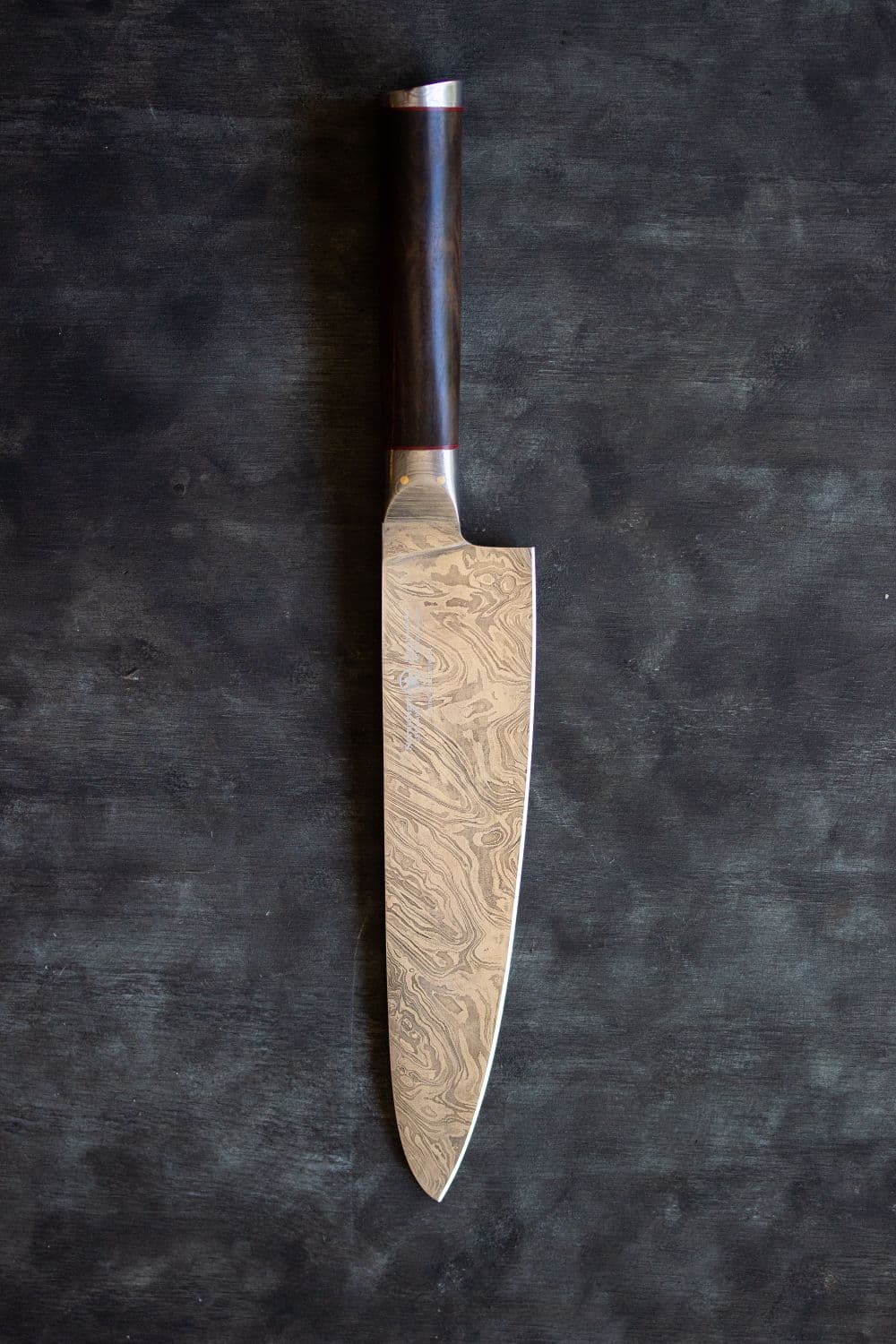
What is a gyuto?
Gyuto literally means "beef sword". The knife is the Japanese adaptation of the Western chef's knife, which came to Japan with Western-style cooking and meat eating from the late 19th century. Japanese makers kept the shape — long blade, pointed tip, curved belly — and built it the way they built their own knives: harder steel, a thinner blade and a finer edge.
Despite the name, it is not a meat-only knife. It is the general-purpose knife of Japanese professional kitchens and of most home knife kits outside Japan, used for vegetables, meat and fish alike.
Gyuto vs Western chef's knife
| Typical gyuto | Typical German chef's knife | |
|---|---|---|
| Hardness | ~60 HRC and above | ~56–58 HRC |
| Edge angle | ~15° per side | ~20° per side |
| Blade | Thinner, lighter | Thicker, heavier |
| Profile | Flatter near the heel, less belly | Pronounced curve for rocking |
| Bolster | Usually none or a small one | Often a full bolster |
| Edge holding | Longer between sharpenings | Dulls sooner, easy to touch up |
| Weak point | Can chip on bone or twisting | Rolls rather than chips |
The flatter heel section means a gyuto does straight chops and push-cuts better than a German knife while still rocking through herbs near the tip. The missing full bolster makes the whole edge easy to sharpen. These are typical ranges; the Japanese vs German knives guide covers the exceptions.
Which size: 180, 210 or 240 mm?
| Length | Inches | Who it suits |
|---|---|---|
| 180 mm | ≈ 7 in | Small boards, small hands, compact kitchens. Handles almost like a santoku. |
| 210 mm | ≈ 8¼ in | The default for home cooks. Long enough for big vegetables, short enough to control. |
| 240 mm | ≈ 9½ in | Lots of prep, large boards, cooks used to longer knives. Common in professional kitchens. |
| 270 mm | ≈ 10½ in | Professional volume work and very large produce. Too long for most home boards. |
A practical check: the blade should fit diagonally across your cutting board with room to spare. On a board under about 40 cm, a 240 mm gyuto starts to feel cramped. The knife size guide has a converter and sizes for every type.
What a gyuto does — and doesn't
Does well
- Vegetables of every size, including cabbage and large onions
- Boneless meat, poultry breasts and fish fillets
- Fine mincing of herbs and garlic by rocking
- Tip work: scoring, trimming, slicing shallots
- Slicing cooked meat when you have no slicer
Avoid using it for
- Bones, joints and frozen food
- Twisting through hard squash
- Prying, splitting or opening packaging
- Glass, stone or ceramic boards
- The dishwasher
For poultry joints use a honesuki, for whole fish a deba, and read can you cut bone with a gyuto? before trying.
Cutting techniques with a gyuto
- Push-cut: move the blade forward and down through the food in one stroke. This is the most useful motion with a Japanese gyuto because its thin edge slices with little pressure.
- Rock-chop: keep the tip on the board and lever the heel up and down for herbs and garlic. It works, but a gyuto has less belly than a German knife, so the rocking arc is shorter.
- Pull-slice: draw the blade back towards you for soft proteins and fish so the edge slices rather than presses.
- Tip work: use the pointed tip for scoring, trimming silver skin and slicing shallots or small items.
Hold it with a pinch grip (thumb and index finger on the blade just ahead of the handle) and use the spine, not the edge, to scrape food across the board.
Laser vs workhorse
Two gyuto of the same length can feel completely different because of how thick the blade is behind the edge. Knife sellers and enthusiasts use two informal labels:
| "Laser" | "Workhorse" | |
|---|---|---|
| Behind the edge | Very thin | Thicker |
| Weight | Light | Heavier |
| Cutting feel | Glides, little resistance | Drives through with its weight |
| Dense food (carrots, squash) | Cuts easily but can flex | Robust, may wedge |
| Forgiveness | Low — needs a light touch | High |
These are not standard terms, so a listing that says "laser" tells you the intent, not a measurement. For a first gyuto, a middle-weight blade is the safest choice.
Variants: k-tip, wa and yo handles
- Kiritsuke-gyuto (k-tip): an angled tip and usually a flatter edge; it suits push-cutting. Not the same as the single-bevel traditional kiritsuke.
- Wa-gyuto: a light wooden Japanese handle, so the balance sits forward in the blade.
- Yo-gyuto: a Western riveted handle with a full tang, heavier and more familiar to hold. Compare them in wa vs yo handles.
- Suji-style long gyuto: 270 mm and above start to overlap with a sujihiki, which is the better choice if slicing is the main job.
How to choose a gyuto
- Length: 210 mm unless you have a reason to change it (see the size table).
- Steel: stainless (VG10, Ginsan, SG2) for low maintenance; carbon (Shirogami, Aogami) for a keener edge that needs drying. The steel chart compares 16 steels, and stainless-clad carbon is a good middle ground.
- Hardness: around 60–62 HRC balances edge holding and toughness. Harder is not simply better — see knife hardness (HRC).
- Handle and weight: wa for a light, blade-forward feel; yo if you are used to Western knives.
- Where it is made: some brands produce in several countries. Our brand guide lists who makes what and where, and the regions guide covers Sakai, Seki, Echizen and Tosa.
Care and sharpening
Hand-wash, dry immediately, and store it where the edge cannot knock against other metal (a saya, magnetic strip or block). Sharpen both sides on a whetstone at about 15°, starting on a #1000 stone — the full routine is in how to sharpen a Japanese knife. Between sharpenings, a few light passes on a strop or a fine ceramic rod keep the edge going; see honing vs sharpening.
The bottom line
If you own one Japanese knife, make it a 210 mm gyuto. It does what a chef's knife does with a thinner, keener edge — as long as you keep it off bones.
Prefer something shorter and flatter? Read the santoku guide, or compare the two in gyuto vs santoku.
Frequently asked questions
What is a gyuto knife?
A gyuto (牛刀, "beef sword") is the Japanese version of the Western chef's knife. It has a long blade, most often 210 mm, a pointed tip and a curved belly, and it is double-bevel. It is usually lighter, thinner, harder and sharpened to a finer angle than a German chef's knife, and it is the most versatile single knife in a Japanese knife kit.
Is a gyuto the same as a chef's knife?
It does the same jobs, so in practice a gyuto is a chef's knife. The differences are in the build: a typical gyuto is harder (around 60 HRC or more vs 56–58), thinner behind the edge, sharpened nearer 15° per side than 20°, and has a flatter heel section and less belly than a German chef's knife. It feels quicker and more precise but chips more easily if misused.
What size gyuto should I get?
210 mm (about 8¼ inches) is the right size for most home cooks. Choose 180 mm for small boards, small hands or tight kitchens, and 240 mm if you do a lot of prep on a large board and are comfortable with a longer blade. 270 mm is mainly for professional kitchens.
Can you cut meat with a gyuto?
Yes — boneless meat, poultry and fish are exactly what it was named for. What it should not do is cut through bone, joints or frozen food: the thin, hard edge can chip. Use a honesuki for poultry joints and a cleaver or bone saw for bones.
What is a laser gyuto?
"Laser" is an informal name for a gyuto ground very thin behind the edge and often light overall. Lasers glide through food with very little effort but are more delicate and can flex. The opposite, a "workhorse", is thicker and heavier, so it is more robust and pushes through dense food with its weight but wedges more in things like carrots. Most home cooks are best served by something in between.
Gyuto vs kiritsuke — what is the difference?
A gyuto has a pointed tip with an upswept curve. A kiritsuke-gyuto (or k-tip gyuto) has an angled, reverse-tanto tip and usually a flatter edge, so it suits push-cutting more than rocking. The traditional kiritsuke is a different knife: single-bevel and aimed at professionals.
Should a beginner buy a gyuto or a santoku?
Both are good first knives. Choose a 210 mm gyuto if you already use a Western chef's knife, like to rock-chop or cut large produce. Choose a 165–180 mm santoku if you want something shorter and easier to control. A stainless steel such as VG10 or Ginsan keeps care simple either way.
Is a gyuto single bevel or double bevel?
A gyuto is double-bevel: sharpened on both sides, so it cuts straight and works in either hand. A few makers offer single-bevel or strongly asymmetric versions, but they are unusual and handed. If you want a single-bevel all-rounder, the traditional kiritsuke is the knife built for that; for everyday cooking, a normal double-bevel gyuto is the practical choice.
How do you sharpen a gyuto?
On a whetstone, at about 15° per side, working both sides evenly because it is double-bevel. A medium stone around #1000 does the sharpening and a #3000–6000 stone refines it. Avoid pull-through sharpeners and heavy use of a steel honing rod, which can chip hard Japanese steel.
Choosing your first gyuto?
Tell us how you cook and what you want to spend, and we'll reply with the size and steel we'd pick — free, by email. Our curated shelf opens soon; join the waitlist.
Ask for advice →