
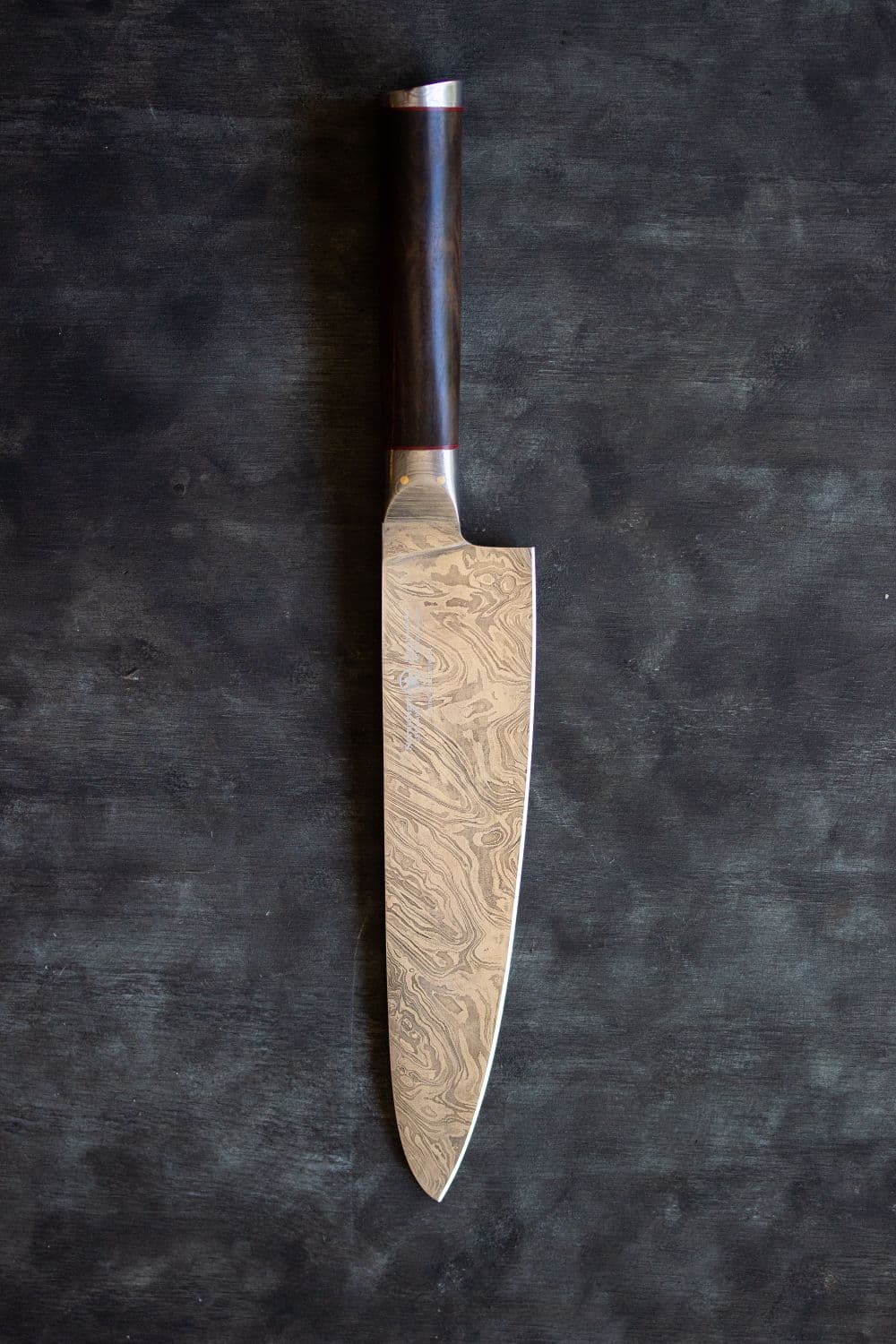
San mai: the clad core
San mai (三枚, "three layers") sandwiches a hard cutting core between two outer layers. Sharpen the knife and only a thin strip of that core shows at the very edge; the sides you see and touch are the cladding. The point is practical: the core delivers the cutting, while a softer or stainless jacket makes the blade tougher and often more rust-resistant. It's a close cousin of the traditional kasumi two-metal construction.
Damascus: patterned cladding
Damascus — known in Japan as suminagashi ("flowing ink") — takes the cladding much further: many layers of steel are folded and forged so the finished sides show flowing, wavy patterns. On a modern kitchen knife it's effectively decorative san mai: those beautiful layers form the outer jacket, and a single cutting steel still forms the core at the edge. The pattern is the point — it's about beauty.
The damascus myth
Damascus does not cut better. This is the most common misconception. The rippling layers are cosmetic; the sharpness, edge retention and sharpening behaviour all come from the core steel at the edge. A damascus knife and a plain-clad knife with the same core cut essentially the same. Pay for damascus because you love how it looks — never because you expect a sharper edge.
Real vs fake damascus
Real damascus is pattern-welded: sheets of two or more steels are stacked, forge-welded, folded or twisted, then acid-etched so the different steels show up as light and dark lines. Because the layers go through the metal, the pattern is part of the blade. A fake pattern is etched, printed or laser-marked onto a single piece of steel and sits only on the surface. Signs to check:
| Check | Genuine damascus | Surface-only pattern |
|---|---|---|
| Edge bevel | Layers continue across the bevel, often as wavy lines after sharpening | Pattern stops where the bevel starts |
| Spine | Layers visible as fine lines along the spine | Plain, uniform spine |
| Pattern | Varies slightly from knife to knife | Identical, repeating, very even |
| Over time | Stays, may soften with polishing | Can wear or rub off |
| Listing | Names the core steel and the cladding | Says "damascus pattern" with no steel named |
A genuine pattern is still not proof of a good knife. Many low-cost "Japanese damascus" knives are neither made in Japan nor built around a good core. Check where it is made (our brand guide lists who produces where) and which core steel it uses.
What layer counts mean
Listings often advertise a number — "67-layer", "33-layer", "101-layer". It is the count of steel layers in the blade, usually the core plus the cladding layers on both sides (67 is typically 33 each side around one core). The number describes how the pattern was built. It does not tell you sharpness, edge retention or toughness; a 67-layer blade and a plain san mai blade with the same core cut the same.
Modern damascus vs historical Damascus steel
The name comes from the patterned sword blades historically associated with Damascus. Those were usually crucible (wootz) steel, whose pattern came from the steel's own internal structure, and the original method is not practised today. Modern damascus kitchen knives are a different thing: pattern-welded layers of ordinary modern steels. Neither the name nor the look implies the properties of the historical blades.
Caring for a damascus knife
- Know the cladding. Stainless damascus needs no more care than a stainless knife. Damascus with carbon or iron layers rusts and patinas like a carbon knife: dry it immediately.
- Protect the etch. The contrast comes from etching, so abrasive pads, polishing compounds and rust erasers on the blade face will fade it. Clean the sides with a soft sponge; if you must remove rust, work gently (see removing rust safely).
- Sharpen normally. Only the edge is sharpened, so the pattern on the face is unaffected. The fresh bevel will look shiny until it dulls down or is re-etched.
- A faded pattern can be restored. Re-etching in a mild acid brings the contrast back. It is best left to a professional sharpener if you have not done it before.
What actually matters
When you assess a knife, look first at the core steel — is it VG10, a carbon steel, a powder steel? That, plus the blade's hardness and geometry, decides how it performs. Cladding — plain san mai or elaborate damascus — changes toughness, rust resistance and appearance, but not the fundamental cut. So judge the core; enjoy the pattern as a bonus.
The bottom line
San mai is a hard core in a protective jacket; damascus is that jacket made beautiful with many layers. Both are about the body, not the edge — the core steel does the cutting. Love damascus for its looks, choose your knife for its core.
For the steels most often used as damascus cores, see the Japanese knife steel chart. Want the deeper tradition behind this? Read honyaki vs kasumi, or the finishes in kurouchi, nashiji & tsuchime.
Frequently asked questions
What is san mai construction?
San mai (三枚, 'three layers') is a blade built from a hard cutting core clad between two softer or stainless outer layers. Only a thin strip of the core is exposed at the edge, so you get the core steel's cutting performance with a more forgiving, and often more rust-resistant, body. It's one of the most common ways Japanese knives are made.
What is damascus steel on a knife?
Damascus (in Japan, suminagashi) is a many-layered patterned cladding — dozens or hundreds of layers folded and forged to create flowing, wavy patterns on the blade's sides. On a modern kitchen knife it's essentially decorative san mai: the beautiful layers are the outer jacket, while a single cutting steel forms the core. The pattern is about looks, not cutting.
Does damascus steel cut better?
No. This is the biggest myth about damascus. The pattern is cosmetic; the cutting performance comes entirely from the core steel at the edge. A damascus knife and a plain-clad knife with the same core will cut essentially the same. Buy damascus because you like how it looks, not because you expect it to be sharper.
San mai vs damascus — what's the difference?
They're the same idea at different layer counts. San mai is a simple three-layer clad (core plus one layer each side); damascus is many-layered cladding worked into a pattern. Both protect and beautify a hard core. Damascus is really 'fancy san mai' — more layers, more pattern, usually more cost, same principle.
What matters most in a knife's construction?
The core steel at the edge — that's what determines sharpness, edge retention and how the knife sharpens. Cladding (plain san mai or damascus) affects the body's toughness, rust resistance and looks, but not the fundamental cutting. So check the core steel first; treat damascus as an aesthetic bonus.
Is a damascus knife worth the extra money?
Only for the looks. You pay a premium for the labour of forging all those layers and the striking pattern, not for better cutting. If you love the appearance, it can be worth it; if you only care about performance, put the money toward a better core steel and grind instead.
How can you tell if a damascus knife is fake?
Genuine damascus is made of real layers of different steels, so the pattern runs through the metal: after sharpening you can see the layers continue across the edge bevel, and they are visible on the spine. A fake pattern is etched, printed or laser-marked onto a single piece of steel, so it sits only on the surface — it stops at the edge bevel, looks identical from knife to knife, and can wear off. A very low price for a damascus knife is also a warning sign.
What does 67-layer damascus mean?
It is the count of steel layers in the blade, usually the core plus the layers of cladding on both sides (for example 33 each side around one core). It tells you how the pattern was built, not how well the knife cuts. A blade with more layers is not sharper or tougher; the core steel still decides that.
Is modern damascus the same as historical Damascus steel?
No. Historical Damascus steel usually refers to crucible (wootz) steel blades whose pattern came from the steel's own structure, and the original method is not in use today. Modern damascus kitchen knives are pattern-welded: different steels are forge-welded in layers and then etched to show the contrast. The name is shared; the material is not.
Does damascus steel rust?
It depends on what the layers are made of. Stainless damascus cladding resists rust about as well as any stainless knife. Damascus made from carbon steel or iron layers will rust and patina like any carbon knife and needs drying straight after washing. Either way, the core at the edge follows its own steel's behaviour, so a carbon core can spot at the edge even inside stainless damascus.
Choosing by construction & steel?
Compare the steels and types side by side. Our curated shelf opens soon — join the waitlist to hear first.
The steel guide →