
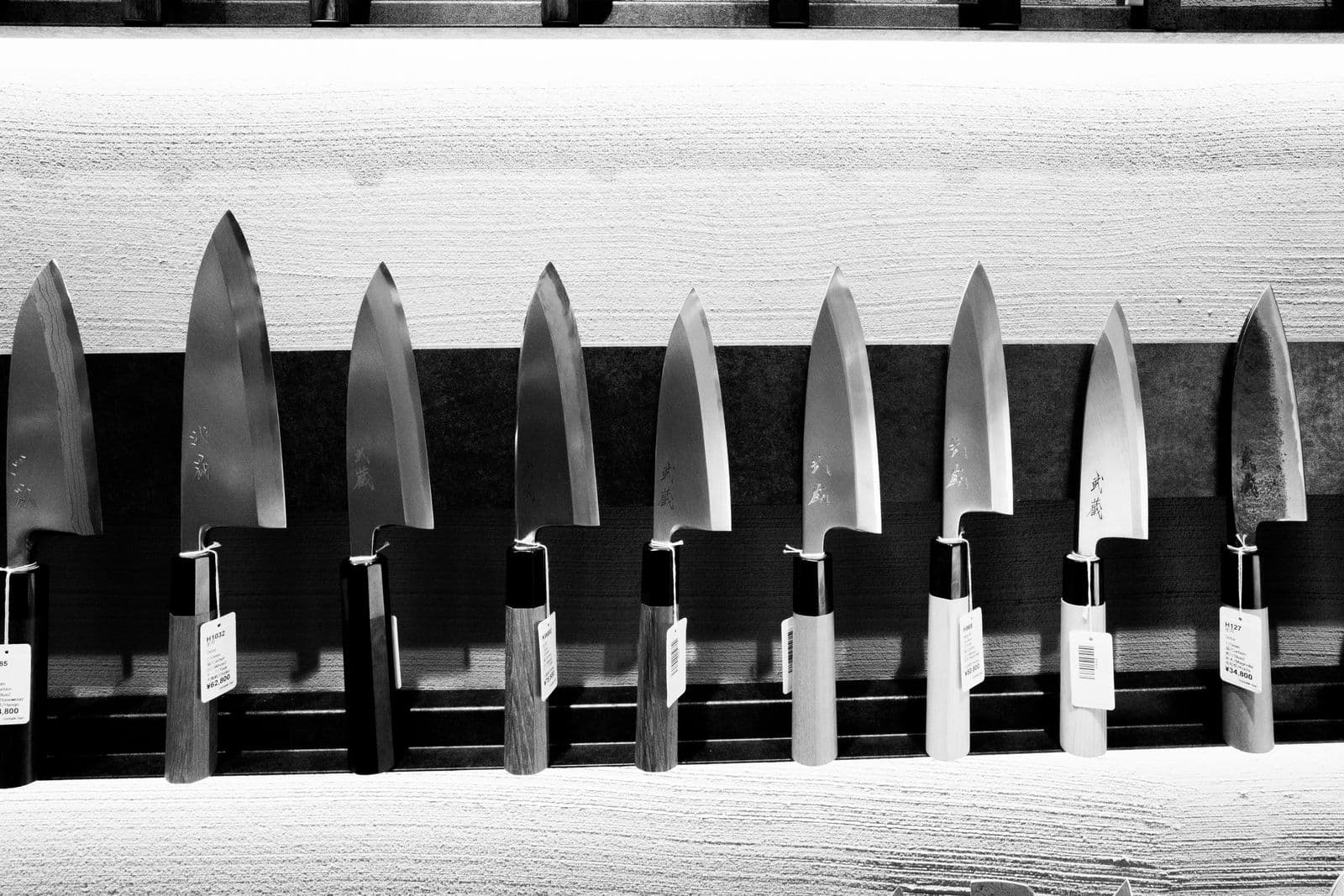
What is a honesuki?
A honesuki (骨スキ, "bone remover") is the Japanese boning knife, most associated with poultry. It has a compact, triangular blade with a stiff spine and a fine, pointed tip — designed to give precise control right at the point and enough rigidity to find and pop joints. Larger relatives exist (the garasuki is a bigger version), but the standard honesuki around 145–150 mm is the common one.
How it works
The honesuki excels at jointing: using the stiff tip to locate a joint, then slicing cleanly through the cartilage and connective tissue to separate the pieces. The rigidity means the blade goes exactly where you push it — no flex, no wandering. What it does not do is chop through bone; like any fine Japanese edge, forcing it through bone will chip it. Work around the bone, and it's superb.
Honesuki vs Western boning knife
The key difference is flex. A Western boning knife is usually narrow and often flexible, so it can bend to follow a curved bone or trim along a large cut; a honesuki is stiff and triangular, giving leverage and precision at the tip for finding and separating joints. Both are "boning knives" — they just approach the job differently. The table below shows typical designs; individual knives vary.
| Honesuki | Western boning knife | |
|---|---|---|
| Blade shape | Triangular, tall at the heel, tapering to a point | Narrow, fairly uniform width |
| Stiffness | Stiff, no meaningful flex | Stiff, semi-flex or flexible versions |
| Tip | Fine, pointed, very controllable | Pointed; flexes on flexible models |
| Typical length | About 135–165 mm, 150 mm most common | About 5–6 in (roughly 130–150 mm) |
| Steel | Usually harder Japanese steel | Usually softer, tougher steel |
| Best for | Poultry joints, cartilage, cleaning bones | Trimming and deboning larger cuts, following curved bones |
For poultry specifically, the honesuki's rigidity is the point: you press the tip into a joint and it goes where you aim it. A flexible boning knife can do the same work, and many cooks prefer one for trimming pork shoulders or large roasts, where following a long curved bone matters more than leverage at the tip.
Honesuki vs garasuki vs deba
These three are often mentioned together because all of them "break things down". The garasuki is generally described as a larger, heavier poultry knife — the honesuki's bigger sibling, used for bigger birds and tougher work in professional kitchens. The deba is a different tool altogether: a thick, heavy, traditionally single-bevel knife for breaking down whole fish, with the mass to cut through fish spines and heads. Exact sizes vary by maker, so treat the table as a general guide.
| Honesuki | Garasuki | Deba | |
|---|---|---|---|
| Main use | Jointing and boning poultry | Heavier poultry work, larger birds | Breaking down whole fish |
| Size & weight | Compact, light | Longer and heavier | Thick and heavy for its length |
| Blade | Stiff, triangular, pointed | Similar shape, more robust | Wide, very thick spine |
| Home cook fit | Good if you butcher chickens | Rarely needed at home | Good if you buy whole fish |
For most home cooks the choice is simple: joint chickens with a honesuki; break down fish with a deba. A garasuki mainly makes sense if you regularly handle large birds in volume.
Thickness and bevel
A honesuki is built stiffer than a petty knife of similar length. The spine is noticeably thicker at the heel and tapers toward the fine point, so the back of the blade resists bending while the tip stays precise. Exact thickness varies a lot between makers and isn't standardised, so compare listed spine measurements if they're given rather than assuming a number. If you want a thinner, more general small knife, see the petty knife guide.
The edge geometry also varies. Many honesuki are sold with an asymmetric grind (sharpened more on one side) or as a true single-bevel knife, while double-bevel versions with a more even grind are also widely available. For a left-handed cook this matters: a single-bevel honesuki is made for one hand, so you would need a left-handed version, and a strongly asymmetric grind is usually biased for right-handers. A double-bevel (roughly even) grind works in either hand. See single vs double bevel and left-handed Japanese knives for what to check before buying.
Honesuki and bones: what it can and can't do
A honesuki is designed to work around bone. It is well suited to:
- Cutting through joints once you have found the gap between the bones
- Slicing cartilage and connective tissue
- Scraping meat off bones — the carcass, thigh bones, wing tips — with the tip or edge held at a shallow angle
It is not meant for chopping through bone, and it should not be twisted or levered when the edge is wedged in a joint. Those are the two most common ways to damage one. For bone-cutting in general, see can you cut bone with a gyuto? — the same principles apply.
What about a hard carbon honesuki, such as Shirogami #2? Hard carbon steels take a very keen edge but are relatively brittle at high hardness. Scraping meat off bones with light pressure is normal use. Hitting bone hard, chopping into it, or levering the blade sideways while the edge is in contact with bone can chip or roll the edge; small chips can usually be sharpened out, larger ones take more work. See Shirogami #1, #2 and #3 explained for how the steel behaves.
Carbon steel and raw poultry: wash and dry a carbon honesuki promptly after cutting raw chicken — both for hygiene and because moisture and juices left on the blade can cause rust spots. See carbon steel knife care.
How to break down a whole chicken with a honesuki
The general method is the same with any knife; the honesuki just makes the joint work more controlled. Use a stable, non-slip board, keep the handle and your hands dry, and cut away from your fingers.
- Legs: cut through the skin between the leg and the body, pull the leg outward to pop the hip joint, then cut through the exposed joint with the tip.
- Thigh and drumstick (optional): find the knee joint along the fat line and cut straight through it.
- Wings: locate the shoulder joint, cut through the skin, and separate the wing at the joint rather than through bone.
- Breasts: cut along one side of the keel (breastbone), then follow the ribcage and wishbone with short strokes, keeping the blade against the bone.
- Clean the carcass: scrape off remaining meat with light strokes — including the "oyster" on the back.
- Save the frame: the carcass, wing tips and trimmings make good stock.
Wash the knife, board and your hands afterwards, and follow standard food-safety guidance for raw poultry.
How to choose a honesuki
- Length: about 150 mm is the most common size and suits chickens well; shorter versions are nimbler, longer ones reach further on bigger birds.
- Steel: stainless is the practical choice for most home cooks, given raw poultry, frequent washing and humid kitchens. Carbon steel is fine if you dry it diligently every time. Browse steels on the steel guide.
- Handle: a Western (yo) handle often has a bolster and a fuller grip; a Japanese (wa) handle is lighter. Either way, choose one you can hold securely when it's slightly wet.
- Bevel and handedness: if you're left-handed or new to Japanese knives, a double-bevel or left-handed version is the easier route.
Still weighing up which knife types you need? Try find your knife or ask us a question.
Do you need a honesuki?
Get one if
- You break down whole chickens often
- You want clean, controlled jointing
- You do light meat butchery at home
- You value a stiff, precise tip
Skip it if
- You buy pre-portioned meat
- You only occasionally joint a bird — a gyuto copes
- You want a fish knife — get a deba
- You're still building your core kit
The bottom line
The honesuki is a specialist that earns its place the moment you start breaking down whole birds. Stiff, pointed and precise, it makes jointing clean and safe — but it's a poultry tool, not a first knife.
Butcher whole fish instead? See the deba. Still choosing your everyday knife? Start with the beginners' guide.
Frequently asked questions
What is a honesuki used for?
A honesuki is a Japanese boning knife, most associated with breaking down poultry — jointing a chicken, separating meat from bone, and working around cartilage. Its stiff, pointed, triangular blade gives precise control at the tip and enough rigidity to pop joints, without the flex of a Western boning knife.
Honesuki vs Western boning knife — what's the difference?
A Western boning knife usually has a narrow, flexible blade that bends to follow bones. A honesuki is stiff and triangular with no flex, giving more precision and leverage at the tip for jointing poultry. Many cooks find the rigidity makes clean, controlled cuts easier; others prefer a flexible blade for filleting. They suit different tasks and styles.
Can you cut through bone with a honesuki?
No — it's for working around bones and joints, not chopping through them. Use the stiff tip to find and separate joints and cartilage. For actually cleaving bone you need a heavier tool; forcing a honesuki (or any fine Japanese knife) through bone will chip the edge.
Honesuki vs deba — which breaks things down?
Different animals. A honesuki is for poultry and light meat butchery — thin, stiff, triangular. A deba is a thick, heavy single-bevel knife for breaking down whole fish, with the weight to cut through fish spines. If you joint chickens, get a honesuki; if you break down whole fish, get a deba.
Is a honesuki single or double bevel?
It varies. Traditional honesuki are often single-bevel or a strongly asymmetric double bevel, while many made for export are a more even double bevel. A double-bevel version works in either hand and is easier to sharpen; a single-bevel one gives more traditional precision but is handed. Check the specific knife.
Honesuki vs garasuki — what's the difference?
Both are Japanese poultry knives with a similar triangular shape. The garasuki is generally larger and heavier, meant for bigger birds and tougher work, mostly in professional kitchens. The honesuki is the compact version (commonly around 150 mm) and is the one most home cooks who joint chickens would choose.
How thick is a honesuki?
Thicker at the spine near the heel than a petty knife of similar length, tapering toward a fine tip — that is what makes it stiff. Exact thickness is not standardised and varies between makers, so check the listed spine measurement of a specific knife rather than assuming a figure.
What happens if a Shirogami #2 honesuki hits bone?
Scraping meat off bones with light pressure is normal use. But hard carbon steel like Shirogami #2 is relatively brittle, so striking bone hard, chopping into it, or twisting and levering the blade while the edge is against bone can chip or roll the edge. Small chips can usually be sharpened out. Also wash and dry a carbon honesuki promptly after raw poultry to prevent rust.
What size honesuki should I buy?
About 150 mm is the most common size and suits breaking down chickens. Honesuki are typically found in roughly the 135–165 mm range; shorter ones are nimbler, longer ones give a little more reach on larger birds.
Do I need a honesuki?
Only if you regularly break down whole poultry. If you buy pre-portioned chicken, you don't need one — a gyuto handles the occasional joint. But if you butcher birds often, a honesuki makes the job far cleaner, faster and safer than forcing a chef's knife through joints.
Building out a specialist kit?
See every Japanese knife type, everyday and specialist alike. Our curated shelf opens soon — join the waitlist.
Browse knife types →