
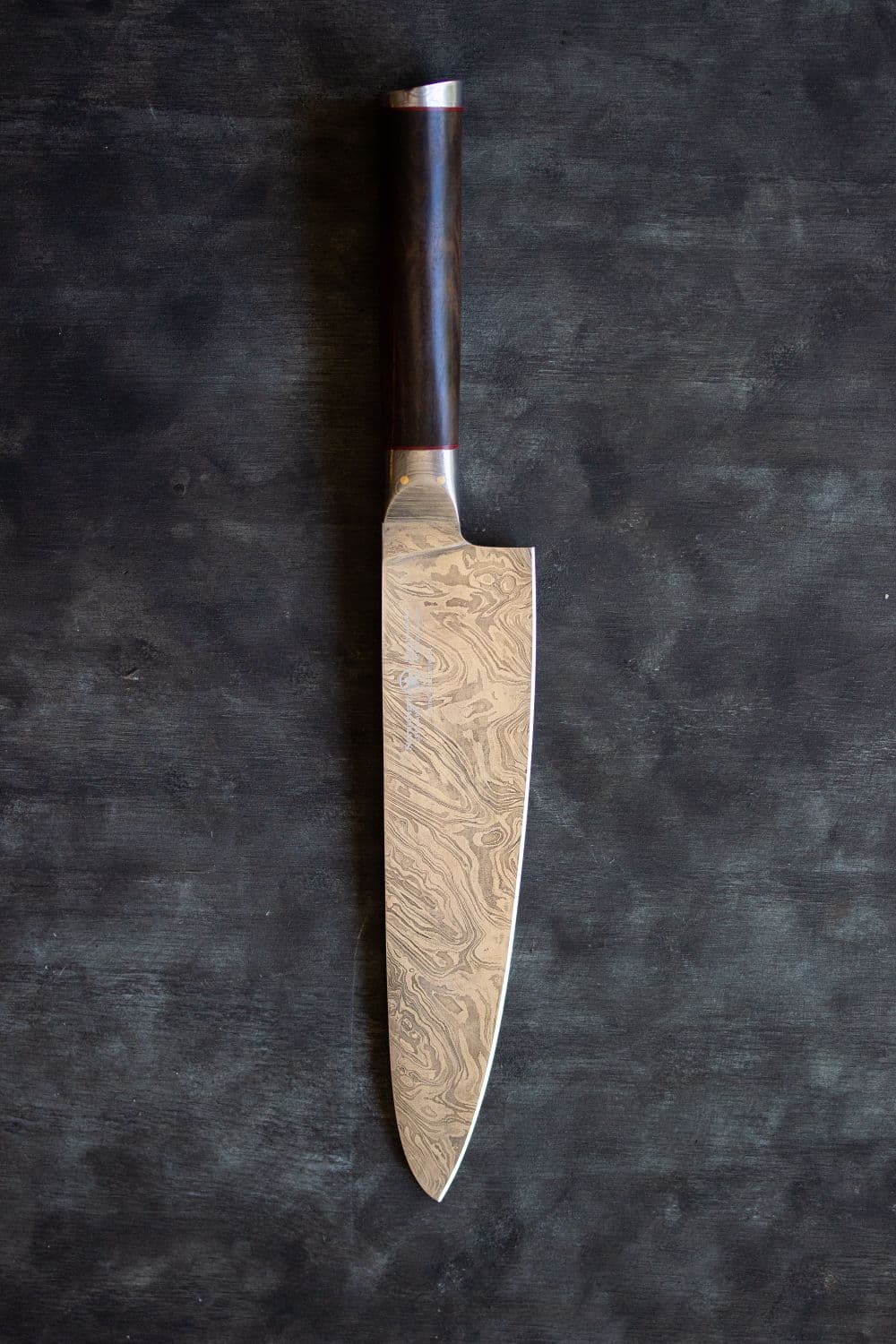
What is a bunka?
A bunka (文化包丁, "culture knife") is a Japanese general-purpose knife — the same everyday role as a santoku: vegetables, boneless meat and fish. It's short and flat, ground on both sides, and suits a straight up-and-down chop rather than a rocking motion.
What sets it apart is the tip. Instead of the santoku's rounded, sheepsfoot nose, the bunka ends in an angular k-tip (reverse tanto) that comes to a sharp, usable point — the reason many cooks reach for one.
The k-tip: why it exists
The k-tip is formed by the spine dropping down in a straight diagonal to meet the edge. The payoff is a precise point you can actually use — for scoring skin, coring tomatoes, splitting chillies, or any fine tip work where a santoku's blunt nose gets in the way. It looks striking, too, which is part of the appeal.
The trade-off is simply that a sharp point is less forgiving than a rounded one — a small thing, but worth a moment's care when you're starting out.
Bunka vs santoku
The bunka and santoku are near-twins: same length class, same flat profile, same straight-chop feel. If you blindfold-tested them on a board of vegetables, they'd cut almost identically. The decision is really about the tip and the look.
| Bunka 文化 | Santoku 三徳 | |
|---|---|---|
| Role | Everyday all-rounder | Everyday all-rounder |
| Tip | Angular k-tip (point) | Rounded (sheepsfoot) |
| Profile | Flat | Flat |
| Motion | Straight chop | Straight chop |
| Length | 165–195 mm | 165–180 mm |
| Best extra | Precise tip work | Slightly safer nose |
| Bevel | Double | Double |
Choose the bunka for a usable point and the sharper look; choose the santoku for a rounded, slightly more forgiving tip. Neither is "better" — it's preference.
Bunka vs gyuto
Lean bunka
- You want a nimble, easy-to-control blade
- You mostly chop straight up and down
- Smaller hands or a smaller board
- You value a precise tip and the look
Lean gyuto
- You want the most versatile single knife
- You like to rock as well as chop
- Larger produce, roasts, bigger tasks
- You want more length and knuckle clearance
The gyuto is the longer, curved-belly all-rounder; the bunka is the shorter, flatter, k-tipped one. Many kitchens are happiest with a gyuto as the main knife and a bunka or santoku as a lighter second blade.
Size & steel
165–180 mm covers most home cooking; go 195 mm if you want more blade. As with any everyday knife, an easy-care stainless steel like VG10 is a low-fuss choice, while carbon steels reward you with a keener edge if you're happy to wipe dry and manage a patina. Whatever the steel, keep it sharp on a whetstone.
Is a bunka the right everyday knife?
Yes if
- You want a nimble, flat all-rounder
- You'll use the k-tip for detail work
- You prefer chopping to rocking
- You like a knife with presence
Look elsewhere if
- You want maximum length and versatility — gyuto
- You'd rather a rounded, safer tip — santoku
- You rock-chop and want a curved belly
- You need a specialist (slicing, fish) — see those guides
The bottom line
The bunka is a santoku that traded its rounded nose for a sharp, usable point. Same easy everyday cutting, with a tip you can actually work with — and a look that turns heads.
It makes a fine first knife, with just a little care for that k-tip. If you're choosing your one everyday blade, weigh it against a santoku and a gyuto in the best Japanese knife for beginners.
Frequently asked questions
What is a bunka knife used for?
A bunka is an all-round Japanese kitchen knife — the same everyday job as a santoku, covering vegetables, boneless meat and fish. Its flat profile suits a straight up-and-down chop, and its angular k-tip adds a precise point for detail work like scoring, coring and fine tip cuts that a rounded santoku tip can't do as easily.
Bunka vs santoku — what's the difference?
They're near-twins. Both are short, flat, double-bevel all-rounders around 165–180 mm, and they cut almost identically with a straight chopping motion. The one real difference is the tip: a santoku has a rounded, sheepsfoot tip, while a bunka has an angular reverse-tanto (k-tip) that comes to a sharp point. Choose the bunka if you want a usable tip for detail work and like the look; choose the santoku for a slightly safer, more rounded profile.
What is a k-tip or reverse tanto?
The k-tip (also called reverse tanto) is the angular tip shape that defines a bunka. Instead of curving to a point, the spine drops down in a straight diagonal to meet the edge, forming a sharp, usable point. It gives you fine control for scoring, coring and precise tip work — the main practical reason to pick a bunka over a santoku.
Bunka vs gyuto — which should I choose?
A gyuto is longer (210 mm typical), taller and has a curved belly that lets you rock as well as chop; it's the more versatile knife for larger tasks and bigger hands. A bunka is shorter and flatter, lighter and easier to control, and better at a straight chop with a precise tip. If you want one do-everything knife, a gyuto is the safer pick; if you prefer a nimble, controllable blade for a home kitchen, the bunka is excellent.
What size bunka should I buy?
165–180 mm is the everyday sweet spot and suits most home kitchens. Larger 195 mm bunka exist for cooks who want more blade and reach. If your board is small or you have smaller hands, stay at 165 mm; if you cut a lot of larger produce, go 180 mm or up.
Is a bunka good for beginners?
Yes. It's a beginner-friendly, double-bevel all-rounder that sharpens conventionally and handles everyday cooking well. The only caution is the sharp k-tip, which is less forgiving than a santoku's rounded tip — worth a little care at first. If you want a single, no-regret first knife, read our beginners' guide.
Choosing your everyday knife?
Compare the all-rounders side by side. Our curated shelf opens soon — join the waitlist to hear first.
Compare knife types →