
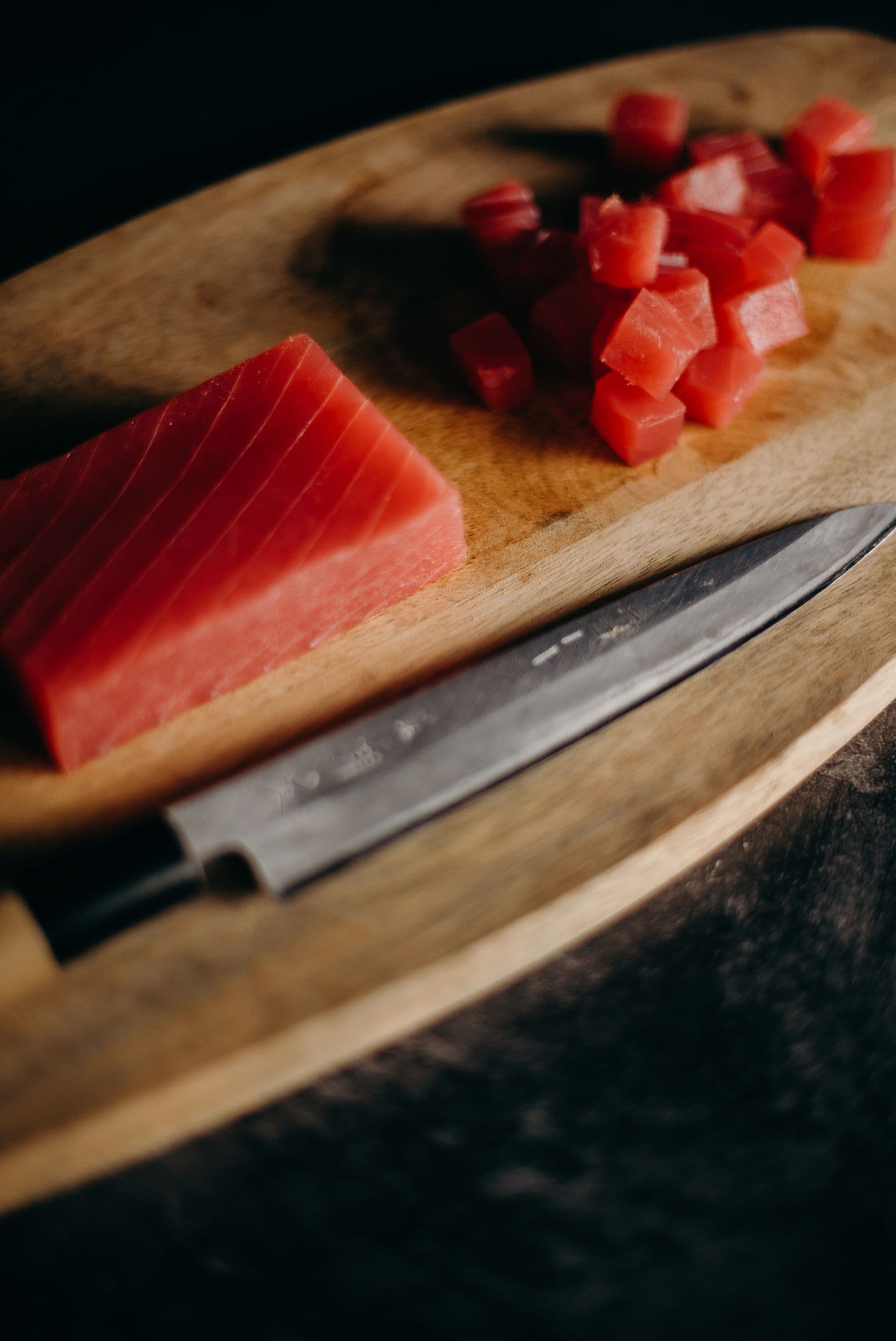
What is a deba?
A deba (出刃) is the traditional Japanese knife for breaking down fish. It has a thick, heavy spine, a fairly short blade (commonly 150–180 mm, with smaller ko-deba and larger sizes too), a pointed tip, and — in its classic form — a single bevel. It's the heavyweight of the Japanese kitchen, and it feels nothing like a thin gyuto in the hand.
All that mass is deliberate. Breaking down a fish means cutting through heads, collars and small bones, and the deba's weight lets it do that cleanly without you forcing the edge. The single bevel lets it ride right along the backbone when filleting, taking every scrap of flesh.
Types of deba
"Deba" covers a small family of fish knives. When people say deba without qualification they usually mean the hon-deba (本出刃, "true deba"). The others vary in length, thickness and bevel, and naming is not perfectly standard between makers, so read the listing's actual length and thickness rather than relying on the name alone.
- Hon-deba: the standard form — thick spine, wide blade, single bevel. This is the knife for heads, collars and backbones, and the one this guide mostly describes.
- Ko-deba (小出刃, "small deba"): a short deba for small fish such as horse mackerel (aji) and sardines, where a full-size blade would be clumsy.
- Mioroshi deba (身卸出刃): usually longer, narrower and thinner than a hon-deba — somewhere between a deba and a yanagiba. It is generally described as better for long filleting strokes and skinning, and less suited to splitting large heads.
- Funayuki (舟行): the name is usually explained as a knife carried by fishermen on boats. Today it generally means a lighter, thinner all-rounder with a deba-like outline; many modern ones are double-bevel and closer to a general kitchen knife than to a true deba.
- Yo-deba (洋出刃, "Western deba"): a thick, double-bevel deba-style blade, often with a Western handle. Some cooks use it for poultry as well as fish; it works in either hand but gives up the single bevel's clean cut along the bone.
| Thickness | Bevel | Best for | |
|---|---|---|---|
| Hon-deba | Thick, heavy | Single | All-round fish breakdown, heads |
| Ko-deba | Thick, but short | Single | Small fish |
| Mioroshi deba | Thinner, narrower, longer | Single | Filleting, lighter work |
| Funayuki | Thin, light | Often double | General prep, small fish |
| Yo-deba | Thick | Double | Fish and (for some) poultry |
What size deba for which fish?
Deba length is quoted in millimetres (or in traditional sun, about 30 mm each). The right size depends mainly on the fish you buy. The ranges below are typical guidance, not fixed rules:
| Length | Typical fish | Notes |
|---|---|---|
| ~105–120 mm | Horse mackerel, sardine, small fish | Ko-deba size; nimble but too light for big heads |
| ~150–165 mm | Mackerel, sea bream, small salmon cuts | Common all-round home size |
| ~180–210 mm | Large fish, big heads and collars | Heavier; more than most home kitchens need |
If you are unsure, 150–165 mm is the safe middle: big enough for most fish a home cook brings home, small enough to control on an ordinary board. For inch conversions see the Japanese knife size guide.
How it's used
To break down a fish you behead and gut it, then run the blade along the backbone to take clean fillets. Use the heel — the thick base of the blade — for tougher spots like the collar, and let the knife's weight drop through bone rather than chopping hard. The tip handles the delicate work near the belly and fins.
The golden rules: it's for fish bone, not hard bone — no poultry or beef bone — and you should never twist or pry hard, which can chip the edge. Respect those and a deba lasts a lifetime.
Tip, middle and heel: which part does what
A deba is really three tools along one edge, because the blade gets thicker from tip to heel. Knowing which part to use is most of the technique. (For the names of each part, see Japanese knife anatomy.)
- Tip (kissaki): the thinnest, most agile part. Use it for delicate work — tracing along the backbone and rib bones when filleting, opening the belly, and working around fins.
- Middle (hara): for ordinary slicing strokes — running along the back and belly, cutting fillets into portions, and trimming.
- Heel (ago): the thickest, heaviest section, meant to take impact. Use it to cut through the head and collar and through small bones, with a firm push straight down. For a tough spot, a common technique is to set the heel in place and tap or press the spine with the palm of your other hand. Never twist the blade in the cut.
A common question is whether a deba is "sharper at the heel than the tip". Not really. The whole edge is sharpened, and every part should cut cleanly. The difference is toughness, not sharpness: behind the edge the heel is much thicker, and some sharpeners leave the heel edge slightly more obtuse on purpose, so it can take chopping and bone contact without chipping. The tip is the finest part — and the part most likely to chip or bend if you use it on bone.
How to fillet a fish with a deba (sanmai oroshi)
The core deba job is sanmai oroshi (三枚おろし, "three-piece filleting"): turning a round fish such as mackerel or sea bream into two boneless fillets and the skeleton. In outline, for a right-handed deba:
- Scale. Scrape the scales off from tail to head with a scaler or the back of the knife, then rinse.
- Remove the head. Cut behind the gill plate and pectoral fin on both sides at an angle, then cut through the backbone with the heel.
- Gut and clean. Open the belly with the tip, remove the innards, scrape out the bloodline along the spine, then rinse and pat dry.
- Cut along the belly and back to the spine. With shallow strokes, cut from head end to tail along the belly, keeping the blade against the bones; turn the fish and do the same along the back.
- Release the first fillet. Cut through at the tail, then run the blade along the backbone to free the fillet in one piece.
- Repeat on the other side. Flip the fish and repeat to take the second fillet, leaving a clean frame.
- Finish the fillets. Trim off the belly (rib) bones with the knife, then pull the pin bones with fish tweezers.
This is a high-level outline, not a full lesson; technique differs by fish and by cook. What comes next is often raw fish: see how to slice sashimi (usually with a yanagiba) and how to make sushi at home.
Deba vs honesuki vs gyuto
These three are often confused because each gets mentioned for "breaking things down". The deba is thick and single-bevel for fish. The honesuki is a small, stiff, triangular boning knife mainly for poultry, working between joints rather than through bone. The gyuto is a thin, double-bevel all-rounder for vegetables and boneless proteins.
| Deba 出刃 | Honesuki 骨スキ | Gyuto 牛刀 | |
|---|---|---|---|
| Main job | Break down whole fish | Bone out poultry | Everyday all-round |
| Thickness | Thick, heavy | Fairly thick, stiff | Thin, light |
| Bevel | Single (classic) | Often asymmetric or single | Double |
| Bones | Fish bone — not hard bone | Around joints, not through bone | No bone at all |
| Handed | Yes (right or left) | Often | Either hand |
| Best for | Filleting, heads, collars | Chicken, small poultry | Veg, proteins, daily prep |
The one thing to avoid is using a thin gyuto where a deba's weight is needed — see can you cut bone with a gyuto? for why thin blades chip.
Buying a deba: hand, steel and handling
- Hand: a single-bevel deba is right- or left-handed. Standard stock is right-handed; left-handed deba are ground as a mirror image and made separately, usually in fewer models and sizes. See left-handed Japanese knives.
- Steel: traditional deba are usually a carbon-steel edge layer — Shirogami (white) or Aogami (blue) — clad in softer iron or steel. Shirogami is generally described as easier to sharpen; Aogami adds alloying elements and is generally described as holding an edge longer. Both rust if left wet. Stainless deba exist for easier care. Compare them in VG10 vs Aogami vs Shirogami and the steel chart.
- Size: use the size table above; 150–165 mm is the common home choice.
- What chips a deba: twisting or prying in the cut, frozen or partly frozen fish, and large beef or pork bones. It is tough for a Japanese knife, but it is not a cleaver.
Single bevel, care & sharpening
Deba are frequently made from reactive carbon steel, so the usual carbon-steel care applies: dry it after use, let a patina form, and don't leave it wet. Sharpening follows the single-bevel method — work the bevel, then lightly deburr the flat back (the uraoshi). New to it? Read single vs double bevel and how to sharpen on a whetstone first.
The flat back of a traditional deba is not completely flat: it has a shallow hollow (urasuki) surrounded by a thin flat rim. Ura-oshi means laying the back flat on the stone and polishing just that rim to remove the burr. Keep it light and brief — heavy work on the back wears the rim wider over time and makes the knife harder to maintain. Most sharpening happens on the bevel side. For stone grits, see how to choose a whetstone.
Do you need a deba?
Get one if
- You regularly buy and break down whole fish
- You want clean fillets with every scrap of flesh
- You're ready to learn single-bevel technique
- You'll pair it with an everyday knife
Skip it if
- You mostly cook pre-cut fillets
- You want one versatile everyday knife
- You expected a bone cleaver — a deba isn't one
- You'd rather not maintain a single-bevel edge
The bottom line
A deba turns the messy job of breaking down a whole fish into a clean, satisfying one — provided you respect what it's for: fish, not hard bone, and never a first knife.
Buy it as a considered specialist alongside a good all-rounder. If you're still choosing that main knife, start with a gyuto or santoku.
Frequently asked questions
What is a deba used for?
A deba is a fish knife. It's used to break down whole fish — beheading, gutting and filleting — where its heavy spine powers through fish heads, collars and small bones, and its pointed tip and heel handle the finer filleting. It's a fish-prep specialist, not a general kitchen knife and not a bone cleaver.
Why is a deba so thick and heavy?
The weight and thick spine do the work. When you cut through a fish head or along the backbone, you let the knife's mass drop through rather than forcing it, which protects the edge and makes clean cuts easy. That heft is exactly what a thin gyuto lacks — and why you should never use a thin knife on fish bones.
Is a deba single or double bevel?
Traditional deba are single-bevel — ground on one side — which lets them cut cleanly right along the bone when filleting. Because it's single-bevel it's handed (a standard deba is right-handed). Some modern 'western deba' are double-bevel for easier use; the classic version is single-bevel.
Can I cut through bones with a deba?
Fish bones, yes — that's its job. Hard bones, no. A deba is made for fish heads, collars and the small bones of a fillet, not for chopping through poultry or beef bone; that will chip the edge. It's a fish knife, not a cleaver. Cut with the heel for tougher spots, and never twist or pry hard.
Deba vs gyuto — what's the difference?
A deba is a thick, heavy, single-bevel fish specialist; a gyuto is a thin, double-bevel all-rounder. The gyuto is your everyday knife for vegetables and boneless proteins; the deba is what you reach for to break down a whole fish. They complement each other — and you should never use a thin gyuto where a deba's weight and thickness are needed.
Do I need a deba?
Only if you regularly buy and break down whole fish. If you mostly cook fillets from the market, you don't need one. If you love working with whole fish, a deba makes the job clean and easy in a way no Western knife quite matches — but keep it as a specialist alongside an everyday knife.
What size deba should I get?
Match it to the fish you buy. As a rough guide, a small ko-deba of about 105–120 mm suits horse mackerel, sardines and other small fish; about 150–165 mm is the common all-round home size for mackerel, sea bream and similar; and about 180–210 mm is for large fish and splitting big heads. If you are unsure, 150–165 mm covers most home fish prep.
Hon deba vs mioroshi deba — what's the difference?
A hon-deba is the standard deba: thick, heavy and wide, built for heads, collars and backbones. A mioroshi deba is usually longer, narrower and thinner, sitting between a deba and a yanagiba. It is generally described as better for long filleting strokes and lighter trimming, and less suited to heavy chopping through large heads.
Honesuki vs deba — which do I need?
They do different jobs. A honesuki is a small, stiff, triangular boning knife mainly for poultry: it cuts between joints and along the carcass rather than through bone. A deba is a thick fish knife for heads, collars and fish bones. Buy a honesuki if you break down chickens, a deba if you break down whole fish.
Is there a left-handed deba?
Yes. Because a traditional deba is single-bevel, left-handed versions are ground as a mirror image and made separately. They are usually offered in fewer models and sizes than right-handed deba, and some are made to order, so check the listing says left-handed before buying. A double-bevel yo-deba works in either hand.
Exploring traditional Japanese knives?
See every Japanese knife type, everyday and specialist alike. Our curated shelf opens soon — join the waitlist.
Browse knife types →