
What honing does
As you cut, a thin edge slowly rolls microscopically to one side — it's still there, just no longer straight, so the knife feels dull. Honing pushes that rolled edge back into alignment. It removes almost no steel; it just re-trues what's already there, restoring the bite of a knife that was recently sharp.
On soft Western steel this is the job of a grooved honing steel. On a hard Japanese blade it's better done with a strop or a smooth ceramic rod — more on that below.
What sharpening does
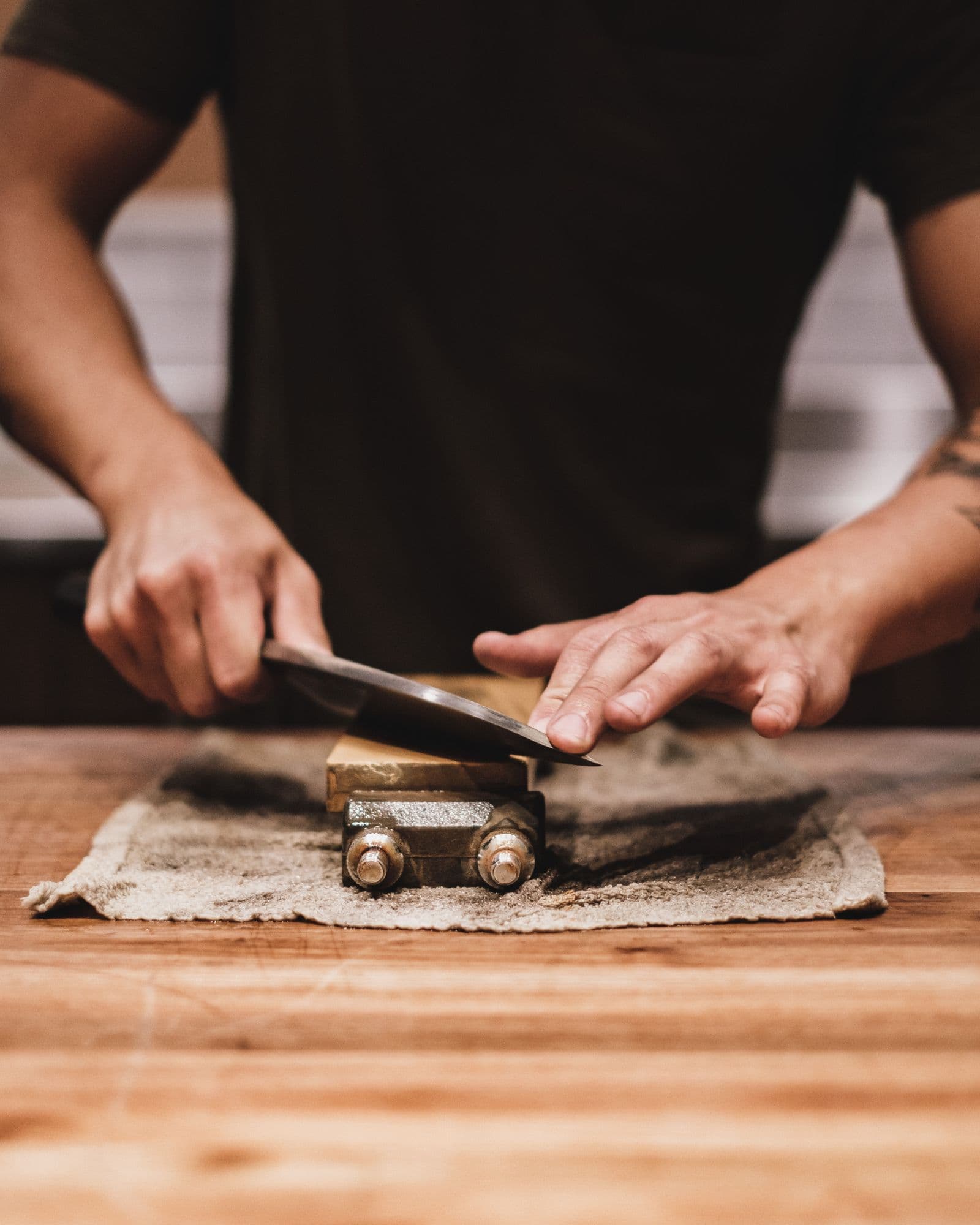
Sharpening abrades metal away to grind a fresh edge. When an edge is truly worn, chipped or rounded, no amount of honing brings it back — you have to remove steel and create a new apex. For Japanese knives that means a whetstone, worked at a consistent angle through progressive grits. It's the deeper reset that honing between-times lets you do less often.
Side by side
| Honing | Sharpening | |
|---|---|---|
| What it does | Realigns the edge | Grinds a new edge |
| Removes metal? | Almost none | Yes |
| Tool | Strop / ceramic rod | Whetstone |
| How often | Every few uses | Every 1–3 months |
| Restores a dull knife? | Only if recently sharp | Yes, fully |
| Skill | Easy | Takes practice |
The Japanese-knife caveat
Don't use a coarse steel rod on a hard Japanese knife. Japanese blades run hard (about 60–63 HRC) and thin. That hardness means the edge chips rather than rolls, so a grooved honing steel does little good and can crack the fine edge. Hone with a strop or a smooth ceramic rod, or just touch up on a high-grit stone.
This is the single most common mistake people bring from Western knives. A hard Japanese edge rewards gentle maintenance and a good stone — not aggressive steeling.
How often to do each
Hone (or strop) little and often to keep the edge true; reach for the whetstone only when honing no longer restores the bite. You'll stretch the time between sharpenings by cutting on wood or soft boards, hand-washing, and drying the blade rather than letting it knock around a drawer.
The bottom line
Honing keeps a sharp knife sharp; sharpening makes a dull knife sharp again. Do the first often and gently, the second rarely and properly — and on a Japanese blade, leave the coarse steel rod in the drawer.
Ready to learn the stone? Start with how to sharpen a Japanese knife on a whetstone.
Frequently asked questions
What is the difference between honing and sharpening?
Honing realigns an edge that has rolled slightly out of true, without removing much metal — it makes a still-sharp knife feel sharp again. Sharpening removes metal to grind a brand-new edge, and is what you do when honing no longer restores keenness. Honing is frequent maintenance; sharpening is occasional renewal.
Do you hone a Japanese knife with a steel rod?
Usually not a traditional grooved steel. Japanese knives use hard steel (around 60–63 HRC) that doesn't roll like softer Western steel, and a coarse steel rod can chip a hard, thin edge. Instead, maintain a Japanese knife with a light strop, a smooth ceramic rod, or a quick touch-up on a high-grit whetstone.
How often should I hone and sharpen?
Honing (or a light strop) can be done every few uses to keep the edge true. Sharpening on a whetstone is needed far less often — for a home cook, roughly every one to three months depending on use, or whenever honing stops bringing the edge back. Cutting on wood or a soft board and hand-washing both stretch the time between sharpenings.
Does honing remove metal?
Very little. A honing rod or strop mostly pushes a rolled edge back into alignment. A whetstone, by contrast, abrades metal away to form a fresh edge — that's why over-sharpening slowly wears a knife down, while honing barely does.
Can I skip honing and just sharpen?
You can, but you'll sharpen more often and remove more metal over the knife's life. Regular light honing or stropping keeps the edge aligned between sharpenings, so the knife stays sharper day to day and needs the stone less often. For hard Japanese steel, a strop or ceramic rod is the gentle way to do it.
What tool should I use to maintain a Japanese knife?
A high-grit whetstone (for sharpening) plus an optional strop or fine ceramic rod (for honing) covers everything. Avoid coarse steel honing rods designed for German knives. If you only buy one thing, buy a good combination whetstone and learn to use it.
Keeping a Japanese edge sharp?
Read the whetstone walkthrough, or see the knife types. Our curated shelf opens soon — join the waitlist.
The whetstone guide →