
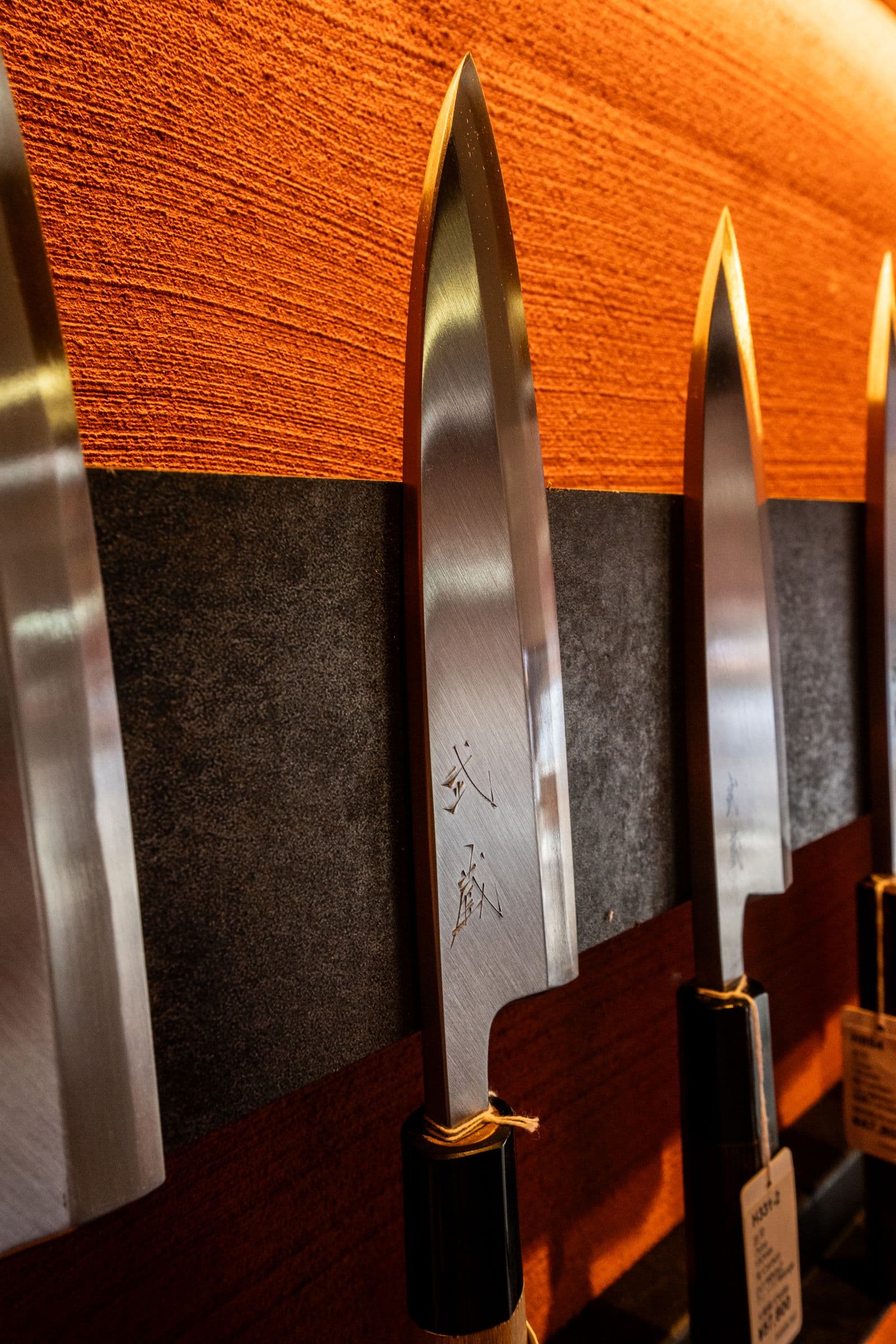
What is a kiritsuke?
Kiritsuke (切付) describes a knife with a distinctive angled, sword-like tip where the spine drops in a long straight diagonal to a fine point. Traditionally it's a single-bevel knife meant to stand in for both a yanagiba and an usuba — which is part of why it carries a certain prestige. The catch is that this traditional form is genuinely hard to use.
What a kiritsuke looks like
If you have searched "what does a kiritsuke knife look like", the short version is: a long, fairly flat blade whose spine drops to the point in a straight, angled line. Most chef's knives curve gently down to the tip; the kiritsuke cuts that corner off with a straight diagonal, which gives it its sword-like look. In Japanese this tip is called 剣型 (kengata); in English you will see it called a k-tip or reverse tanto.
- Edge: long and fairly flat, with only a little curve near the tip.
- Spine: runs straight, then angles down to meet the edge at a fine point.
- Tip: acute and angular rather than rounded or curved.
- Grind (traditional): single-bevel, sharpened on one side with a hollowed back — in effect a hybrid of a yanagiba's length and an usuba's flat edge.
- Grind (modern kiritsuke-gyuto): double-bevel, like any Western-style chef's knife.
Here is how that tip compares with the other tip shapes on Japanese kitchen knives:
Pointed
Gyuto, petty, sujihiki, yanagiba
Sheepsfoot
Santoku
K-tip (reverse tanto)
剣型 kengata
Bunka, kiritsuke, kiritsuke-gyuto
Square
角型 kakugata
Nakiri, Kanto-style usuba, takohiki
Sickle
鎌型 kamagata
Kansai-style usuba
Against its closest relatives: a gyuto has a pointed tip, with the spine and a curved belly meeting at the point, so it looks softer and rocks more easily. A bunka shares the k-tip, but on a shorter, taller blade — roughly santoku-sized — so its angled tip looks stubbier. The kiritsuke is the long, low, dramatic version of the shape. For every tip shape with its Japanese name and the knives that use it, see the tip-shape table in our Japanese knife anatomy guide.
The two kiritsuke (this is the key point)
Traditional kiritsuke = single-bevel, keen, handed, for experienced professionals. Modern kiritsuke-gyuto / kiritsuke-santoku = double-bevel all-rounders that borrow the angular tip but work in either hand and are beginner-friendly. Almost every "kiritsuke" sold to home cooks is the second kind — and that's the one you want unless you're chasing traditional single-bevel skill.
Traditional kiritsuke vs kiritsuke-gyuto
The two share a name and a silhouette, but they are built for different people. Lengths below are typical ranges, not fixed rules — makers vary.
| Traditional kiritsuke | Kiritsuke-gyuto | |
|---|---|---|
| Bevel | Single (one side, hollow back) | Double (both sides) |
| Typical length | Roughly 240–300 mm | Roughly 210–240 mm |
| Main jobs | Slicing fish, fine vegetable work | General prep: meat, fish, vegetables |
| Who it's for | Experienced single-bevel users, professionals | Home cooks and pros alike |
| Sharpening | Harder: one-sided bevel plus the back | Standard double-bevel sharpening |
| Handedness | Handed — left-handed versions must be specified | Works in either hand |
If the bevel question is new to you, read single bevel vs double bevel first — it decides almost everything else. For the gyuto side of the family, see the gyuto knife guide.
The "only the head chef uses it" story
You will often read that in traditional Japanese kitchens only the head chef was allowed to use a kiritsuke. It is a good story and it is repeated everywhere, but it is hard to verify and probably says more about the knife's reputation than about any fixed rule. Treat it as lore, not history.
The practical point behind it is real, though. The traditional single-bevel kiritsuke tries to do two specialist jobs with one blade: the long pull-slice of a yanagiba and the flat, precise vegetable work of an usuba. Each of those is a demanding single-bevel knife on its own. A blade that compromises between them is harder to steer straight and harder to sharpen well, so it rewards someone who already has both skills. That, rather than a rule, is why it is associated with senior cooks.
Kiritsuke vs gyuto
A kiritsuke-gyuto is, functionally, a gyuto with a flatter edge and an angular tip.
| Kiritsuke-gyuto | Gyuto | |
|---|---|---|
| Tip | Angular, sword-like | Curved point |
| Profile | Flatter | Curved belly |
| Motion | Push cut / chop | Rock or chop |
| Detail tip work | Excellent | Good |
| Forgiveness | Slightly less | A touch more |
| Bevel (modern) | Double | Double |
Choose the kiritsuke-gyuto for a flat profile, a precise tip and the striking look; choose the plain gyuto for a rocking belly and a hair more forgiveness.
Kiritsuke vs bunka
Both wear an angular tip, but the bunka is the compact one — a shorter reverse-tanto (k-tip) on a santoku-sized body — while the kiritsuke is longer and more dramatic, closer to a gyuto in length. Same family, different scale: bunka for nimble everyday work, kiritsuke for reach and presence.
Kiritsuke sizes
Japanese knives are sold by blade length in millimetres. Inch figures below are rounded; the fit notes are general guidance, not rules.
| Length | ≈ Inches | Who it suits |
|---|---|---|
| 210 mm | 8¼ in | Most home cooks; smaller boards and kitchens; a first kiritsuke-gyuto |
| 240 mm | 9½ in | Home cooks who want more reach; large vegetables and roasts; a common all-round size |
| 270 mm | 10½ in | Experienced users with plenty of board space; long slicing strokes |
| 300 mm | 11¾ in | Mostly traditional single-bevel kiritsuke for professional fish work |
The flat profile makes a kiritsuke feel a little longer in use than a curved gyuto of the same length, because more of the edge meets the board. If you are unsure, 210 or 240 mm is the usual choice for a double-bevel kiritsuke-gyuto. Our Japanese knife size guide covers board size and hand size in more detail.
How to use a kiritsuke
The shape tells you how it wants to move. Three techniques cover most of what a kiritsuke does:
- Push-cutting on the flat section. Move the blade forward and down so the long, flat middle of the edge meets the board along its length. This is the kiritsuke's strength for onions, carrots, cabbage and herbs, and the flat edge leaves fewer "accordion" cuts that stay joined.
- Pull-slicing (traditional single-bevel). For raw fish, the traditional kiritsuke is used like a yanagiba: start at the heel and draw the blade toward you in one long stroke, without sawing. See how to slice sashimi for the technique.
- Tip work. The acute angled tip is good for fine work: scoring fish skin or meat, making shallow cuts in onions before dicing, trimming, and cutting in tight spaces. It is also the part most likely to chip if it hits the board hard or twists, so use it deliberately.
What it does badly: rocking. With so little curve near the tip, a rocking motion lifts the heel awkwardly and leaves uncut sections. If you rock-chop herbs by habit, a curved gyuto will feel more natural — or adjust to a push-cut or a tap-chop. As with any thin Japanese blade, avoid bones, frozen food and twisting through hard squash.
How to choose a kiritsuke
- Bevel first. For almost every home cook, choose a double-bevel kiritsuke-gyuto. Only choose the single-bevel traditional kiritsuke if you already use and sharpen single-bevel knives.
- Length. 210 mm or 240 mm for a double-bevel kiritsuke-gyuto (see the size table above). Traditional single-bevel kiritsuke tend to be longer.
- Steel. Stainless or stainless-clad steels ask less of you; carbon steels such as shirogami or aogami can take a very keen edge but rust and patina if neglected. Compare them in our steel guide.
- Handle. A lighter Japanese wa handle moves the balance forward; a Western yo handle feels familiar. See wa vs yo handles.
- Left-handed? A double-bevel kiritsuke-gyuto works for you as-is. A single-bevel kiritsuke must be ground for the left hand; availability is more limited, and it may need to be ordered specially. Details in our left-handed Japanese knives guide.
Which should you buy?
Kiritsuke-gyuto (double) if
- You want a striking, flat-profile all-rounder
- You push-cut and chop more than you rock
- You value a precise, pointed tip
- You want a usable everyday knife
Traditional kiritsuke (single) if
- You're an experienced single-bevel user
- You've mastered yanagiba and usuba technique
- You want the traditional chef's knife
- You'll sharpen a single bevel properly
The bottom line
The kiritsuke is two knives wearing the same silhouette. The modern double-bevel one is a gorgeous, usable all-rounder; the traditional single-bevel one is a master's tool. Know which you're buying.
If it's your first Japanese knife, a plain gyuto or santoku is the safer start — see the best Japanese knife for beginners.
Frequently asked questions
What is a kiritsuke knife?
Kiritsuke refers to a knife with a distinctive angled, sword-like tip. Traditionally it's a single-bevel knife that combines the roles of a yanagiba and usuba, and is associated with senior chefs. Today most kiritsuke sold in the West are double-bevel 'kiritsuke-gyuto' or 'kiritsuke-santoku' — all-rounders that borrow the striking angled tip but are far easier to use.
Is a kiritsuke single or double bevel?
Both exist, and it matters a lot. The traditional kiritsuke is single-bevel — very keen, handed, and notoriously demanding, meant for skilled professionals. The popular modern kiritsuke-gyuto and kiritsuke-santoku are double-bevel all-rounders that work in either hand and are beginner-friendly. If you want a usable everyday knife, you want the double-bevel version.
Kiritsuke vs gyuto — what's the difference?
A kiritsuke-gyuto is essentially a gyuto with a flatter profile and an angular, sword-like tip instead of a curved point. The flatter edge favours a push-cut and straight chop over rocking, and the pointed tip is great for detail work. A standard gyuto has more belly for rocking and is a touch more forgiving. Cut-wise they overlap heavily; the kiritsuke is the flatter, more striking take.
Kiritsuke vs bunka — how do they differ?
Both have an angular tip, but the shapes differ. A bunka has a shorter reverse-tanto (k-tip) on a santoku-sized body, while a kiritsuke has a longer, straighter diagonal tip and is usually longer overall, closer to a gyuto. Think of the bunka as the compact all-rounder and the kiritsuke as the longer, more dramatic one.
Is a kiritsuke good for beginners?
The double-bevel kiritsuke-gyuto or kiritsuke-santoku, yes — it's a normal all-rounder with a striking tip, and the main thing to mind is the sharp point. The traditional single-bevel kiritsuke, no — it's one of the hardest Japanese knives to use well and is meant for experienced professionals.
Why is the kiritsuke seen as a status knife?
It is often said that in traditional Japanese kitchens only the head chef used the single-bevel kiritsuke. That story is widely repeated but hard to verify. What is clear is that the traditional kiritsuke tries to do the jobs of both a yanagiba and an usuba with one blade, so using it well takes a lot of single-bevel skill. That reputation gives it prestige; the modern double-bevel versions keep the look without the difficulty.
What does a kiritsuke knife look like?
A kiritsuke is long with a fairly flat edge, and its spine does not curve down to the point: it drops in a straight, angled line to a sharp tip. This is called a k-tip or reverse tanto (剣型, kengata). The result looks a little like a sword. The traditional single-bevel version is ground on one side only, somewhat like a cross between a yanagiba and an usuba; the double-bevel kiritsuke-gyuto has a gyuto-style grind with the same angled tip.
What is a kiritsuke-gyuto?
A kiritsuke-gyuto is a double-bevel chef's knife with a kiritsuke-style angled tip and a flatter edge than a standard gyuto. It is used like a gyuto for meat, fish and vegetables, works in either hand, and is sharpened like any double-bevel knife. Makers label it differently: you may see kiritsuke-gyuto, k-tip gyuto, or simply kiritsuke.
What size kiritsuke should I get?
For a double-bevel kiritsuke-gyuto, 210 mm (about 8¼ in) or 240 mm (about 9½ in) suits most home kitchens; 210 mm is easier on a small board, 240 mm gives more reach for large produce and proteins. Traditional single-bevel kiritsuke are generally longer, often 270 mm and up, and are aimed at professionals.
Drawn to the kiritsuke look?
Compare it with the other all-rounders. Our curated shelf opens soon — join the waitlist.
Compare knife types →