
Blade anatomy
- Edge
- The sharpened cutting part of the blade, where the two faces meet at the apex. See single vs double bevel.
- Bevel
- The angled face ground into the blade to form the edge. Japanese knives are either single- or double-bevel. See single vs double bevel.
- Spine
- The thick, unsharpened top of the blade, opposite the edge; its thickness affects weight and how the knife wedges.
- Tip
- The pointed front of the blade, used for detail work and piercing.
- Heel
- The rear corner of the edge nearest the handle, used for heavier cuts with more force.
- Belly
- The curved part of the edge; more belly suits rocking, a flatter profile suits straight chopping.
- Tang
- The part of the blade steel that extends into the handle. Full/partial tangs are riveted (yo); a hidden tang is friction-fitted (wa). See wa vs yo handle.
- Choil
- The unsharpened notch or curve where the edge ends and the heel meets the handle.
- Urasuki裏すき
- The concave hollow on the back of a single-bevel knife that makes the edge keen and food release cleanly. See single vs double bevel.
Knife types
- Gyuto牛刀
- The Japanese chef's knife — a long, pointed, curved all-rounder for almost everything. See gyuto guide.
- Santoku三徳
- A shorter, flatter home all-rounder with a rounded tip; nimble and easy to control. See santoku guide.
- Bunka文化
- A santoku-sized all-rounder finished with an angular k-tip (reverse tanto) for detail work. See bunka guide.
- Nakiri菜切
- A tall, flat, double-bevel vegetable knife for clean straight-down chopping. See nakiri guide.
- Usuba薄刃
- The traditional single-bevel vegetable knife — the professional, harder-to-use cousin of the nakiri. See usuba guide.
- Pettyペティ
- A small utility knife for peeling, trimming and detail — part paring knife, part mini chef's knife. See petty guide.
- Sujihiki筋引
- A long, thin, double-bevel slicer for carving meat and portioning fish. See sujihiki guide.
- Yanagiba柳刃
- A long single-bevel slicer for cutting sashimi in one clean pull. See yanagiba guide.
- Takohiki蛸引
- The Kanto (Tokyo) form of the sashimi knife: a single-bevel slicer with a square tip instead of a point. See takohiki guide.
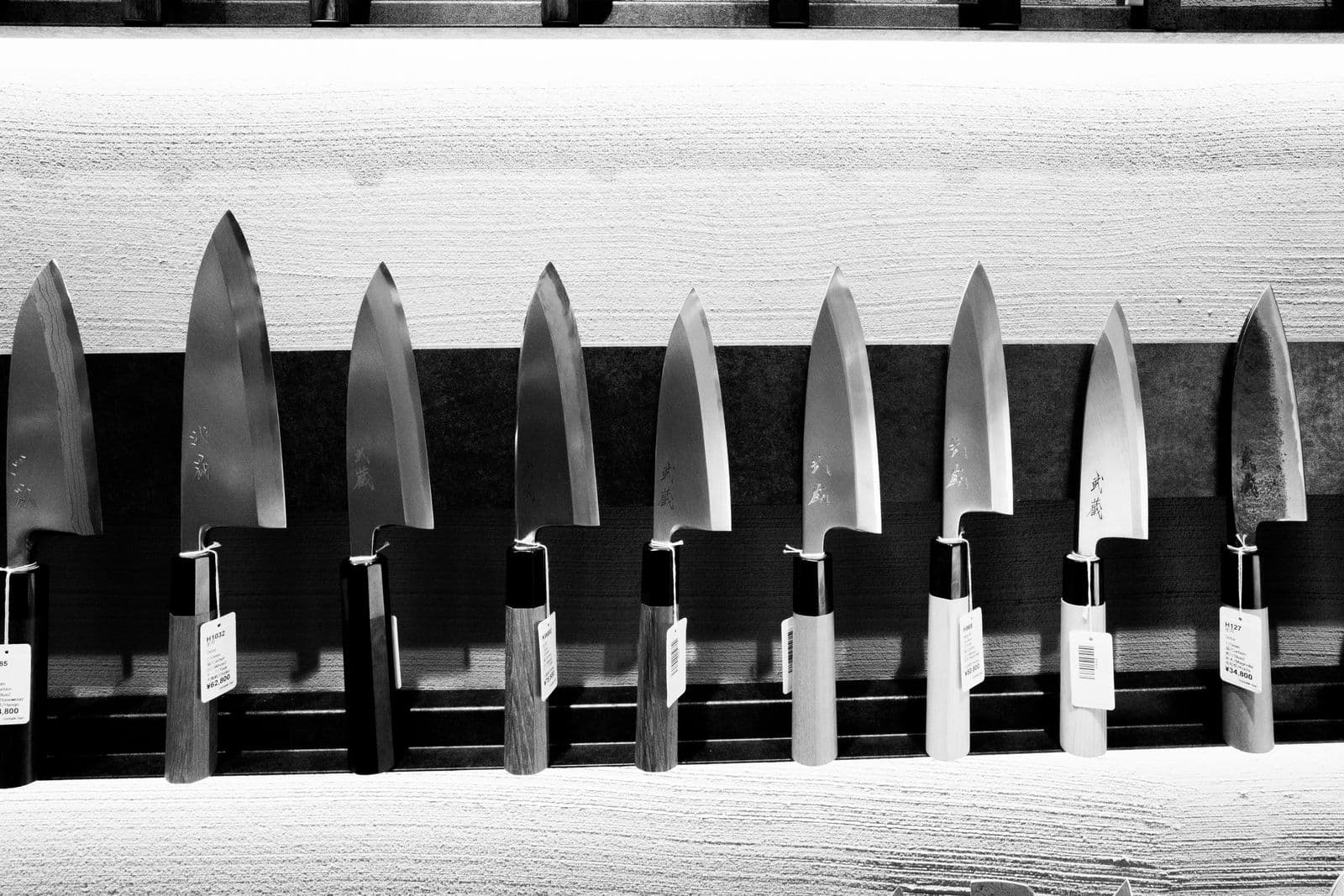
- Deba出刃
- A thick, heavy single-bevel knife for breaking down whole fish. See deba guide.
- Honesuki骨スキ
- A stiff, pointed boning knife, most associated with breaking down poultry. See honesuki guide.
- Kiritsuke切付
- A hybrid shape with an angular tip; a double-bevel version works as a stylish all-rounder. See kiritsuke guide.
- Pankiriパン切り
- A serrated Japanese bread knife that saws through crust without crushing the crumb. See bread knife guide.
Steel & metallurgy
- Carbon steel
- Non-stainless steel that takes a very keen edge and sharpens easily, but rusts and reacts unless cared for. See carbon steel care.
- Stainless steel
- Chromium-rich steel that resists rust and needs little maintenance; slightly harder to get screaming sharp than carbon. See steel guide.
- Shirogami白紙
- "White" carbon steel — very pure, takes an exceptionally keen edge, sharpens easily, but reactive. See steel guide.
- Aogami青紙
- "Blue" carbon steel — white steel plus tungsten/chromium for better edge retention and toughness. See steel guide.
- VG10
- A popular Japanese stainless steel — sharp, holds an edge well, easy to care for and to sharpen. See steel guide.
- SG2 / R2
- A powder (particle-metallurgy) stainless with a fine grain, long edge retention and stainless convenience. See SG2 / R2 guide.
- HRC (hardness)
- Rockwell hardness. Japanese knives typically run ~60–63 HRC — harder than Western knives, so sharper and more edge-stable but more chip-prone. See hardness explained.
- Patina
- The stable grey-blue oxide layer a carbon blade develops with use, which protects it from red rust. See carbon steel care.
- Reactivity
- How readily a steel reacts with acidic food and moisture — high in carbon steels, negligible in stainless. See carbon steel care.
Construction & finish
- San mai三枚
- "Three layers" — a hard steel core clad in two softer outer layers for a keen edge with more forgiveness.
- Damascus墨流し
- A layered, patterned cladding (suminagashi) that is largely decorative; the cutting core is a single steel.
- Kurouchi黒打ち
- The rustic black forge-scale finish left on the blade; traditional and low-cost, it also adds some rust resistance.
- Tsuchime槌目
- A hammered, dimpled finish that looks striking and can help food release from the blade.
- Nashiji梨地
- A textured "pear-skin" finish on the blade's cladding.
- Honyaki本焼
- A knife forged from a single piece of steel and differentially hardened — the most demanding, prized construction.
- Single bevel
- Ground on one side only; extremely keen and food-releasing, but handed and harder to sharpen. See single vs double bevel.
- Double bevel
- Ground on both sides like a Western knife; works in either hand and is easy to sharpen. See single vs double bevel.
Sharpening & care
- Whetstone
- A water stone used to sharpen Japanese knives, in progressive grits from coarse to fine. See choosing a whetstone.
- Grit
- The abrasiveness of a stone; low grit removes metal fast, high grit refines and polishes the edge. See grit explained.
- Honing
- Realigning a rolled edge with little metal removal — frequent upkeep, distinct from sharpening. See honing vs sharpening.
- Stropping
- Polishing and lightly realigning the edge on leather or a fine surface; a gentle way to maintain a hard edge. See honing vs sharpening.
- Burr (wire edge)
- The tiny lip of metal raised on the far side of an edge as you sharpen; removing it finishes the edge. See how to sharpen.
- Uraoshi裏押し
- Lightly flattening the back of a single-bevel knife to remove the burr after sharpening the bevel. See single vs double bevel.
Handles
- Wa handle和
- The traditional Japanese wooden handle — light, often octagonal, friction-fitted, and replaceable. See wa vs yo handle.
- Yo handle洋
- The Western-style handle — heavier, riveted to the tang, often with a bolster; robust and secure. See wa vs yo handle.
- Ho wood朴
- Magnolia wood, the light, traditional material for many wa handles and saya (blade covers).
Ready to put the words to work?
Compare the knife types side by side, or find your match in four questions.
Browse knife types →