
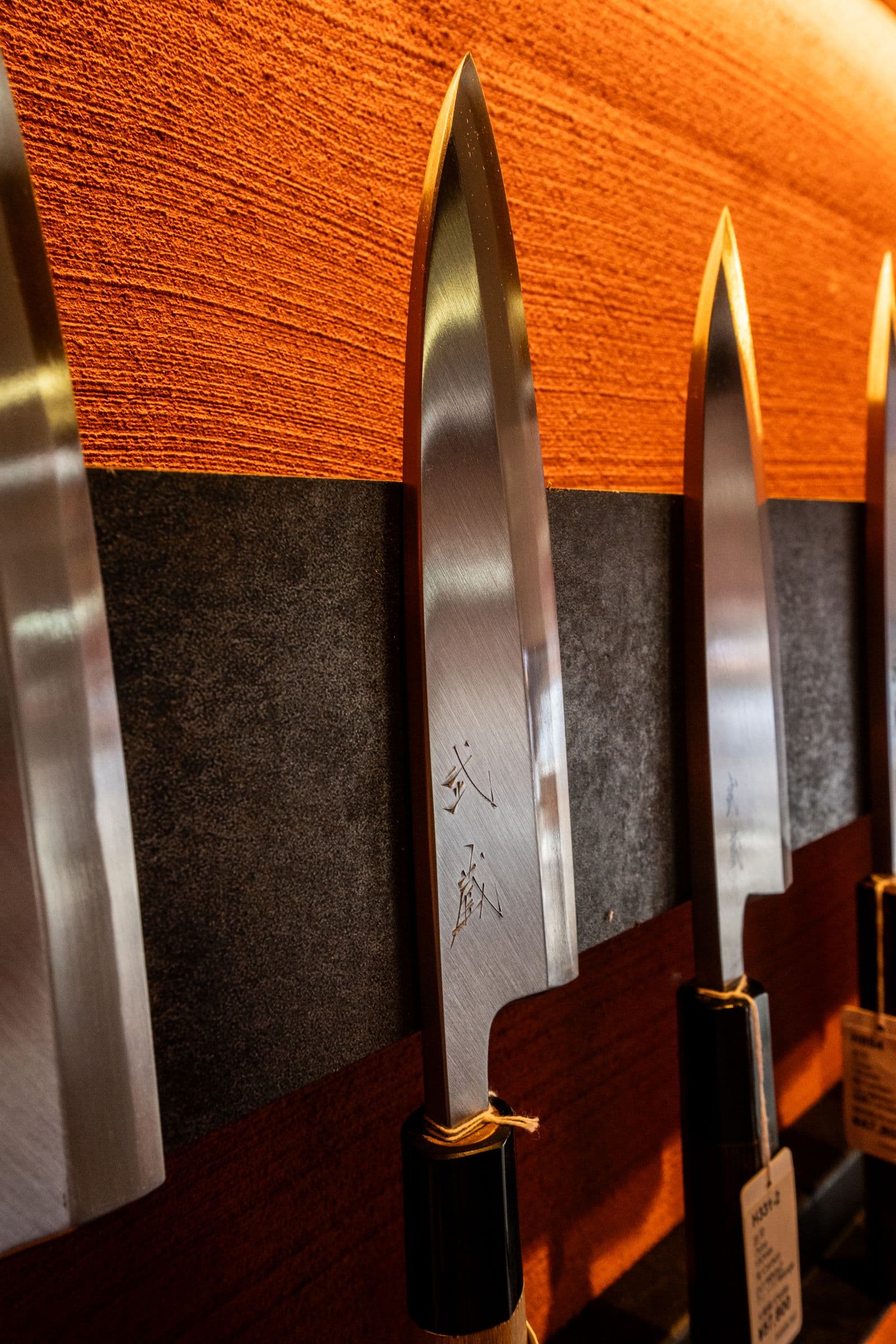
What is a yanagiba?
A yanagiba (柳刃, "willow blade") is the traditional Japanese slicer for raw fish. It's long (240–330 mm, with 270 mm the common size), slender, and ground on one side only with a flat, subtly hollowed back. That single bevel lets it take an extraordinarily keen, acute edge — exactly what slicing delicate raw fish demands.
The pointed style is the Kansai (Osaka) form; the Kanto (Tokyo) version, with a squared-off tip, is called a takohiki (also written takobiki). Either way, this is a knife built for one job — turning a fillet into clean, glossy slices — not a general kitchen blade.
Anatomy of a yanagiba
A yanagiba is built differently from a Western knife, and the parts explain how it cuts. Looking at a right-handed blade:
- Kireha (切刃) — the single bevel. The wide, flat bevel on the front (right-hand) face, running the full length of the blade. It is much wider than the small edge bevel on a Western knife, which is what gives the yanagiba its acute, keen edge. On traditional clad blades, the softer iron cladding and the hard steel core are often visible here as two tones.
- Shinogi (鎬) — the ridge line. The crisp line where the kireha meets the flat upper face of the blade (the shinogi-ji). A straight, even shinogi is commonly treated as a sign of careful grinding, and it is the reference you follow when sharpening the bevel.
- Urasuki (裏すき) — the hollow back. The back (left-hand) face is not truly flat: it is ground slightly concave. Only a narrow rim touches a flat surface.
- Ura-oshi (裏押し) — the flat rim. That narrow, flat band around the edge and spine of the back. It is the only part of the back you touch on the stone, just enough to remove the burr.
- Kissaki (切先) — the tip. The spine curves gently down to meet the edge in a fine point. The point is used for detail work — scoring, finishing a cut, lifting a slice — but it is thin and can snap if you pry with it.
Why the hollow back matters. The concave urasuki reduces the area of steel in contact with the fish, so slices tend to fall away from the blade instead of clinging to it. It also makes maintenance practical: because only the ura-oshi rim touches the stone, you can keep the back flat without grinding the whole face. See every part named in our Japanese knife anatomy guide, and how one-sided grinds behave in single bevel vs double bevel.
How it cuts: one long pull
The whole point of a yanagiba is to slice in a single, smooth pulling stroke — drawing the full length of the blade through the fish rather than sawing back and forth. A sawing motion tears the flesh and dulls the surface; one clean pull leaves a glossy, undamaged cut face that catches the light and tastes cleaner. That's why the blade is so long: you want to finish the slice before you run out of edge.
It rewards a light touch and a very sharp edge. What it won't do is chop, dice or handle anything but boneless fish — for that, reach for a gyuto. The grip, the fish and the two classic cuts — hira-zukuri (straight, thick slices) and sogi-zukuri (thin, angled slices) — are covered step by step in how to slice sashimi.
Yanagiba sizes: which length?
The rule is simple: a longer blade lets you finish a larger slice in one pull. Yanagiba are commonly made from about 240 mm to 330 mm (shorter and longer blades exist), and these four lengths are the usual choices:
| Length | ≈ Inches | Typically suits |
|---|---|---|
| 240 mm | 9½" | Home cooks with small boards or smaller blocks of fish |
| 270 mm | 10½" | The common all-round size; a good first yanagiba for home use |
| 300 mm | 11¾" | Professional counters, larger fillets, serious home sushi |
| 330 mm | 13" | Professional use and large blocks of fish |
Lengths are measured along the edge, heel to tip, not including the handle. A longer knife also needs a longer board — a 300 mm blade on a small board is awkward. For a home kitchen, 240–270 mm covers almost everyone; our knife size guide has conversions for every length.
Yanagiba vs sujihiki
If the single-bevel commitment sounds like a lot, the sujihiki is the easier alternative — a long, double-bevel Western-style slicer. It works in either hand, sharpens like any double-bevel knife, and slices cooked meat and roasts as well as fish.
| Yanagiba 柳刃 | Sujihiki 筋引 | |
|---|---|---|
| Bevel | Single | Double |
| Made for | Raw fish, sashimi | Meat, fish, all slicing |
| Handed | Yes (right or left) | Either hand |
| Length | 240–330 mm | 240–270 mm |
| Edge | Exceptionally keen | Very keen |
| Sharpening | Bevel + light back (uraoshi) | ~15° both sides |
| Learning curve | Steeper | Easy |
Choose the sujihiki for an easy, versatile slicer; choose the yanagiba for traditional sashimi work and the cleanest possible cut.
Yanagiba vs takohiki vs fugubiki
The yanagiba is one of three traditional single-bevel sashimi knives. All three slice raw fish with a long pull; they differ in tip shape, blade build and the job they were refined for.
| Yanagiba 柳刃 | Takohiki 蛸引 | Fugubiki ふぐ引 | |
|---|---|---|---|
| Tip | Pointed | Square | Pointed |
| Region / origin | Kansai (Osaka) | Kanto (Tokyo) | Specialist variant |
| Blade | Standard reference | Thinner, lower | Very thin, flexible |
| Made for | Sashimi, sushi toppings | Sashimi | Paper-thin fugu (pufferfish) slices |
| How easy to find | Very common | Uncommon | Rare |
The takohiki name means roughly "octopus puller", but it is a general sashimi knife, and octopus (tako) sashimi is sliced with the same long pull on either knife — a yanagiba handles it fine. The fugubiki is a narrow specialist for the translucent, very thin slices of fugu. For a first sashimi knife, the yanagiba is the practical choice: it is the easiest to find, especially left-handed, and the pointed tip adds versatility.
How to choose a yanagiba
- Hand first. A single-bevel knife is made for one hand. Most yanagiba are right-handed; left-handed versions are made separately as mirror images, usually in smaller numbers. Don't buy the wrong hand and hope to adapt — see left-handed Japanese knives.
- Steel. The traditional choice is carbon steel — Shirogami (white) or Aogami (blue) — clad in softer iron. It takes a very keen edge but rusts if left wet. Stainless options such as Ginsan (silver-3) or VG10 trade a little of that traditional feel for much easier care. Compare them in the steel chart.
- Kasumi or honyaki. Most yanagiba are kasumi: a hard steel edge forge-welded to a soft iron body, which is more forgiving and easier to sharpen. Honyaki blades are made from one piece of hard steel, differentially hardened; they are harder to make, typically far more expensive and less forgiving of mistakes. See honyaki vs kasumi.
- Handle. Yanagiba almost always have a wooden wa handle, usually octagonal or D-shaped. An octagonal handle suits either hand; a D-shaped handle is itself handed, so it must match the blade. More in wa vs yo handles.
- Length. 270 mm for most home cooks, 240 mm for small boards, 300 mm and up for professional work (see sizes above).
- Budget. Prices span a wide range. Mass-produced stainless yanagiba cost far less than hand-forged carbon ones, and honyaki sit at the top. Extra money mostly buys finer grinding, a straighter shinogi and a flatter, better-shaped urasuki — which matter more than decorative finishes.
What a yanagiba is for — and what it isn't
Good for
- Sashimi — tuna, salmon, yellowtail, white fish
- Sushi toppings (neta) for nigiri
- Thin slices of raw fish for carpaccio or crudo
- Skinning a fillet, with care and a sharp edge
- Slicing boiled octopus for sashimi
Not for
- Bones, heads or breaking down whole fish
- Frozen food
- Chopping vegetables or herbs
- Carving cooked roasts — use a sujihiki
- Prying, twisting or scraping with the tip or edge
The thin, hard edge can chip on bone or frozen food, and single-bevel geometry steers in dense vegetables. Breaking a whole fish into fillets is the job of the deba; the yanagiba takes over once the fillet is boneless. For cooked meat and roasts, the double-bevel sujihiki is the better slicer.
Single bevel, care & sharpening
Yanagiba are often made from reactive carbon steels (white or blue), so treat them like any carbon knife — wipe dry, welcome the patina, keep them out of the sink. Sharpening is different from a double-bevel knife: you work the single bevel, then take the wire edge off the flat back with a light touch (the uraoshi). If you're new to it, read single vs double bevel first.
Do you need a yanagiba?
Get one if
- You slice your own sashimi or sushi regularly
- You want restaurant-clean, glossy slices
- You're ready to learn single-bevel technique
- You'll buy it for your dominant hand
Skip it if
- You want a versatile, everyday knife
- You rarely prepare raw fish
- You'd rather not learn a new sharpening method
- An easy slicer would do — get a sujihiki
The bottom line
A yanagiba does one thing better than any other knife: slice raw fish, cleanly, in a single pull. If that's a thing you do, it's a joy. If it isn't, it'll live in the drawer.
Treat it as a considered specialist bought alongside an everyday knife — never as a first purchase. For that, start with a gyuto or santoku.
Frequently asked questions
What is a yanagiba used for?
A yanagiba is a slicing knife for raw fish — sashimi and sushi toppings. Its long, thin, single-bevel blade lets you slice a fillet in one smooth pulling stroke, leaving a clean, glossy cut face. Slicing in a single pull (rather than sawing) matters: it doesn't crush the flesh, so the fish looks better and tastes cleaner.
Why is a yanagiba so long?
Length lets you slice through a piece of fish in one continuous pull, with no sawing back and forth. A 270 mm blade is the common all-round size; home users sometimes go 240 mm, while professionals often use 300 mm or more. The longer the blade, the larger the piece you can slice cleanly in a single stroke.
Is a yanagiba single or double bevel?
Single bevel. It's ground on one side, with a flat, slightly hollowed back (urasuki), which is what lets it take such an acute, clean edge for slicing. Because it's single-bevel it's also handed — a standard yanagiba is made for right-handers, and left-handed versions exist but are rarer and usually cost more.
Yanagiba vs sujihiki — what's the difference?
Both are long slicers, but a yanagiba is single-bevel and traditional, made for raw fish; a sujihiki is the double-bevel, Western-style slicer. The sujihiki is easier to use and sharpen, works in either hand, and also slices cooked meat and roasts. The yanagiba gives a cleaner, keener cut on sashimi but demands single-bevel technique and care. If you want an easier all-round slicer, choose a sujihiki; for traditional sashimi work, the yanagiba.
What does yanagiba mean?
Yanagiba (柳刃) means "willow blade" — a reference to the long, narrow blade, which is often compared to a willow leaf. The full name is sometimes given as yanagiba-bocho (bocho means kitchen knife), and in Japan it is also commonly called simply a sashimi knife (sashimi-bocho).
What size yanagiba should I get?
For most home cooks, 240–270 mm (about 9½–10½ inches). 270 mm is the most common all-round length and slices a typical home-sized block of fish in one pull; 240 mm is easier to handle on a small board. 300 mm and longer (about 11¾ inches and up) is typically chosen for professional counters and large fillets.
Yanagiba vs takohiki — what's the difference?
They are regional versions of the same sashimi knife. The yanagiba has a pointed tip and is the Kansai (Osaka) form; the takohiki (also takobiki) has a squared-off tip and is the Kanto (Tokyo) form, commonly described as thinner and lower in blade height. Both slice raw fish in one long pull. The yanagiba is far more common today, easier to find in left-handed versions, and the pointed tip allows some detail work.
Can a left-handed person use a yanagiba?
Not a standard one comfortably. A yanagiba is single-bevel, and a right-handed blade steers and wedges the wrong way in a left hand. Left-handed yanagiba are made as mirror images, with the bevel on the other side, but they are produced in smaller numbers, so they are usually harder to find and can cost more. If a left-handed version isn't available, a double-bevel sujihiki works in either hand.
Do I need a yanagiba?
Only if you regularly slice your own sashimi or sushi. It's a specialist knife, not a general kitchen blade — it won't chop vegetables or break down a chicken. If you love preparing raw fish and want restaurant-clean slices, it's wonderful; otherwise a good gyuto covers everyday cooking far better.
Exploring traditional Japanese knives?
See every Japanese knife type, everyday and specialist alike. Our curated shelf opens soon — join the waitlist.
Browse knife types →