
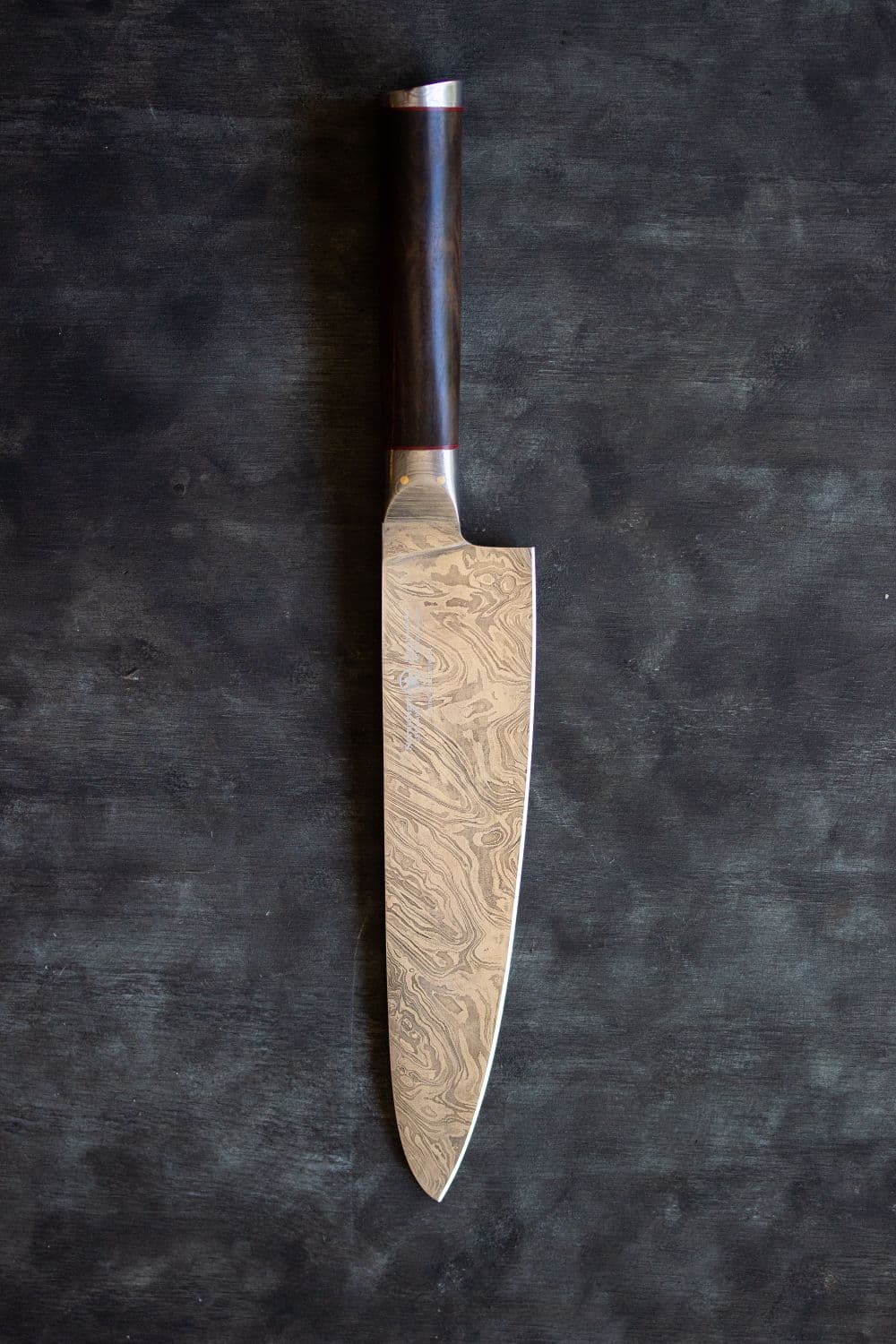
What is SG2 / R2?
SG2 and R2 are the same class of high-carbon stainless steel, made by two Japanese producers — SG2 is Takefu's name, R2 is Kobelco's. For a buyer they're interchangeable: a hard, fine-grained stainless prized for holding a keen edge a long time. You'll often see it clad in a softer stainless jacket (san-mai) or in a damascus pattern, with the SG2/R2 forming the cutting core.
Why powder metallurgy matters
Conventional steel is melted and cast, which can leave larger, uneven carbides in the structure. Powder (particle) metallurgy instead atomises the steel into a fine powder and consolidates it, producing a very even, fine grain. A finer grain can be sharpened to a keener apex and resists the micro-chipping and rounding that dull an edge — which is exactly why SG2 both gets sharp and stays sharp.
SG2 vs VG10
VG10 is the benchmark Japanese stainless; SG2 is the step up. The trade is edge retention vs ease and price.
| SG2 / R2 | VG10 | |
|---|---|---|
| Hardness | ~63–64 HRC | ~60–61 HRC |
| Edge retention | Longer | Very good |
| Ease of sharpening | A little harder | Easy |
| Toughness | Slightly less forgiving | More forgiving |
| Rust resistance | Stainless | Stainless |
| Price | Premium | Value |
Choose SG2 for maximum edge life and a fine edge; choose VG10 for an easier, cheaper stainless that still performs beautifully.
SG2 vs carbon steel
Reactive carbon steels (white and blue) can reach a fraction keener an edge and are often a touch easier to sharpen, but they rust, stain and demand careful drying and patina management. SG2 gives you most of the performance with none of the anxiety — stainless convenience with edge retention that gets close to carbon. For most people that trade is very appealing.
Sharpening & care
Because SG2 is stainless, day-to-day care is easy — wash, dry, no patina to manage. When it finally needs it, sharpen on quality whetstones at a consistent angle; the hard, fine steel rewards clean technique with a superb edge. Between sharpenings, a light strop keeps it keen — but see honing vs sharpening for why you skip the coarse steel rod.
Is SG2 for you?
Yes if
- You want long edge life and stainless convenience
- You'd rather sharpen less often
- You're happy to pay for premium steel
- You keep a consistent sharpening angle
Look at VG10 / carbon if
- You want the easiest steel to sharpen — VG10
- You're on a budget — VG10
- You enjoy a reactive blade and patina — carbon
- You sharpen often and happily anyway
The bottom line
SG2 (R2) is the modern sweet spot: a powder stainless that gets keen, stays keen, and doesn't rust. You pay for it, and it asks a little more when sharpening — but few steels offer this much edge for this little maintenance.
Still deciding on steel in general? Start with VG10 vs Aogami vs Shirogami.
Comparing steels side by side? Our knife steel table puts all 16 in one sortable chart — hardness, edge retention, toughness, rust resistance and how hard each is to sharpen.
Frequently asked questions
What is SG2 / R2 steel?
SG2 and R2 are the same class of high-carbon stainless steel made by powder (particle) metallurgy. 'SG2' is Takefu's name and 'R2' is Kobelco's; in practice they're treated as the same steel. The powder process gives an extremely fine, even grain, which lets the steel take a keen edge and hold it a long time while staying stainless.
Are SG2 and R2 the same thing?
For a buyer's purposes, yes. They're powder stainless steels of essentially the same composition and performance, from two different Japanese producers. You'll see makers use either name; don't overthink the distinction.
SG2 vs VG10 — which is better?
SG2 (R2) is harder (around 63–64 HRC vs VG10's ~60–61), with a finer grain, so it takes a slightly keener edge and holds it noticeably longer. VG10 is easier to sharpen, more forgiving, and cheaper. Choose SG2 if you want maximum edge retention and don't mind paying more and sharpening more carefully; choose VG10 for an easier, budget-friendlier stainless that's still excellent.
Is SG2 stainless or carbon steel?
It's stainless — a high-carbon stainless. You get edge retention approaching a good carbon steel, but with far more rust resistance and low maintenance. It won't develop a patina and doesn't need the wipe-dry vigilance of a reactive carbon knife.
Is SG2 hard to sharpen?
A little harder than VG10 because it's harder steel, but it's very manageable on quality whetstones. Because it holds its edge so long you'll sharpen it less often. The main thing is to keep a consistent angle and use good stones; the very fine grain rewards a clean technique with a superb edge.
Is SG2 worth the extra cost?
If you value long edge retention and stainless convenience together, yes — it's one of the best all-round modern knife steels. If you sharpen often and happily, or you're on a budget, VG10 or a good carbon steel will serve you well for less. It's a premium choice, not a necessary one.
Choosing a knife by its steel?
Compare the steels and types side by side. Our curated shelf opens soon — join the waitlist to hear first.
The steel guide →