
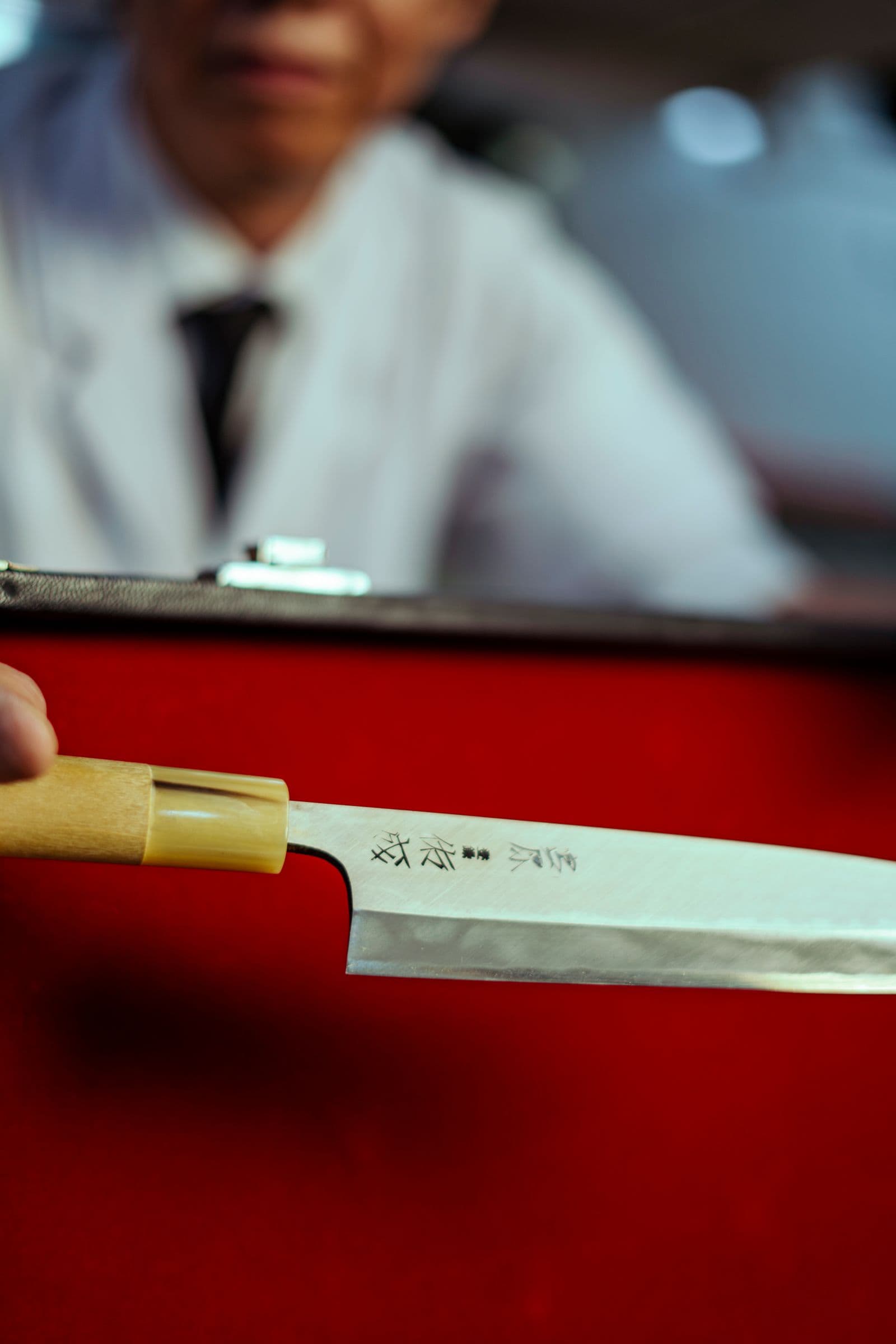
Why the steel matters more than the brand
Two knives with the same shape can feel completely different because of the steel inside them. Steel choice drives four things you actually notice at the board: how keen the edge can get, how long it holds that edge (edge retention), how easy it is to sharpen back, and how much maintenance it needs to avoid rust. Almost every trade-off in Japanese knives comes down to a single tension: keenness and ease of sharpening pull one way, rust resistance and low maintenance pull the other.
VG10, Aogami and Shirogami sit at three points along that line. None is "best" — the right one depends on how you cook and how much fuss you'll tolerate.
VG10 — the low-maintenance stainless
VG10 is a stainless steel made by Takefu Special Steel in Fukui. Its high chromium content (around 15%) is what makes it stainless and rust-resistant, while added vanadium and cobalt give it fine grain and good edge retention for a stainless steel. Hardened to about 60–61 HRC, it's the steel behind hugely popular knives like the Tojiro DP and countless Damascus-clad gyuto.
The appeal is simple: VG10 takes a genuinely sharp edge, keeps it well, and forgives almost everything. You can cut a lemon, leave it a minute, rinse and wipe, and nothing happens. The trade-off is that those wear-resistant carbides make it a touch slower to sharpen to the very finest edge than pure carbon steel, and at high hardness it can be a little less tough. For most people, that's a price worth paying for a knife you never have to worry about.
Aogami (Blue) — carbon that holds its edge
Aogami (青紙, "blue paper" steel, named after the colour of the paper Hitachi wraps it in) is a high-purity carbon steel with a little chromium and tungsten added. Those additions give it better edge retention and toughness than white steel, and a more forgiving heat treat — which is why so many smiths reach for it. Common grades are Aogami #2 and the high-performance Aogami Super (around 64–66 HRC).
Blue steel is the enthusiast's daily carbon: it takes a keener edge than VG10, holds it impressively well, and still sharpens easily. In return it's reactive — it will develop a patina and needs drying after use. If you want carbon-steel performance without the highest-maintenance option, Aogami is the sweet spot.
Shirogami (White) — the keenest, purest edge
Shirogami (白紙, "white paper" steel) is Hitachi's purest carbon steel — essentially iron and carbon with very little else. That purity is exactly why sharpeners love it: with no hard alloy carbides to fight, it takes the sharpest, cleanest edge of the three and is the easiest to bring back on a stone. It's the traditional choice for single-bevel knives and artisan blades. Grades include Shirogami #1 and #2.
The catch is that white steel is the most reactive and least edge-retentive of the three — it patinas quickly, will rust if left wet, and needs touching up a little more often. It rewards a cook who enjoys the ritual of care and sharpening. If that sounds like fuss to you, it isn't your steel; if it sounds like the point, nothing else feels quite the same.
VG10 vs Aogami vs Shirogami: side by side
| VG10 | Aogami 青紙 | Shirogami 白紙 | |
|---|---|---|---|
| Type | Stainless | Carbon (alloyed) | Carbon (pure) |
| Maker | Takefu (VG10) | Hitachi (Blue paper) | Hitachi (White paper) |
| Typical hardness | 60–61 HRC | 62–64 HRC (Super higher) | 61–64 HRC |
| Edge keenness | Very good | Excellent | Exceptional |
| Edge retention | Good (best stainless here) | Excellent (esp. Super) | Moderate |
| Ease of sharpening | Moderate | Easy | Easiest |
| Rust resistance | High — stainless | Low — patinas / can rust | Very low — reacts fastest |
| Maintenance | Wipe & go | Dry promptly, forms patina | Dry at once, oil to store |
| Best for | Low-fuss daily use | Enthusiasts wanting performance | Purists & sharpening lovers |
Head to head: the pairs people compare
Most buyers are not choosing between all three at once — they are weighing two specific steels. Hardness figures below are the ranges commonly seen on kitchen knives; the exact number depends on each maker's heat treatment.
Aogami vs Shirogami (blue vs white)
Both are Hitachi carbon steels and both rust. The difference is what is added: Shirogami is nearly pure iron and carbon, while Aogami is essentially white steel with chromium and tungsten added.
- Edge retention: Aogami holds an edge longer; Shirogami needs touching up more often.
- Sharpening: Shirogami is the easier and quicker of the two to bring to a very fine edge.
- Rust: both need drying straight away; the small chromium content in Aogami does not make it stainless.
- Choose Aogami for a carbon daily knife; choose Shirogami if you sharpen often and want the keenest feel. Details by grade: Shirogami #1, #2 and #3.
VG10 vs Shirogami
This is the widest gap of the three pairs: an easy-care stainless against the most reactive carbon steel.
- Care: VG10 tolerates being left wet; Shirogami can spot with rust in minutes if left wet.
- Hardness: VG10 is typically 60–61 HRC; Shirogami #2 is typically 61–63 and #1 slightly higher.
- Sharpening: Shirogami is much easier to sharpen to a very fine edge; VG10 is slower on the stone.
- Choose VG10 unless you specifically want a traditional carbon edge and will dry the blade every time. Single-bevel traditional knives are more often made in Shirogami.
VG10 vs Aogami #2 and Aogami Super
- VG10 vs Aogami #2: Aogami #2 (typically 61–63 HRC) takes a keener edge and sharpens more easily; VG10 is stainless and needs almost no care. Edge retention in home use is broadly similar, with the edge going to Aogami #2 at equal geometry.
- VG10 vs Aogami Super: Aogami Super (typically 64–66 HRC) holds an edge noticeably longer than VG10 and takes a finer edge, but it is carbon steel, so it rusts, and at that hardness it is less tolerant of twisting or hitting bone. See the Aogami Super guide.
- Want Aogami performance without the rust? Choose Aogami clad in stainless (san mai) — only the edge reacts — or a harder stainless such as SG2 / R2.
Aogami #2 vs Aogami Super
Aogami Super adds more carbon, chromium and tungsten, plus molybdenum and vanadium, and is usually run harder. The result is longer edge retention in exchange for slightly slower sharpening and a less forgiving edge. Aogami #2 is the more balanced, tougher everyday choice; Super suits cooks who sharpen well and want the edge to last.
| Pair | Holds an edge longer | Easier to sharpen | Easier care |
|---|---|---|---|
| Aogami vs Shirogami | Aogami | Shirogami | Similar (both carbon) |
| VG10 vs Shirogami | Broadly similar | Shirogami | VG10 |
| VG10 vs Aogami #2 | Aogami #2 (slightly) | Aogami #2 | VG10 |
| VG10 vs Aogami Super | Aogami Super | Similar | VG10 |
| Aogami #2 vs Super | Aogami Super | Aogami #2 | Similar (both carbon) |
Stainless vs carbon: the real difference
On paper the performance gaps look dramatic. In a home kitchen they're smaller than the internet suggests — a well-made VG10 knife is plenty sharp for anything you'll cook. The difference you'll actually live with is care:
- Stainless (VG10) — wash it, wipe it, put it away. It tolerates being left wet or cutting acidic food without complaint. The knife you don't think about.
- Carbon (Aogami / Shirogami) — dry it right after use, every time. It will darken into a patina (normal and protective — see caring for a carbon-steel knife), and it rewards you with a keener edge that's quicker to restore. The knife you build a small relationship with.
There's also a clever middle path: san-mai (三枚) construction, where a hard carbon core is clad in stainless on both sides. Only the thin edge is reactive, so you get carbon-steel cutting with far less of the rust worry — a great way to try carbon without fully committing.
Which steel should you choose?
Choose VG10 (stainless) if
- You want a knife you never have to baby
- You're new to Japanese knives, or buying a gift
- Your kitchen is humid, or the knife may sit wet sometimes
- You'd rather cook than maintain gear
Choose carbon (Aogami / Shirogami) if
- You want the keenest edge and don't mind the care
- You'll dry the blade after every use, reliably
- You enjoy sharpening — or want to learn
- You like that a carbon blade ages and patinas with use
And within carbon: pick Aogami if you want the easier daily driver that holds its edge longest, or Shirogami if outright sharpness and effortless resharpening matter more than retention. If you're carbon-curious but nervous about rust, start with a stainless-clad (san-mai) blue-steel knife.
What about other steels you'll see?
These three are the classics, but a few more names come up often: SG2 / R2 (a powdered stainless that holds an edge like carbon — low care, high retention, harder to sharpen), Ginsan (Silver 3) (a stainless that sharpens almost like white steel — a lovely low-maintenance upgrade), and plain Damascus, which is usually just a decorative cladding wrapped around a VG10 or SG2 core rather than a steel of its own. The same trade-off always applies: chase keenness and ease of sharpening, or chase low maintenance — no single steel maxes out both.
The bottom line
Match the steel to your patience, not to a spec sheet. Want zero fuss? VG10. Want the finest edge and enjoy the care? Carbon — Aogami to hold it, Shirogami to chase it.
A great knife in any of these steels, kept sharp and kept dry, will outlast the debate. The steel just decides how you and the knife get along in the meantime — so choose the relationship you actually want.
Comparing steels side by side? Our knife steel table puts all 16 in one sortable chart — hardness, edge retention, toughness, rust resistance and how hard each is to sharpen.
Frequently asked questions
Is carbon steel better than stainless for a kitchen knife?
Not better — different. Carbon steels like Aogami and Shirogami take a slightly keener edge and are easier to sharpen, but they react with food and water, so they patina and can rust without care. Stainless like VG10 gives up a fraction of that keenness in exchange for being almost maintenance-free. For most home cooks the practical performance gap is small; the maintenance gap is what you'll actually feel day to day.
Will an Aogami or Shirogami knife rust?
It can if you neglect it. Carbon steel reacts with moisture and acids, so a wet blade left on the board will spot. In normal use it instead forms a thin grey-blue patina — a protective oxide layer that's completely normal and actually helps resist deeper rust. The rule is simple: wipe the blade dry after each use, never leave it wet or in the sink, and it will be fine for decades.
What is Aogami Super?
Aogami Super (青紙スーパー) is the highest-performing grade of Hitachi's blue paper steel, with more carbon and added alloying (chromium, tungsten, a little vanadium and molybdenum). Hardened to roughly 63–64 HRC, it holds a keen edge exceptionally well for a carbon steel while still being pleasant to sharpen. It's a favourite for high-end gyuto where edge retention matters.
Which steel is easiest to sharpen?
Shirogami (white) is the easiest — it's a very pure carbon steel with no hard alloy carbides to fight, so it comes back to a screaming edge with minimal effort. Aogami (blue) is close behind. VG10 is the most stubborn of the three: its vanadium carbides give great wear resistance but make it a little slower to raise a burr, especially on natural or low-grit stones.
Do I need to oil a carbon-steel knife?
For daily use, no — drying it after every wash is what matters. Oil comes in for storage: if a carbon knife won't be used for a while, a thin wipe of food-safe camellia (tsubaki) or mineral oil keeps rust off the bare steel. Stainless knives like VG10 don't need oiling at all.
Is Aogami Super better than VG10?
It holds an edge longer and takes a finer edge — Aogami Super is typically hardened to about 64–66 HRC against VG10's 60–61. But it is carbon steel, so it rusts and must be dried at once, and at that hardness it is less forgiving of twisting or hitting bone. For low-maintenance daily use VG10 is the better fit; for maximum edge life with careful handling, Aogami Super.
What's the difference between blue (Aogami) and white (Shirogami) steel?
Both are high-purity carbon steels from Hitachi. White steel is the purer of the two and takes the keenest, easiest-to-sharpen edge, but loses its edge a little sooner and is the most reactive. Blue steel adds chromium and tungsten, which give better edge retention and toughness and a slightly more forgiving heat treat, at the cost of being marginally harder to sharpen. Blue is the easier daily carbon steel; white is the sharpener's favourite.
Find a knife in the steel that suits you
Our shelf will be tight and curated, with stainless and carbon labelled clearly. It opens soon — join the waitlist.
Explore the shelf →