
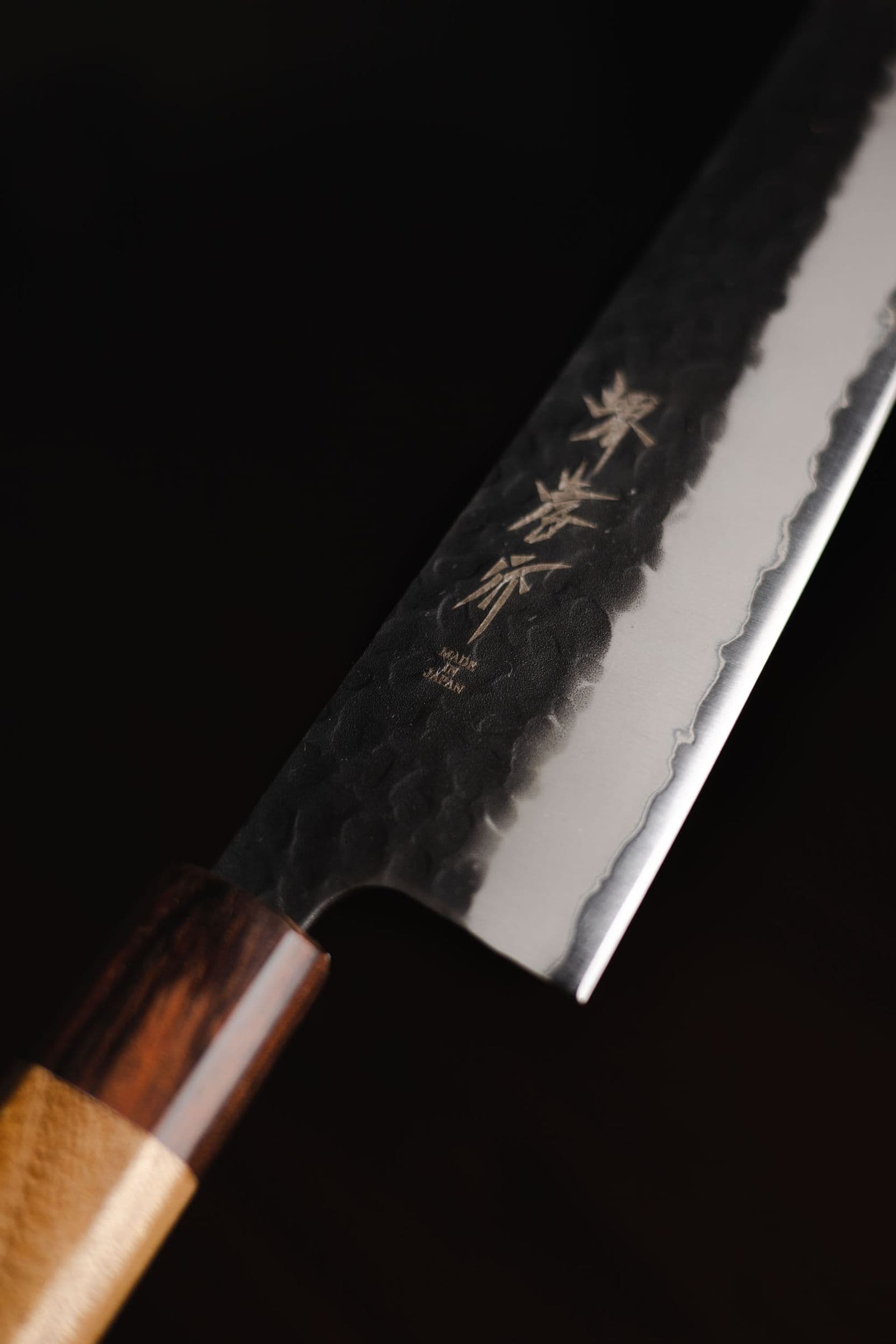
Why carbon steel needs a little care
Carbon steels like Aogami and Shirogami are prized because they're nearly pure iron and carbon — that purity is what lets them take such a keen, easily-restored edge. The same purity means there's little chromium to resist corrosion, so the steel reacts with water, air and acids. Left wet, it spots; used and dried, it forms a protective patina. None of this is fragility — it's just chemistry you work with rather than against.
The daily routine (the whole thing)
This is the entire habit, and it takes about ten seconds:
- Wipe as you cook. During long prep, a quick wipe with a damp cloth keeps reactive juices off the blade.
- Hand-wash with warm water and a little dish soap. No soaking, no leaving it in the sink under other dishes.
- Dry it immediately and completely with a towel — both sides, spine and tip. Don't let it air-dry; that's exactly when spots form.
- Put it away dry. Never the dishwasher — heat, detergent and knocks will corrode the edge and can crack the handle.
That's it. Everything below is just understanding what you'll see, and the occasional deeper step.
Patina: the knife's natural armour
Within a few uses, a carbon blade starts to change colour — first a faint blue-grey, then a mottled grey over months. This is patina: a thin, stable layer of oxide that forms as the steel reacts with food. It's completely normal, it's unique to your knife and how you cook, and crucially it protects the steel underneath from deeper rust. Don't scrub it off. A well-patinated carbon knife is a well-loved one.
If you'd rather not wait, you can force a patina on a new knife — wipe it clean, then leave it coated in hot vinegar, mustard or a cut onion for a few minutes, rinse and dry. It gives an even grey finish quickly and tames the metallic edge that raw carbon steel can leave on the first few foods. It's optional; nature does the same job for free.
Patina vs rust: how to tell the difference
| Patina (good) | Rust (act on it) | |
|---|---|---|
| Colour | Grey, blue-grey, purplish | Orange, red-brown |
| Texture | Smooth, flat, bonded | Rough, flaky, raised |
| What it is | Stable protective oxide | Active corrosion, eats the steel |
| What to do | Nothing — leave it | Remove it, then dry & oil |
Dealing with rust
Caught early, rust is a two-minute fix. For light orange spots, use a rubber rust eraser, or make a paste from a mild abrasive cleanser like Bar Keepers Friend (a wine cork dipped in cleanser works as an applicator) and rub gently along the blade until the spot lifts. Rinse, then dry thoroughly and wipe on a little oil. If rust has been left long enough to pit the steel, you can stop it spreading the same way, but the pit itself is permanent — which is exactly why the dry-it-now habit matters.
Food, acids and that metallic taste
Acidic ingredients — onions, citrus, tomatoes, stone fruit — react fastest. On a new carbon knife they can discolour the blade in seconds and leave a faint metallic taste on the food. It's harmless and temporary. To manage it:
- Wipe the blade during long acidic prep, and cut acidic ingredients last.
- Dry the knife straight after, as always.
- Let a patina establish — or force one — and the reactivity and off-taste largely disappear.
Storing a carbon knife
For everyday storage, dry is enough: a knife strip, a block slot, or a blade guard (saya) all work, as long as the knife goes away completely dry. For longer breaks — a knife you won't use for weeks — add a thin wipe of food-safe camellia (tsubaki) oil or mineral oil over the whole blade first. One rule above all: never seal a damp blade into a tight wooden saya or a drawer — trapped moisture is how the worst rust starts.
Do & don't
Do green lights
- Dry the blade fully after every wash
- Let the patina build and leave it be
- Wipe during acidic prep; cut acids last
- Oil the blade before long storage
Don't red flags
- Dishwasher, sink-soaking, or air-drying
- Scrubbing off a healthy patina
- Leaving the knife wet "for later"
- Sealing a damp blade in a saya or drawer
The bottom line
Dry it now, every time. Welcome the grey patina, act on orange rust, and oil it before a long rest. That's carbon-steel care — one habit, not a hobby.
A carbon knife rewards a few seconds of attention with an edge and a character no stainless quite matches. And if the routine isn't for you, that's useful to know too — a stainless knife will be perfectly happy with far less. See VG10 vs Aogami vs Shirogami to weigh it up.
Frequently asked questions
Is patina on a carbon-steel knife bad?
No — patina is good and normal. It's a thin grey-blue layer of stable oxide that forms as carbon steel reacts with food, and it actually protects the blade from deeper rust. Leave it alone. The thing to prevent is orange-red rust, which is flaky and corrosive. In short: grey/blue patina = healthy; orange/red rust = act on it.
How do I remove rust from a carbon knife?
For light orange spots, make a paste of a mild abrasive cleanser (such as Bar Keepers Friend) or use a rubber rust eraser, and rub gently along the blade until the spot lifts. A wine cork dipped in cleanser works too. Rinse, dry immediately and thoroughly, and consider a wipe of oil afterwards. Catch rust early and it's a two-minute fix; leave it and it pits the steel.
Can I force a patina on a new carbon knife?
Yes, and many people do to get ahead of rust and tame the metallic taste new carbon steel can leave. A common method is to wipe the clean blade, then leave it coated in something acidic — hot vinegar, mustard, or a cut onion — for a few minutes, rinse and dry. It gives an even grey patina quickly. It's optional, though: a patina forms naturally with normal use anyway.
Will acidic food like lemon or onion ruin a carbon knife?
It won't ruin it, but acids react fast and will discolour the blade and, on very new steel, can leave a brief metallic taste on the food. The fix is simple: wipe the blade during long acidic prep, cut acidic ingredients last, and dry the knife straight after. Once a stable patina has formed, the reactivity and any off-taste settle down.
Do I need to oil a carbon knife after every use?
No. Day to day, drying the blade after washing is what matters. Oil is for storage: if the knife won't be used for a while, a thin wipe of food-safe camellia (tsubaki) or mineral oil keeps rust off the bare steel. Wiping a little oil on before bed is a nice habit in a humid kitchen, but it isn't required after every use.
Is a carbon-steel knife worth the extra care?
If you enjoy the ritual, yes — carbon steel takes a keener edge, sharpens more easily, and ages with character. If drying a blade every time sounds like a chore, a stainless knife (like VG10) gives you most of the performance with none of the worry. It's a genuine preference, not a question of one being better.
Thinking about a carbon-steel knife?
Our curated shelf — carbon and stainless, labelled clearly — opens soon. Join the waitlist to hear first.
Explore the shelf →