
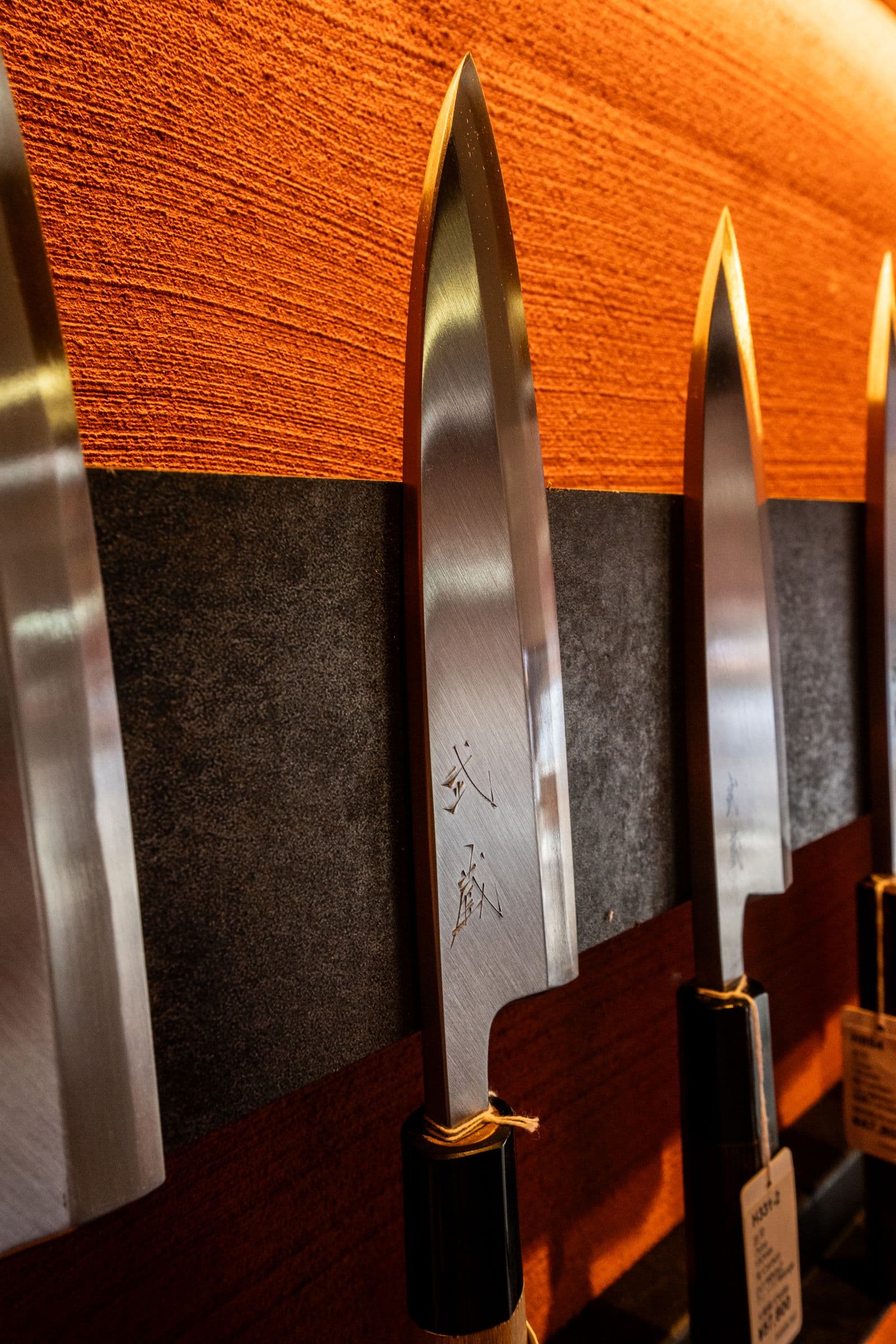
The difference is in the edge
Look at a knife end-on and the difference is obvious. A double bevel tapers in equally from both faces to a centred apex — a symmetric wedge. A single bevel has one flat face (the ura, usually with a subtle hollow) and all the grinding on the other side, so the apex sits to one side. That asymmetry is the source of every difference that follows.
Double bevel (両刃) — the everyday edge
Because it's symmetric, a double-bevel knife tracks straight through food, feels natural to anyone used to a Western knife, and works the same in either hand. It's also the easiest to sharpen: hold about 15° per side, do both sides, done (see how to sharpen on a whetstone). Nearly every knife you'll cook with — gyuto, santoku, petty, bunka, nakiri — is double bevel. Modern Japanese double-bevels are often ground slightly asymmetric (say 70/30) for extra keenness, but they still handle and sharpen like a symmetric edge.
Single bevel (片刃) — the specialist's edge
Grinding only one side lets a knife take an incredibly acute, thin edge and make cuts of astonishing cleanliness — which is why traditional Japanese cuisine relies on single bevels for its most precise work. The flat back has a shallow hollow (urasuki) that reduces friction and helps food fall away from the blade. The trade-offs are real: a single bevel steers (pulls toward its flat side) until your technique compensates, it's handed so you must buy for your dominant hand, and sharpening means working the bevel while barely touching the back — a different skill from a double bevel.
The classic single-bevel knives, each built for one job:
- Yanagiba (柳刃) — a long, slender slicer for sashimi and raw fish, in one clean pull.
- Deba (出刃) — a thick, heavy knife for breaking down whole fish and light bone work.
- Usuba (薄刃) — a tall, flat vegetable knife for precise work like katsuramuki rotary peeling.
Single vs double bevel: side by side
| Double bevel 両刃 | Single bevel 片刃 | |
|---|---|---|
| Ground on | Both sides (symmetric V) | One side; flat, hollowed back |
| Cutting feel | Tracks straight | Steers until mastered |
| Handedness | Either hand | Right- or left-specific |
| Learning curve | Easy, intuitive | Steeper — needs practice |
| Sharpening | ~15° both sides | Bevel + light back (uraoshi) |
| Best for | All-round everyday cooking | Sashimi, fish, precise veg work |
| Examples | Gyuto, santoku, petty, nakiri | Yanagiba, deba, usuba |
Which should you choose?
Choose double bevel if
- You want one versatile, everyday knife
- You're buying your first Japanese knife
- You want it easy to use and to sharpen
- More than one person will use it
Choose single bevel if
- You slice raw fish or sashimi, or break down whole fish
- You want the cleanest possible traditional cuts
- You're ready to learn its technique and sharpening
- You'll buy it for your dominant hand
For almost everyone, the answer is double bevel — it's the whole everyday toolkit. Treat a single bevel as a considered second (or third) knife, bought for a specific craft you want to pursue. If you're still choosing your main knife, start with the best Japanese knife for beginners.
How to tell which one you have
Hold it edge-down, tip pointing away
Good light, and look at the blade just above the edge on each side in turn.
Look for a wide face ending in a ridge
A double-bevel knife shows a narrow sharpened band on both sides. A single-bevel knife shows one wide ground face ending in a crisp ridge line — the shinogi — on one side only.
Check the other side
On a single-bevel knife it is flat, usually with a very shallow hollow ground into it (the urasuki).
Note which side the wide face is on
With the tip pointing away from you, a wide face on the right means a right-handed knife; on the left, left-handed.
One trap: some Western-market knives are sold as "single bevel style" but are really an asymmetric double bevel, ground something like 70/30. If you can see even a small sharpened band on the "flat" side, it is a double bevel. The labelled diagram in the anatomy guide shows where each of these parts sits.
The bottom line
Symmetric and forgiving, or asymmetric and specialised. Double bevel is the knife you cook with; single bevel is the knife you graduate to for one thing done perfectly.
Neither is more "authentic" than the other — Japan makes and uses both, brilliantly. Match the edge to the job and your patience, and you'll enjoy whichever you pick.
Want the parts rather than the words? The knife anatomy guide has a labelled diagram of every part of the blade and handle, in Japanese and English.
Frequently asked questions
What's the difference between a single-bevel and double-bevel knife?
A double-bevel knife is sharpened on both sides into a symmetric V, like a Western knife — it cuts straight, works in either hand, and is easy to sharpen. A single-bevel knife is ground on one side only; the other side is flat with a slight hollow, so it takes an extremely thin, acute edge and releases food cleanly, but it's handed, steers in the cut until you learn it, and is trickier to sharpen.
Should a beginner buy a single-bevel knife?
Usually not as a first knife. Single-bevel knives are specialist tools that reward practice — they pull to one side until your technique adjusts, and they demand a specific sharpening routine. Start with a double-bevel gyuto or santoku, and add a single-bevel knife later if you take up tasks like slicing sashimi or breaking down whole fish.
Are gyuto and santoku single or double bevel?
Double bevel. The gyuto, santoku, petty, bunka and nakiri you'll see for everyday cooking are almost always double-bevel knives, sharpened on both sides. Single-bevel construction is reserved mainly for traditional Japanese knives like the yanagiba, deba and usuba.
What are yanagiba, deba and usuba knives?
They're the classic single-bevel Japanese knives. A yanagiba is a long, slender slicer for sashimi and raw fish; a deba is a thick, heavy knife for breaking down whole fish; and an usuba is a tall, flat vegetable knife used for precise work like katsuramuki (rotary peeling). Each is single-bevel to cut exceptionally thin and clean.
Can left-handed cooks use single-bevel knives?
Yes, but you need a left-handed version, because a single bevel is ground for a specific hand. Left-handed single-bevel knives exist but are rarer and often cost more, sometimes made to order. Double-bevel knives, by contrast, work equally well in either hand.
Is a single-bevel knife sharper than a double-bevel one?
It can take a more acute edge and, for its specific jobs — slicing raw fish paper-thin, clean single-direction cuts — nothing double-bevel quite matches it. But 'sharper' depends on the task. For general cooking a well-sharpened double-bevel knife is keen, versatile and far easier to live with. Single-bevel is about precision in a narrow lane, not all-round superiority.
How can I tell if my knife is single or double bevel?
Hold it edge-down and look at both faces just above the edge. A double-bevel knife shows a narrow sharpened band on both sides. A single-bevel knife shows one wide ground face ending in a clear ridge line (the shinogi) on one side, and a flat side — usually with a shallow hollow — on the other. If the wide face is on the right when the tip points away from you, it is a right-handed knife.
Which side is the bevel on a left-handed single-bevel knife?
The left. A left-handed single-bevel knife is a mirror image of the right-handed one: hold it edge-down with the tip pointing away and the wide bevel face is on the left, with the flat, hollowed back facing right. It has to be made that way — you cannot turn a right-handed knife into a left-handed one by sharpening.
Why is a single-bevel knife harder to sharpen?
Three things have to stay right at once: the wide bevel must be held flat on the stone at a consistent angle, the ridge line (shinogi) must stay straight, and the back is treated differently — only a few light strokes to remove the burr, never a full grind, or the hollow in the back is destroyed. A double-bevel knife asks for none of that.
Why do some Japanese knives only have a single bevel?
Because traditional Japanese cooking values the cut itself. A single bevel can be ground to a very acute edge, and the flat back lets a slice fall away cleanly and lets the knife track straight along a fish's backbone or peel a vegetable into a continuous sheet. Those are the jobs single-bevel knives such as the yanagiba, deba and usuba were developed for.
Find the right edge for your cooking
Our curated shelf — double-bevel everyday blades and traditional single-bevels alike — opens soon. Join the waitlist.
Explore the shelf →