
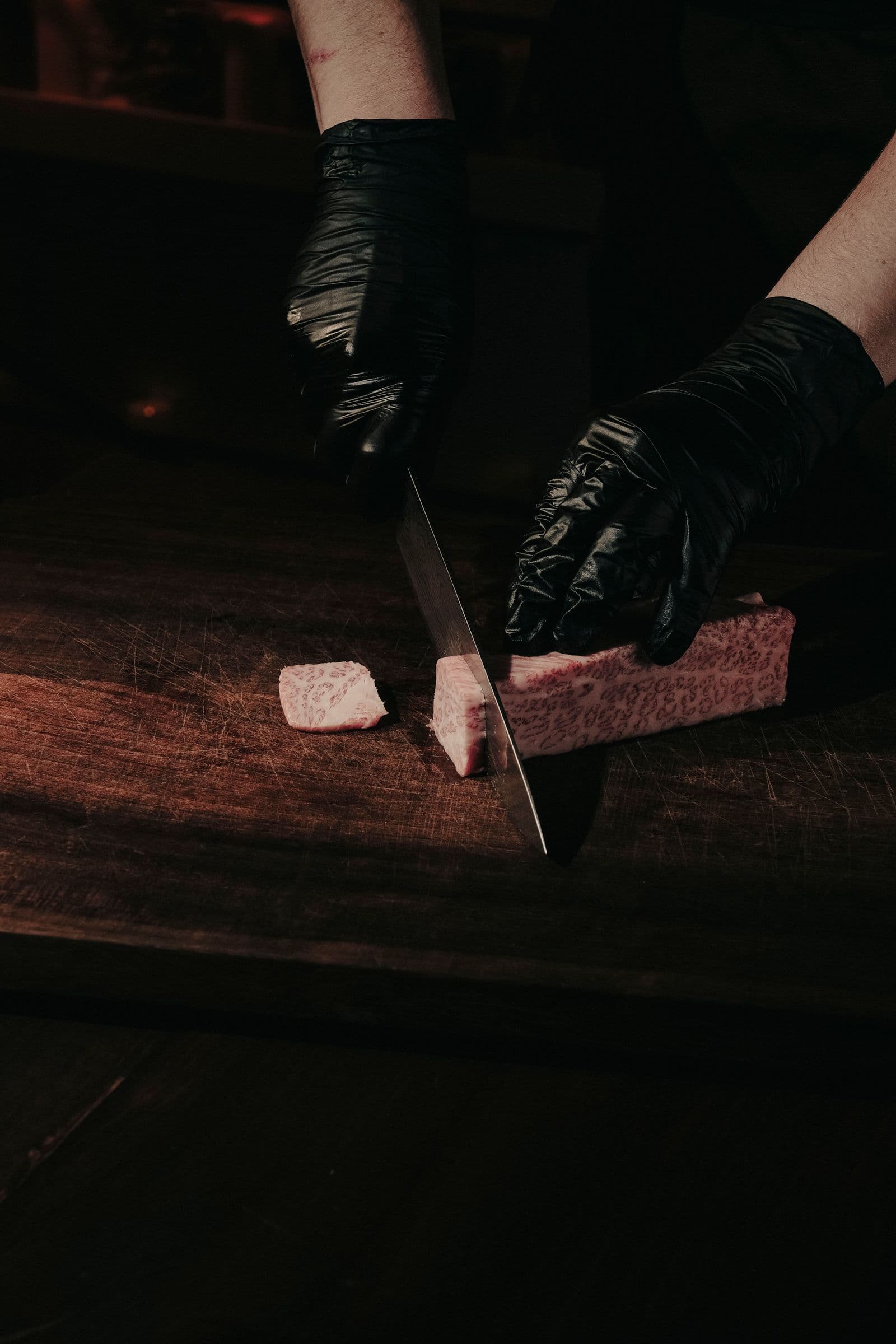
What is a petty?
Petty comes from the French petit — it's the Japanese take on a small Western utility knife. Sitting between a paring knife and a chef's knife at roughly 120–150 mm, it has a pointed tip, a thin, nimble blade and enough length to work comfortably on a cutting board as well as in your hand.
Like the gyuto and santoku, it's a double-bevel knife, so it cuts and sharpens with no special technique. Think of it as a small, agile chef's knife for the jobs where a big blade feels like overkill.
What it's for
The petty shines wherever precision beats power: peeling and trimming, slicing garlic and shallots, prepping small fruit and vegetables, hulling strawberries, segmenting citrus, deveining, and any fiddly task that wants a pointed tip and close control. On a board it slices smaller produce cleanly; in the hand it does the delicate work your gyuto is simply too big for.
The useful way to think about it is by grip rather than by ingredient. A petty is the only knife in a Japanese kit designed to work well in both hands-off board mode and hands-on in-air mode, and the tasks below split neatly along that line.
| Task | How you hold it | Why the petty wins |
|---|---|---|
| Peeling apples, ginger | In the hand | Short enough to control against your thumb, long enough not to feel cramped |
| Hulling strawberries, coring | In the hand | The pointed tip digs in and lifts cleanly |
| Segmenting citrus | In the hand | Thin blade follows the membrane instead of tearing it |
| Garlic, shallots, chillies | On the board | Small enough to work in a tight area without knocking things over |
| Trimming fat and sinew | On the board | Tip work a big knife cannot do without lifting the whole blade |
| Cheese, cured meat, sandwiches | On the board | Thin grind releases instead of dragging |
| Deveining prawns | In the hand | Fine tip, no need to reach for a paring knife |
What size to buy (120–180 mm)
Size is the decision that actually matters, and the range is wider than most listings suggest. Petties are sold from about 120 mm to 180 mm, and the character changes completely across that span: at the short end it is a hand tool, at the long end it is a small chef's knife. Pick by which of those two jobs you actually need, not by which sounds more useful.
| Length | Character | Buy it if | The trade-off |
|---|---|---|---|
| 120 mm | A large paring knife | You mostly peel, core and trim in your hand | Cramped on a board; too short for a shallot in one pass |
| 135 mm | The in-between | You want in-hand control but occasional board use | Less common, so less choice of maker and steel |
| 150 mm | The default petty | You want one small knife that does everything | Slightly big for delicate in-hand peeling |
| 180 mm | Effectively a mini gyuto | You cook in a small kitchen and want a compact main knife | No longer a precision tool; overlaps a real gyuto |
If you only take one number away: 150 mm. It is the size most people end up keeping, because it is the only one that is genuinely comfortable both in the hand and on the board. Go 120 mm only if you already own a chef's knife you like and want a pure detail tool.
Note that Japanese knives are specified in millimetres while Western listings often use inches, so the same knife may appear as a "6-inch utility" or a "150 mm petty". Our size guide has the conversions and what each length suits.
Petty vs paring vs utility
Three names, one crowded slot in the drawer — and the confusion is genuine, because a petty overlaps both. The short version: a paring knife is shorter (about 75–100 mm) and lives in your hand; a Western utility knife is a similar length to a petty but thicker and blunter in grind; a petty is a thin, precise blade that covers both jobs properly.
| Petty | Paring | Western utility | |
|---|---|---|---|
| Length | 120–180 mm | 75–100 mm | 120–150 mm |
| Grind | Thin, flat, precise | Thin but short | Thicker, sometimes serrated |
| Used | In hand and on a board | Mostly in the hand | On a board |
| Best at | Small produce, trimming, detail board work | Peeling, coring, tiny tasks | Rough in-between jobs, sandwiches |
| Doubles as a mini chef? | Yes, at 150–180 mm | No | Not really — too thick |
| Typical hardness | Hard (60+ HRC common) | Varies | Softer, tougher |
| Bevel | Double | Double | Double |
If you already own a Western utility knife and rarely reach for it, that is the normal experience — it is thick enough to crush a tomato skin rather than part it. The thin grind is the whole reason a petty gets used instead. For the paring comparison in more depth, including when a paring knife is genuinely the better buy, see paring vs petty.
What to look for when buying
Steel: choose stainless unless you have a reason not to. A petty spends its working life on exactly the jobs that punish carbon steel — citrus, tomatoes, apples, onions — and it tends to get left on the board between tasks rather than washed and dried like a main knife. VG10 or Ginsan give you a hard, keen edge without that anxiety. A carbon petty is a lovely thing, but expect a patina within days.
Grind matters more than the steel name. The single quality that separates a good petty from a bad one is how thin it is behind the edge. A petty that is thick there behaves like the utility knife you were trying to escape. You cannot read this from a spec sheet — but you can from the price and the maker's reputation for grinding, which is why cheap stamped petties disappoint even when the steel is nominally fine.
Handle: pick by feel, not by rule. On a knife this small the wa versus yo question matters less than on a gyuto. A light wooden wa handle keeps the balance forward and nimble; a riveted Western handle gives a more secure grip with wet hands. Neither is wrong.
What a petty is bad at
Being honest about the limits is what stops it becoming the wrong purchase. A petty is a precision tool, not a small do-everything knife.
- Large, dense vegetables. Squash, cabbage, swede — the blade is too short to reach through and too thin to take the wedging force. That is a gyuto or nakiri job.
- Anything with bone. A thin, hard petty chips. Poultry joints are a honesuki's job; fish is a deba's.
- Volume prep. Dicing onions for a stockpot with a 150 mm blade is slow and tiring. Reach for the big knife.
- Being your only knife. It can be done in a very small kitchen, but you will feel the ceiling within a week.
The classic second knife
A petty comes into its own alongside a main knife. Your gyuto or santoku powers through the big work; the petty handles everything small and precise. That one-big-one-small pairing covers the vast majority of home cooking, which is exactly why the petty is the most common next buy after a chef's knife — and often a better choice than a third large knife. If you cook a lot of vegetables, a nakiri makes a great third. If you are still choosing your first knife rather than your second, start with the beginner guide instead — a petty is the wrong place to begin.
The bottom line
One big knife, one small knife. A gyuto or santoku for the heavy lifting and a petty for everything precise — that pairing will out-cook a whole block of knives.
The petty isn't glamorous, but it's the knife you'll reach for a dozen times a day. Add one to a good chef's knife and your kitchen suddenly feels complete.
Frequently asked questions
What is a petty knife used for?
A petty is a small utility knife — think of it as a large paring knife or a mini chef's knife. It handles the jobs a big knife is too clumsy for: peeling and trimming, slicing garlic and shallots, prepping small fruit and vegetables, deveining, segmenting citrus, and any fiddly detail work that needs a pointed tip. It works both in your hand and on a board.
Petty vs paring knife — what's the difference?
A paring knife is short (about 75–100 mm) and used mostly in the hand for tiny tasks. A petty is longer (120–150 mm), so it does everything a paring knife does but also works comfortably on a cutting board like a small chef's knife. If you want one small knife that's more versatile than a paring knife, the petty is it.
What size petty should I get?
120 mm is the nimble, in-hand favourite for peeling and detail work; 150 mm is more versatile and doubles as a small chef's knife for board work on smaller produce. If you want it mainly for delicate tasks, go 120 mm; if you want it to pull double duty as a compact all-rounder, go 150 mm.
Is a petty a good second knife?
It's the classic second knife. A gyuto or santoku handles the big jobs; a petty covers everything small and precise that a large blade does clumsily. That two-knife pairing — one big, one small — covers the vast majority of home cooking, which is why so many cooks reach for a petty as their next purchase after a chef's knife.
Can a petty be my only knife?
It can if you cook mostly small tasks or have a tiny kitchen, but it's limited: a petty struggles with large vegetables like squash and cabbage, and with anything that needs a long blade. For one do-everything knife, a gyuto or santoku is a better main; keep the petty as the nimble specialist alongside it.
Is a petty single or double bevel?
Double bevel, like a Western knife — sharpened on both sides, easy to use in either hand and easy to sharpen. That makes it an approachable, low-fuss knife to add to your kit.
Is a petty knife the same as a utility knife?
They occupy the same slot in the kitchen, but they are not built the same. A Western utility knife is usually thicker, often has a slight belly or even a serrated edge, and is treated as a rough-and-ready in-between knife. A petty is ground thin, kept flat and precise, and is closer to a shrunken chef's knife. If you have used a utility knife and found it clumsy, that thinness is exactly what a petty fixes.
What does petty mean, and what is it called in Japanese?
The name comes from the French petit, meaning small. In Japanese it is written ペティナイフ (petinaifu) — a loanword, not a traditional Japanese term, because the knife itself is Japan's adaptation of a Western small utility knife rather than a traditional wa-bocho shape like a deba or usuba.
Should a petty have a wa handle or a yo handle?
Either works, and on a knife this small the difference is smaller than on a gyuto. A light wooden wa handle keeps the knife blade-forward and nimble, which suits in-hand work; a riveted Western yo handle adds a little weight and a more secure grip when your hands are wet. Pick by feel, not by rule — and if you already own a wa-handled main knife, matching it makes the pair feel consistent.
Stainless or carbon for a petty?
Stainless, for most people. A petty spends its life on acidic jobs — citrus, tomatoes, apples, onions — and often gets left on the board between tasks, which is exactly the treatment that stains and rusts carbon steel fastest. If you want a carbon petty for the keener edge, expect a patina within days and dry it immediately after every use.
Rounding out your knife kit?
Our curated shelf — gyuto, santoku, nakiri, petty and more — opens soon. Join the waitlist to hear first.
Explore the shelf →