
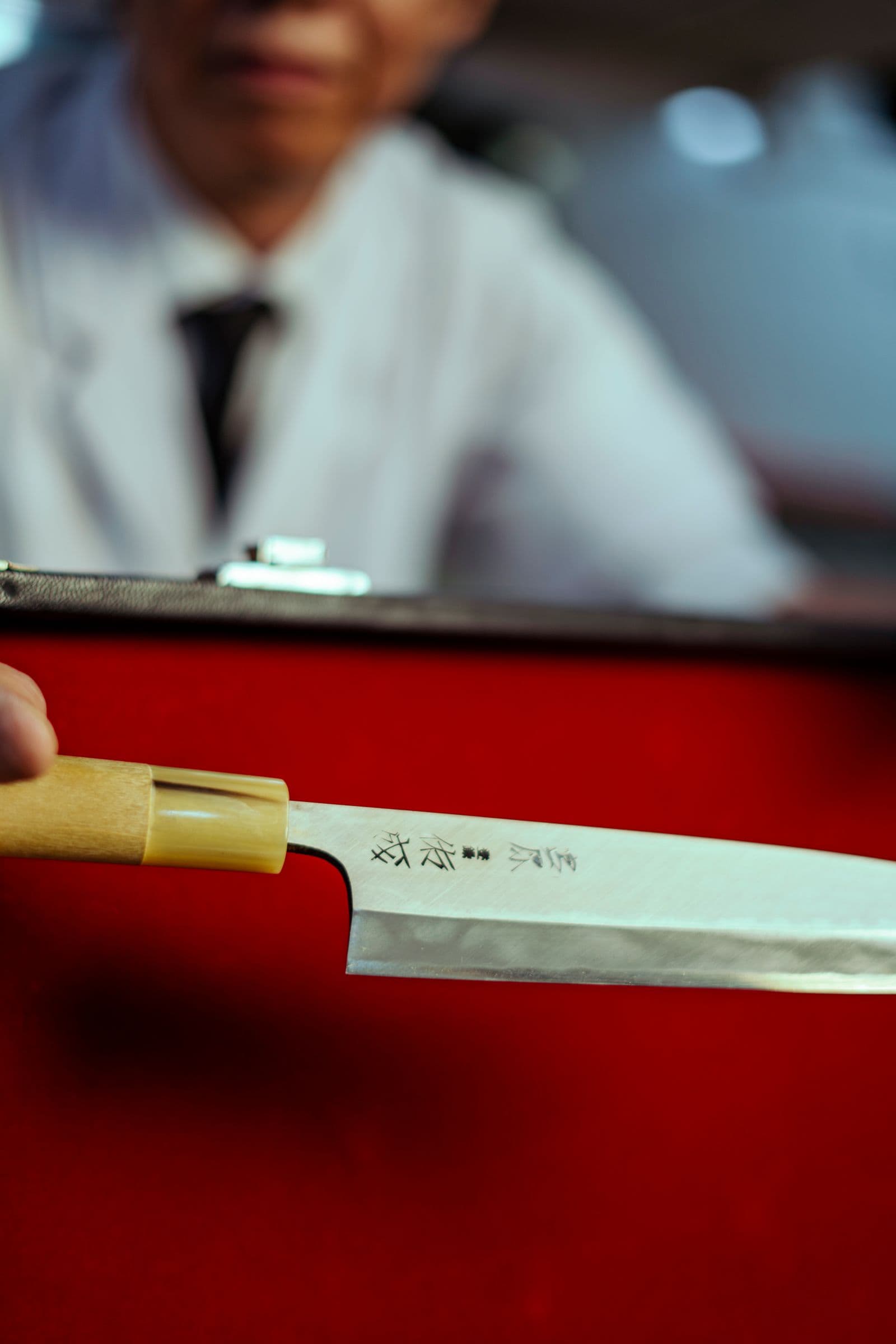
Six centuries in one city
Sakai's relationship with iron is older than its knives. The city sits beside the enormous kofun burial mounds of the 5th century, and the tools used to build them were made locally — that is where the region's metalworking story usually begins.
The knives came much later. In the 16th century Portuguese traders introduced tobacco to Japan, and Sakai's smiths began making the specialised knives used to shred tobacco leaf. They were good enough that the Tokugawa shogunate granted Sakai an official quality seal and exclusive rights to sell them — a government-backed guarantee of quality, several hundred years before anyone called it branding. That reputation is what turned a port city into a cutlery centre.
During the Edo period, as Japanese cuisine formalised, Sakai's smiths developed the knives that cooking needed: the heavy deba for breaking down fish, the long yanagiba for slicing it, and the usuba for vegetables. Those three shapes are still the professional Japanese kitchen's core set, and they are still what Sakai is known for.
Bungyo: three hands, one blade
This is the part that genuinely separates Sakai from every other region. A Sakai knife is not made by one person. It passes through a chain of independent specialists, a system called bungyo (分業):
- The blacksmith (kaji) forge-welds the hard cutting steel to the soft iron body and hammers out the blank. At this stage the blade is not sharp and barely looks like a knife.
- The sharpener (togishi) takes over — and does far more than put an edge on. They grind the blade's geometry, thin it, establish the bevel, and on a single-bevel knife maintain the concave hollow on the back called urasuki. This stage takes multiple passes across coarse to fine wheels and stones.
- The handle maker fits the wa handle and ferrule, burning the tang into the wood so it seats without glue.
Each craftsperson does one job for a working lifetime. It is slow, it is expensive, and it produces a level of refinement that a single generalist would struggle to match — particularly in the grinding, which is where a Japanese knife's cutting feel actually comes from.
It also explains something that confuses buyers: the name on a Sakai blade is usually not the blacksmith's. It is the brand of the finishing workshop or wholesaler that commissioned the blade and assembled it. That is not deception — it is how the system has always worked — but it does mean the brand tells you whose standards the finishing met, not whose hammer shaped the steel.
What Sakai is known for making
Sakai's reputation rests on single-bevel knives, which are ground on one side only. They cut with extraordinary precision and release food cleanly, and they are also handed, demanding to sharpen and unforgiving of misuse:
| Knife | Job | Bevel |
|---|---|---|
| Yanagiba | Slicing sashimi in one pull | Single |
| Deba | Breaking down whole fish | Single |
| Usuba | Precise vegetable work, katsuramuki | Single |
| Gyuto / santoku | Everyday all-round cooking | Double |
| Sujihiki | Carving and portioning | Double |
Sakai's own trade association has long claimed that the great majority of Japan's professional washoku chefs use Sakai blades. Treat the exact figure as an industry claim rather than an audited statistic — but the underlying point is not seriously disputed: this is the professional's region.
What to expect from a Sakai knife
Sakai knives tend to be finished rather than rustic. Where Tosa and much of Echizen leave the black forge scale on the blade, Sakai typically polishes: a bright migaki finish, or the misty kasumi contrast between the hard core steel and the soft iron cladding. The look is understated. The refinement is in the grind, not the surface.
Steel is most often carbon — Shirogami (white) or Aogami (blue) — because traditional single-bevel work rewards a steel that sharpens keenly. If you want that character without the maintenance, Ginsan is the stainless most associated with Sakai, and it behaves remarkably like white steel.
Expect to pay more than for an equivalent knife from Tosa. You are paying for three specialists rather than one, and for a grinding stage that takes far longer than the forging did.
Sakai vs the other three regions
| Sakai | Echizen | Seki | Tosa | |
|---|---|---|---|---|
| Best known for | Traditional single-bevel knives for Japanese cuisine | Hand-forged double-bevel knives with striking finishes | Consistent, precisely made Western-style kitchen knives | Tough, rustic, well-priced hand-forged blades |
| Signature knives | Yanagiba, deba, usuba | Gyuto, santoku, nakiri, bunka | Gyuto, santoku, petty, bread knives | Nakiri, gyuto, santoku, outdoor blades |
| Typical finish | Polished (migaki), kasumi | Kurouchi, tsuchime, damascus | Polished, damascus | Kurouchi (black forge finish) |
| Typical steels | Shirogami, Aogami, Ginsan | VG10, SG2, Aogami Super, Shirogami | VG10, AUS-8/10, SG2, molybdenum-vanadium | Shirogami, Aogami, Aogami Super |
| Character | Refined, exacting, built for daily professional use | Expressive and modern, without leaving hand-forging behind | Consistent and repeatable — the least variable of the four | Rugged and utilitarian — character over polish |
The full comparison, including who each region suits, is on the four great regions page.
Who should buy from Sakai
Sakai if
- You want a traditional single-bevel knife
- You cook Japanese food seriously, especially fish
- You value refinement of grind over rustic looks
- You are willing to learn to sharpen properly
Look elsewhere if
- You want your first Japanese knife — start double-bevel
- You like a kurouchi, hand-hammered look
- You want the lowest price for hand-forged carbon steel
- You are left-handed and set on a single-bevel knife
That last point matters: single-bevel knives are ground for one hand. Left-handed versions exist but are made to order and cost more — see left-handed Japanese knives.
Frequently asked questions
What are Sakai knives?
Sakai knives (堺打刃物, Sakai uchihamono) are kitchen knives forged in and around Sakai, Osaka. The craft was designated a national traditional craft of Japan in 1982. Sakai is most associated with traditional single-bevel knives for Japanese cuisine — the deba, yanagiba and usuba — and with a production system in which forging, sharpening and handle-fitting are each done by a different specialist.
Why are Sakai knives so expensive?
Because three or more separate craftspeople work on a single blade. The blacksmith forges it, a sharpener (togishi) grinds and sets the edge over multiple stages, and a third artisan fits the handle. Each stage is hand work by someone who has done only that job for years. On a single-bevel knife the sharpening stage alone is far more involved than on a double-bevel one, because the concave back (urasuki) has to be maintained.
Is a Sakai knife right for a home cook?
Sometimes. Sakai's single-bevel knives — yanagiba, deba, usuba — are professional tools that are handed, harder to sharpen and easy to damage if misused. But Sakai smiths also make excellent double-bevel gyuto and santoku, and those are perfectly suited to a home kitchen. Judge the knife type first, then the region.
Do Sakai knives carry the maker's name?
Usually not the forger's. Because of the division of labour, the name on a Sakai blade is most often the brand of the finishing workshop or wholesaler who commissioned and assembled it, not the blacksmith who forged it. This is normal in Sakai and not a sign of anything being hidden — but it does mean the brand name tells you about the finisher's standards rather than one smith's hands.
Sakai or Echizen — which should I buy?
Sakai if you want a traditional Japanese knife made to a professional standard, especially a single-bevel one. Echizen if you want a hand-forged double-bevel everyday knife, often with a kurouchi or hammered finish and modern steel such as VG10. Neither is objectively better; they are strongest at different things.
Curated from Japan's four regions
Compare Sakai with Echizen, Seki and Tosa. Our curated shelf opens soon — join the waitlist to hear first.
The four great regions →