
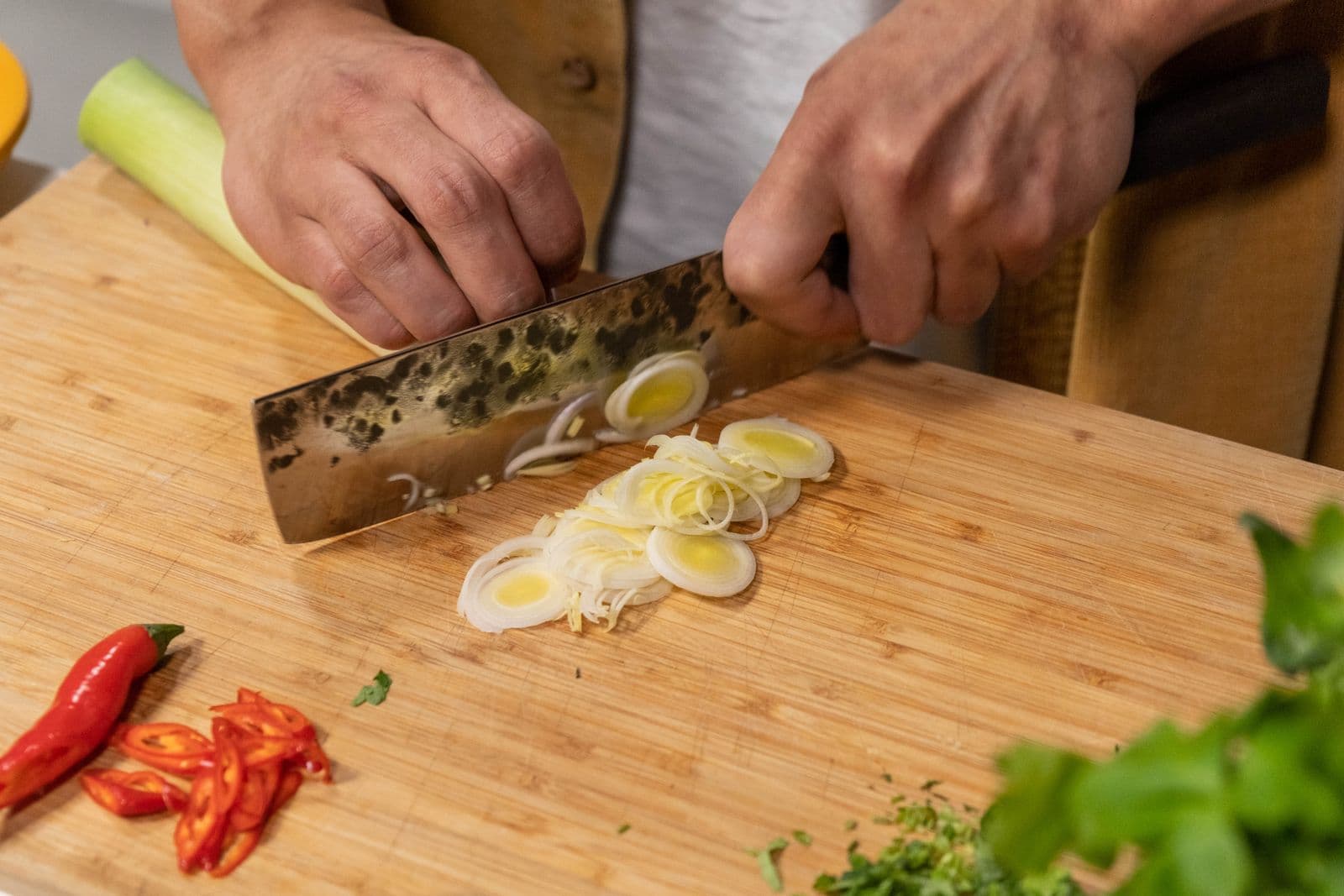
What is an usuba?
An usuba (薄刃, "thin blade") is the traditional Japanese vegetable knife used in professional kitchens. Like a nakiri it's tall and dead-flat for clean straight-down cuts — but it's ground on one side only, which gives it a keener, more precise edge and the ability to make cuts a double-bevel knife can't.
It comes in two regional shapes: the square-tipped Kanto usuba, and the pointed, curved kamagata usuba of the Kansai region.
Katsuramuki & precision
The usuba's signature is katsuramuki: rotary-peeling a daikon into a single, continuous sheet as thin as paper, which is then cut into fine threads. It's a benchmark of knife skill, and the flat single-bevel edge exists precisely to make it — and other clean, exact vegetable cuts — possible. This is a knife for precision, not speed or brute chopping.
Usuba vs nakiri
They look similar and share a job, but they're worlds apart in use. The difference is the bevel.
| Usuba 薄刃 | Nakiri 菜切 | |
|---|---|---|
| Bevel | Single | Double |
| Handed | Yes | Either hand |
| Edge | Exceptionally keen | Very keen |
| Sharpening | Bevel + uraoshi | ~15° both sides |
| Learning curve | Steep | Easy |
| Best for | Pro precision, katsuramuki | Everyday veg |
Choose the usuba to learn traditional single-bevel vegetable technique; choose the nakiri for an easy, everyday tall vegetable knife.
Single bevel, care & sharpening
As a single-bevel knife, the usuba is bought for one hand and sharpened differently from a Western knife: you work the bevel, then lightly flatten the back to remove the burr (the uraoshi). Many are made from reactive carbon steel, so treat them with the usual wipe-dry care. New to single bevels? Read single vs double bevel first.
Who is the usuba for?
Get one if
- You want to learn traditional single-bevel technique
- You do precise, decorative vegetable work
- You're ready to master katsuramuki
- You'll sharpen a single bevel properly
Get a nakiri if
- You want an easy everyday vegetable knife
- You'd rather not learn single-bevel skills
- You want a knife that works in either hand
- You value simple sharpening
The bottom line
The usuba is the connoisseur's vegetable knife: the cleanest cuts in Japanese cooking, earned through real single-bevel skill. Wonderful if you want that craft — overkill if you just want to chop dinner.
For everyday vegetables, start with the nakiri — then graduate to an usuba if the technique calls to you.
Frequently asked questions
What is an usuba knife used for?
An usuba is a traditional Japanese single-bevel vegetable knife used for precise, delicate vegetable work — clean straight cuts, fine julienne, decorative cuts, and katsuramuki (rotary-peeling a vegetable into one long, paper-thin sheet). It's the professional counterpart to the everyday double-bevel nakiri.
Usuba vs nakiri — what's the difference?
Both are tall, flat vegetable knives, but the usuba is single-bevel and the nakiri is double-bevel. The single bevel gives the usuba an exceptionally clean, precise cut prized by professionals, but it's handed, harder to sharpen and harder to use. The nakiri is double-bevel, works in either hand, is easy to sharpen and beginner-friendly. For home cooks the nakiri is the practical choice; the usuba is a specialist's tool.
What is katsuramuki?
Katsuramuki is the classic usuba technique of rotary-peeling a vegetable — usually daikon — into a single continuous sheet as thin as paper, which is then finely julienned. It's a benchmark of Japanese knife skill, and the usuba's flat single-bevel edge is designed specifically to make it possible.
Is an usuba hard to use?
Yes, relative to a nakiri. A single-bevel edge pulls to one side as it cuts, so it takes practice to steer straight, and sharpening involves working the bevel plus lightly flattening the back (uraoshi). It's a rewarding knife for someone committed to technique, but it's not a beginner's vegetable knife — that's the nakiri.
What's the difference between a Kanto and Kansai usuba?
It's the shape. The Kanto (Tokyo) usuba has a square, flat tip; the Kansai (Osaka) style, called kamagata usuba, has a pointed, curved tip that helps with detail work. Both do the same job — the choice is regional and personal preference.
Should a home cook buy an usuba or a nakiri?
For almost all home cooks, a nakiri. It gives you the tall, flat vegetable knife experience with none of the single-bevel difficulty — easy to use, easy to sharpen, and it works in either hand. Choose an usuba only if you specifically want to learn traditional single-bevel technique like katsuramuki.
Exploring traditional Japanese knives?
See every Japanese knife type, everyday and specialist alike. Our curated shelf opens soon — join the waitlist.
Browse knife types →