
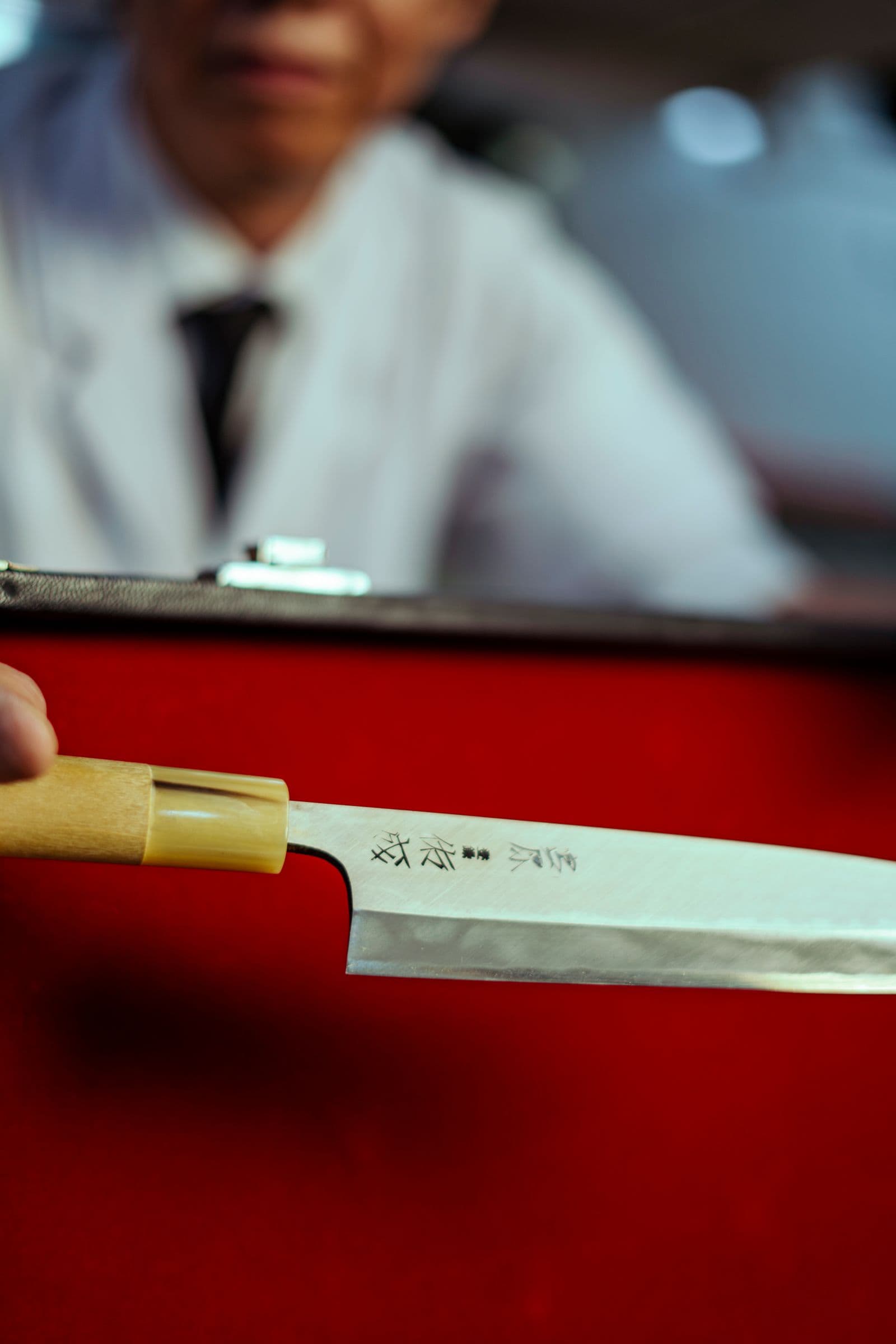
What is honyaki?
A honyaki (本焼, "true forged") is made from a single piece of high-carbon steel and differentially hardened: the smith coats the blade in clay before quenching so the edge hardens fully while the spine stays softer — exactly the technique behind a traditional katana. This produces a beautiful hamon (temper line) and an exceptionally hard, long-lasting edge. It's one of the hardest things a bladesmith can make, with a high failure rate, so honyaki are expensive and revered. The flip side: they're brittle and demanding to sharpen.
What is kasumi?
A kasumi (霞, "mist") knife is forge-welded from two metals — a hard, high-carbon cutting steel (hagane) backed by a softer iron (jigane). The soft jigane makes the blade tougher, easier to sharpen and to correct, and cheaper to produce, which is why most traditional Japanese knives are kasumi. The name comes from the hazy, misty contrast between the two metals on the finished blade. It's the practical, everyday tradition — closely related to san-mai cladding.
Side by side
| Honyaki 本焼 | Kasumi 霞 | |
|---|---|---|
| Construction | Single steel | Two metals forge-welded |
| Hardening | Differential (clay + quench) | Uniform, on the hard steel |
| Edge | Hardest, longest-lasting | Excellent |
| Toughness | More brittle | More forgiving |
| Sharpening | Demanding | Easier |
| Signature look | Hamon | Misty two-metal contrast |
| Price | Very high | Accessible |
Which should you buy?
Kasumi for almost everyone
- More affordable and available
- Easier to sharpen and maintain
- Tougher and more forgiving
- Performs superbly for nearly all cooks
Honyaki only if
- You're an experienced sharpener
- You want the ultimate single-steel blade
- You value the hamon and the craft
- You accept the price and the care
The bottom line
Honyaki is the summit — one steel, differentially hardened, crowned with a hamon, and priced accordingly. Kasumi is the living tradition most knives are built on: two metals, more forgiving, and excellent for nearly everyone.
Curious how the metals are layered in modern knives? See san mai and damascus construction, and meet the smiths on our makers page.
Frequently asked questions
What is a honyaki knife?
A honyaki (本焼) is forged from a single piece of high-carbon steel and differentially hardened — clay is applied before the quench so the edge hardens fully while the spine stays softer, much like a traditional katana. This creates a hamon (temper line) and an extremely hard, long-lasting edge. Honyaki are very difficult to make, expensive, and prized by professionals and collectors.
What is a kasumi knife?
A kasumi (霞) knife is made by forge-welding a hard, high-carbon cutting steel (hagane) to a softer iron (jigane) — a laminated, two-metal construction. It's easier and cheaper to make than honyaki, more forgiving to use and sharpen, and it's the standard construction for the great majority of traditional Japanese knives. The name 'kasumi' (mist) refers to the hazy contrast between the two metals.
Honyaki vs kasumi — what's the real difference?
Honyaki is one steel, differentially hardened; kasumi is two metals forge-welded together. Honyaki reaches a slightly harder, longer-lasting edge and is far more prestigious, but it's brittle, demanding to sharpen and very expensive. Kasumi is more forgiving, easier to sharpen, much more affordable, and performs beautifully for nearly everyone. For all but dedicated professionals and collectors, kasumi is the sensible choice.
Is a honyaki knife better?
Better in edge hardness and prestige, not in everyday practicality. The differential hardening gives a superb, long-lasting edge and a beautiful hamon, but it also makes the blade more brittle and much harder to sharpen and correct — and it commands a premium price. Unless you specifically want that pinnacle (and can maintain it), a good kasumi knife gives you most of the performance with far less cost and fuss.
What is a hamon?
A hamon is the visible line on a honyaki blade where the hardened edge meets the softer spine, created by the clay-and-quench differential hardening. It's both a sign of that construction and a prized aesthetic feature. Kasumi knives don't have a true hamon, since their contrast comes from two forge-welded metals rather than differential hardening of one.
Which should I buy?
For almost everyone, kasumi. It's more affordable, easier to sharpen and maintain, more forgiving, and performs excellently. Consider a honyaki only if you're an experienced sharpener who wants the ultimate traditional single-steel blade, values the hamon, and accepts the price and the care it demands.
Drawn to the craft?
Meet the four regions behind the steel. Our curated shelf opens soon — join the waitlist to hear first.
Meet the makers →