
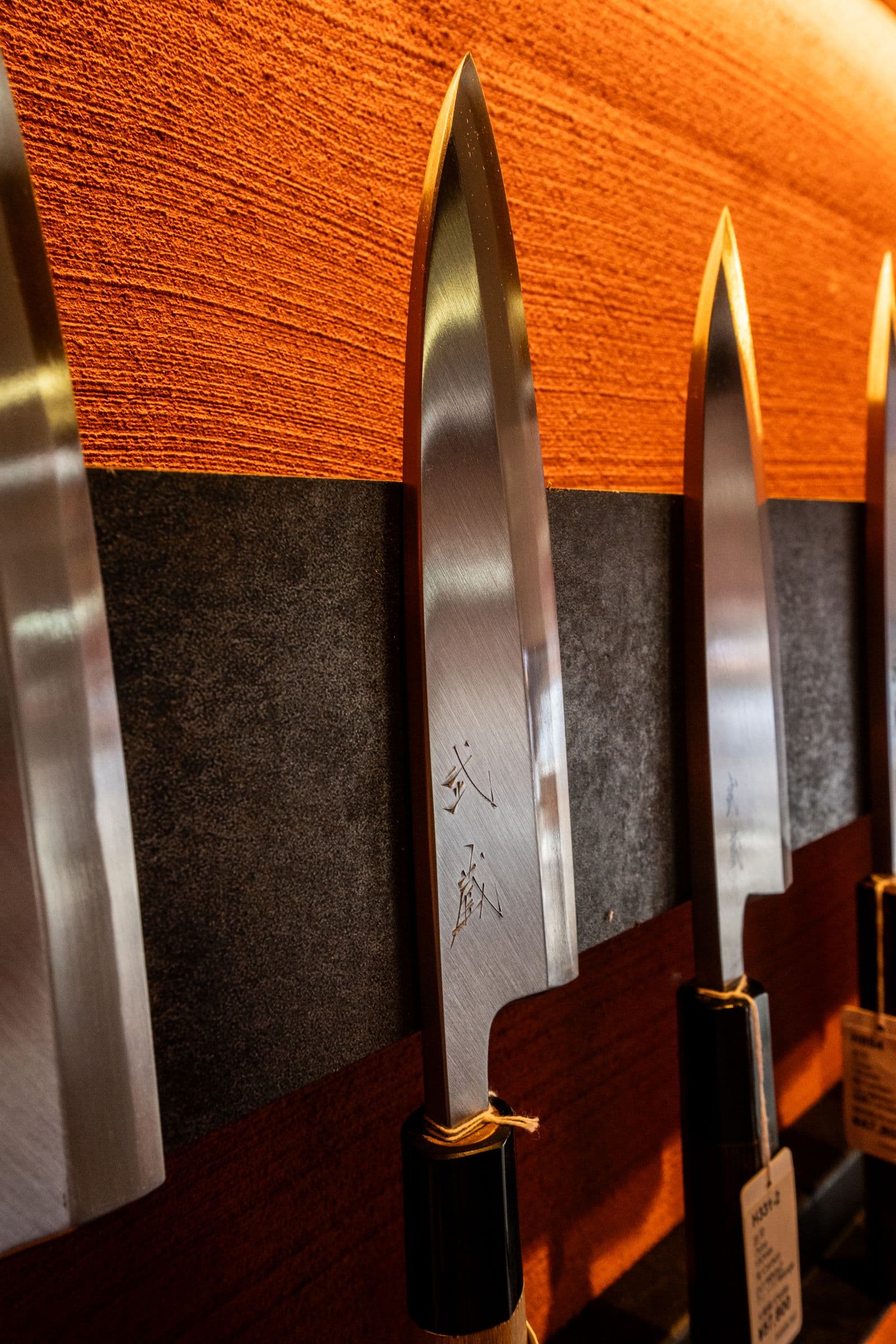
What is a takohiki?
The takohiki is one of Japan's traditional sashimi knives. The name combines tako (octopus) and hiki (from hiku, to pull), so it is often translated as "octopus puller" — but it is used for sashimi in general, not only octopus.
Like the yanagiba, it is long, narrow and ground on one side only, with a hollow (urasuki) on the flat back. The visible difference is the end of the blade: where the yanagiba tapers to a point, the takohiki's spine runs straight to a squared-off tip. Makers and retailers also commonly describe it as thinner, lighter and lower in blade height than a yanagiba of the same length, though the exact dimensions vary from maker to maker.
Why the square tip?
Japanese regional knife styles split broadly into Kanto (Tokyo) and Kansai (Osaka and Kyoto). The pointed yanagiba is the Kansai sashimi knife and is now the standard nationwide; the square-tipped takohiki is the Kanto one. The same regional split shows up in vegetable knives, where the Kanto usuba is also square and the Kansai version has a rounded, sickle-shaped end.
There is no single documented reason for the square end. The explanation most often repeated is that Kanto sushi chefs worked in a way that favoured a straighter edge and a blunt end. Treat that as tradition rather than established history. The practical effect is clear, though: a takohiki slices well along its length but has no point for detail work. See every tip shape side by side in our knife anatomy guide.
Takohiki vs yanagiba, sujihiki and fugubiki
| Takohiki 蛸引 | Yanagiba 柳刃 | Fugubiki ふぐ引 | Sujihiki 筋引 | |
|---|---|---|---|---|
| Region / origin | Kanto (Tokyo) | Kansai (Osaka) | Specialist variant | Western-style |
| Tip | Square | Pointed | Pointed | Pointed |
| Bevel | Single | Single | Single | Double |
| Blade | Thin, lower | Standard reference | Very thin, flexible | Thin, symmetrical |
| Made for | Sashimi | Sashimi | Paper-thin fugu slices | Meat and fish slicing |
| Handed | Yes | Yes | Yes | No |
| How easy to find | Uncommon | Very common | Rare | Common |
You may also see a sakimaru takohiki, a modern hybrid with a rounded, sword-like tip that sits between the two regional styles. It is made by some makers but is not a traditional standard form.
How a takohiki is used
The technique is the same as for a yanagiba. Set the heel of the blade on the far edge of the fish, then draw the knife towards you in one continuous stroke, using the full length of the edge. Sawing back and forth tears the flesh; a single pull leaves a glossy, clean cut face. Our sashimi slicing guide walks through the grip, the fish and the stroke step by step.
What a takohiki does not do is chop, portion bone-in fish or handle cooked food at the board. For breaking a whole fish down you need a deba, and for everything else a gyuto.
Should you buy a takohiki?
Consider one if
- You slice sashimi often and already know single-bevel sharpening
- You specifically want the Tokyo (Edomae) style
- You already own a yanagiba and want the other regional form
Buying and sharpening a takohiki
- Length: around 270 mm for home use; 300 mm and above for professional counters.
- Hand: single-bevel knives are handed. Most takohiki are right-handed; left-handed ones are usually small-batch or made to order. See left-handed Japanese knives.
- Steel: traditional takohiki are usually carbon steel (Shirogami or Aogami) clad in softer iron, which takes a very keen edge but must be dried promptly. See carbon steel care.
- Sharpening: sharpen the bevel side on a whetstone to follow its existing angle, then lightly flatten the back (uraoshi) to remove the burr — never grind a bevel onto the back. The sharpening guide covers single-bevel knives.
The bottom line
The takohiki is the Tokyo form of the sashimi knife — a square-tipped yanagiba. It cuts beautifully, but it is harder to find and no more capable, so buy one because you want that style, not because you need it.
Frequently asked questions
What is a takohiki knife?
A takohiki (蛸引, often written takobiki) is a long, single-bevel Japanese knife for slicing sashimi. It is the Kanto (Tokyo) regional form of the sashimi knife and is recognisable by its squared-off tip. The more common yanagiba, with a pointed tip, is the Kansai (Osaka) form. Both do the same job: slicing raw fish in one long pulling stroke.
What does takohiki mean?
Tako means octopus and hiki comes from hiku, to pull, so the name is usually translated as "octopus puller" or "octopus slicer". Despite the name, it is a general sashimi knife, not an octopus-only tool.
Takohiki vs yanagiba — which is better?
Neither is better; they are regional variations of the same knife. The takohiki has a square tip and is commonly described as lighter, thinner and lower in blade height than a yanagiba of the same length. The yanagiba's pointed tip is more useful for detail work and it is far easier to find, especially in left-handed versions. For most people outside Japan, the yanagiba is the practical choice.
Why does a takohiki have a square tip?
There is no single documented reason. The explanation most often given is that Kanto sushi chefs worked in a way that favoured a straighter edge and a blunt end, and that a squared tip became the Tokyo style. Whatever the origin, the practical effect is that the takohiki has no point: it slices well along its length but cannot do tip work.
Is a takohiki good for a home cook?
Only if you slice sashimi often and specifically want the Tokyo style. It is a single-bevel specialist that is right- or left-handed, needs single-bevel sharpening, and does little besides slicing boneless fish. A double-bevel sujihiki is more versatile for home cooking, and a yanagiba is easier to buy and sharpen correctly.
What length takohiki should I get?
Takohiki are made in roughly the same lengths as yanagiba, from about 240 mm to 330 mm. The longer the blade, the longer the single slicing stroke you can make. 270 mm is a sensible length for home use; 300 mm and above suit professional counters and large fillets.
Is there a left-handed takohiki?
Yes, but they are uncommon. Because it is single-bevel, a takohiki is made for one hand, and most are right-handed. Left-handed versions are usually made in small numbers or to order, so expect a longer wait and a higher price than for a right-handed knife.
Choosing a sashimi knife?
Tell us what you slice and which hand you use, and we'll reply with the knife and length we'd pick — free, by email.
Ask for advice →