
A swordsmith, some farmers, and 700 years
The founding story of Echizen is unusually specific. Around 1337 a swordsmith from Kyoto came to the area looking for good water for tempering. While he was there he made sickles for local farmers — and the farmers kept coming back. Blades for agriculture, not for war, are what actually established the craft.
That agricultural origin shaped the region's character. Echizen blades were tools for people who used them every day and could not afford a fragile one. The forging tradition that survives today grew out of making things that had to work, in volume, by hand.
In 1979, Echizen Uchihamono became the first bladesmithing craft in Japan to receive national traditional-craft designation — ahead of Sakai (1982) and Tosa (1998). That is a small piece of bureaucratic history, but it says something real: Echizen's techniques were documented and distinct enough to be recognised first.
Nimai-hiroge and the case for hammering two at once
Two techniques are named in Echizen's designation, and both are about getting steel thinner and more evenly than brute force allows.
Nimai-hiroge (二枚広げ, “spreading two”) means forging two blades stacked together. Working them as a pair distributes the hammer's force differently and lets the smith spread the steel thinner and flatter than a single blade would tolerate. A thinner blade is a better cutter — it wedges less on the way through — so this is not decoration, it is performance.
Mawashi-hagane-tsuke (廻し鋼付け) is the region's way of forge-welding the hard cutting steel onto the softer body, wrapping it rather than simply laying it on. The result is the same hard-core-in-soft-cladding structure described in san mai construction: a keen edge with a body that absorbs shock instead of cracking.
Takefu Knife Village
In 1993 a group of Echizen makers did something no other Japanese knife region has quite matched: they built a shared workshop. Takefu Knife Village put independent smiths under one roof, with a showroom attached, at a moment when traditional crafts across Japan were quietly dying of invisibility.
It worked. Several of the makers most recognisable to international knife buyers today work from Echizen, and the region's contemporary output — dramatic hammered finishes, damascus cladding, bold handle materials — is a direct result of smiths sharing a space and competing on ideas rather than hiding in separate forges.
Why VG10 comes from here
Takefu Special Steel, the company that makes VG10, is based in Echizen City. That single fact explains a lot about the region's modern identity. Where Sakai leans on traditional carbon steels and Tosa on Shirogami and Aogami, Echizen's smiths have had a world-class stainless supplier on their doorstep for decades.
The result is a region where a blade can be hand-hammered in the old way and still be VG10 or SG2 powder steel at the core — hand craft on top of industrial metallurgy. If you want the look and feel of a traditional knife but do not want to babysit carbon steel, this combination is exactly what you are looking for.
What to expect from an Echizen knife
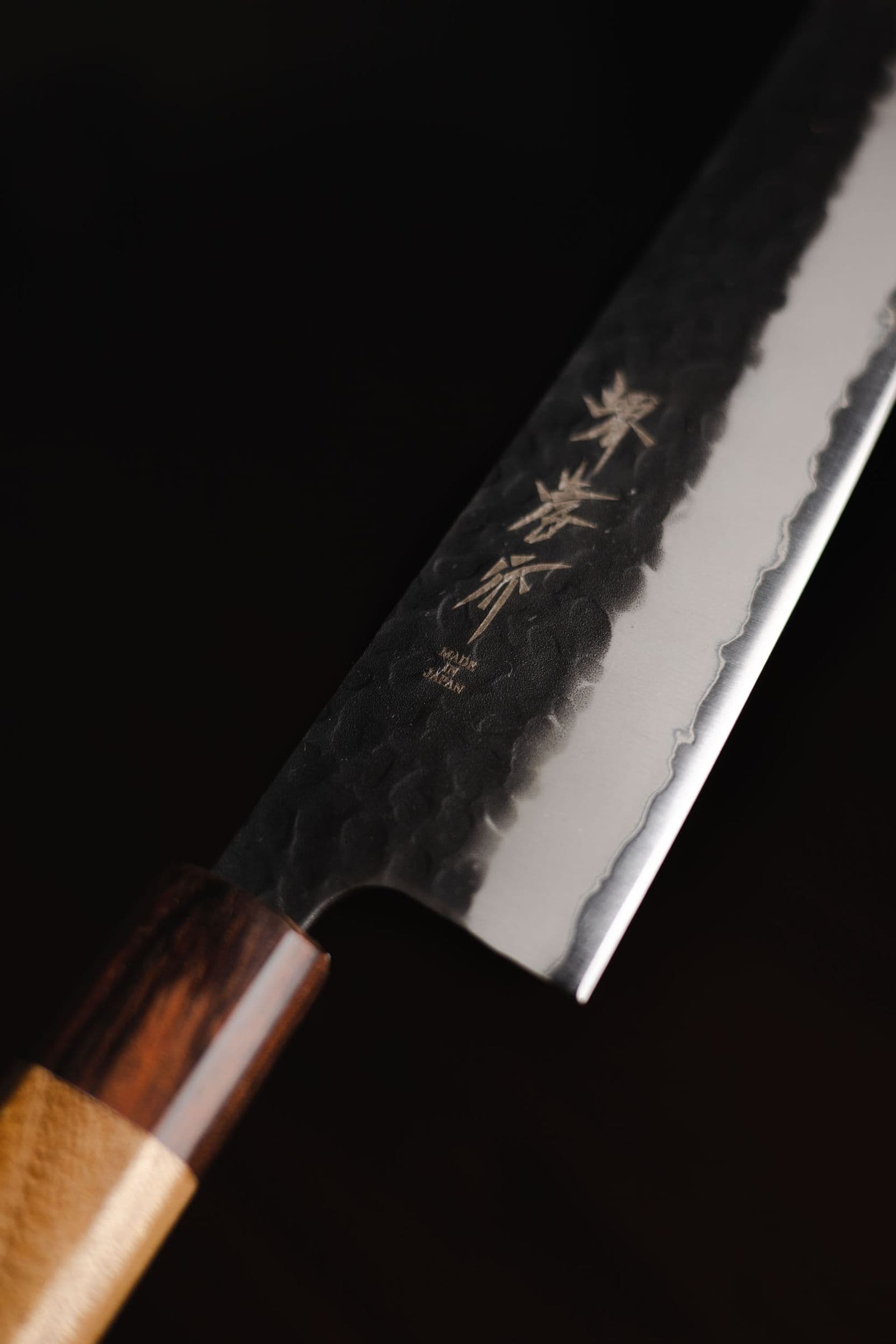
Echizen knives are the most visually expressive of the four regions. Expect kurouchi black forge scale left deliberately on the flats, hammered tsuchime dimples that also help food release, and damascus cladding patterns. Two blades from the same maker will not look identical, and that is the point.
Most Echizen kitchen knives are double bevel, which makes them a sensible choice for a first Japanese knife regardless of which hand you cut with. Prices sit between Tosa and Sakai: more than a rustic Tosa carbon blade, less than a fully hand-finished Sakai single-bevel.
Echizen vs the other three regions
| Sakai | Echizen | Seki | Tosa | |
|---|---|---|---|---|
| Best known for | Traditional single-bevel knives for Japanese cuisine | Hand-forged double-bevel knives with striking finishes | Consistent, precisely made Western-style kitchen knives | Tough, rustic, well-priced hand-forged blades |
| Signature knives | Yanagiba, deba, usuba | Gyuto, santoku, nakiri, bunka | Gyuto, santoku, petty, bread knives | Nakiri, gyuto, santoku, outdoor blades |
| Typical finish | Polished (migaki), kasumi | Kurouchi, tsuchime, damascus | Polished, damascus | Kurouchi (black forge finish) |
| Typical steels | Shirogami, Aogami, Ginsan | VG10, SG2, Aogami Super, Shirogami | VG10, AUS-8/10, SG2, molybdenum-vanadium | Shirogami, Aogami, Aogami Super |
| Character | Refined, exacting, built for daily professional use | Expressive and modern, without leaving hand-forging behind | Consistent and repeatable — the least variable of the four | Rugged and utilitarian — character over polish |
Who should buy from Echizen
Echizen if
- You want a hand-forged everyday knife
- You like kurouchi or hammered finishes
- You want modern stainless in a traditional blade
- You want each knife to look individual
Look elsewhere if
- You want a traditional single-bevel washoku knife (Sakai)
- You want two knives to be visually identical (Seki)
- You want the cheapest hand-forged carbon blade (Tosa)
- You dislike a textured, uneven blade surface
Frequently asked questions
What are Echizen knives?
Echizen knives (越前打刃物, Echizen uchihamono) are hand-forged blades made in Echizen City, Fukui — the area historically called Takefu. The craft dates to around 1337 and in 1979 became the first cutlery in Japan to be designated a national traditional craft. Echizen is best known for hand-forged double-bevel kitchen knives with kurouchi, hammered or damascus finishes.
Is VG10 steel from Echizen?
Yes. VG10 is made by Takefu Special Steel, based in Echizen City — the same town as the traditional forges. That is why so many Echizen knives use VG10 and its powder-steel relatives: the steel supplier is local. The steel itself is modern industrial metallurgy; the forging around it is often still done by hand.
What is nimai-hiroge?
Nimai-hiroge (二枚広げ) is an Echizen forging technique in which two blades are stacked and hammered out together. Working them as a pair lets the smith spread the steel thinner and more evenly than a single blade would allow. It is one of the two techniques cited in the region's traditional-craft designation, along with mawashi-hagane-tsuke, a method of wrapping the hard cutting steel onto the softer body.
What is Takefu Knife Village?
A shared workshop and showroom in Echizen City, opened in 1993, where a group of independent makers forge under one roof rather than in separate scattered smithies. It was a deliberate attempt to keep the craft alive by making it visible and collaborative, and several of the best-known contemporary Japanese knife makers work from it.
Echizen or Seki — which is better?
They are strong at different things. Echizen is hand-forging with visible character: kurouchi finishes, hammered tsuchime facets, individual variation between blades. Seki is precision manufacturing: consistent grinds, tight fit and finish, very little variation. If you want a knife with a personality, Echizen. If you want a knife that is the same every time, Seki.
Curated from Japan's four regions
Compare Echizen with Sakai, Seki and Tosa. Our curated shelf opens soon — join the waitlist to hear first.
The four great regions →