
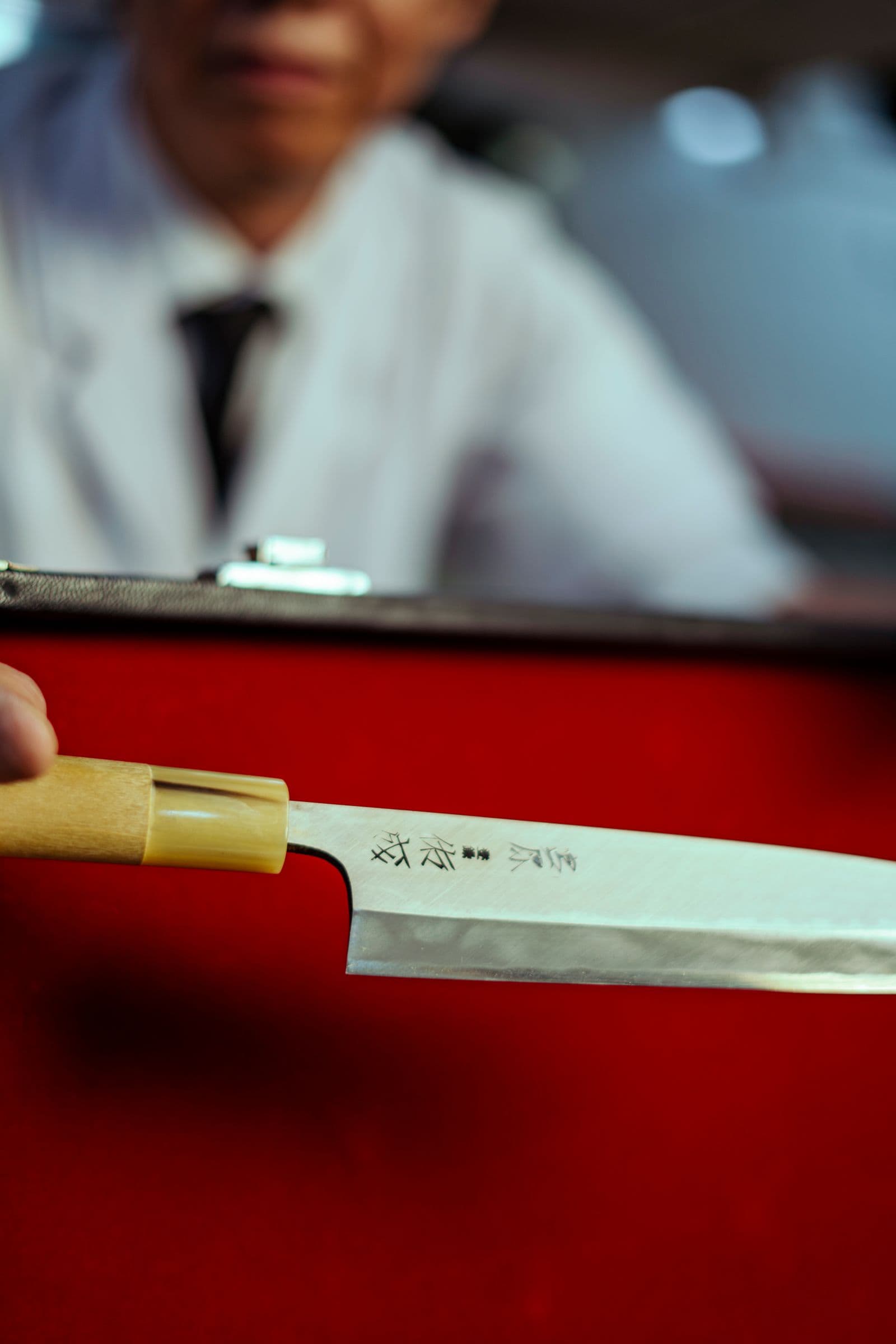
Kurouchi — the black forge finish
Kurouchi (黒打ち, "black forged") is the dark forge scale left on the blade rather than polished off. It gives a distinctive matte-black, rustic look, keeps costs down, and adds a little rust resistance to the covered area. It wears away gradually where you sharpen and where the blade rubs — that's normal and part of its lived-in charm, not a defect.
Nashiji — the pear-skin finish
Nashiji (梨地, "pear skin") is a fine, speckled matte texture on the cladding that resembles the skin of an Asian pear. It sits between rustic kurouchi and bright polish, is mainly aesthetic, and its texture helps hide scratches and slightly reduces food sticking.
Tsuchime — the hammered finish
Tsuchime (槌目, "hammer mark") leaves visible hammered dimples across the blade face. It's the most functional of the looks: the little pockets trap air and cut down the contact between blade and food, so slices are a bit less likely to cling. Striking and practical, it's a favourite on modern knives.
Migaki — the polished finish
Migaki (磨き) is a polished finish, from satin to bright, where the sides are smoothed rather than left rustic or textured. It looks refined and wipes clean easily, though a smooth face can let food stick a touch more than a dimpled tsuchime. It's the polished counterpoint to kurouchi.
Looks, function & care
These finishes are on the outer cladding, not the edge. They shape a knife's look and, for the textured ones, give a small boost to food release — but they don't change sharpness, edge retention or the core steel. Care is the same as for the blade's steel: wipe dry, don't soak, and accept that a kurouchi layer thins with use. Choose a finish for how it looks and feels to you.
The bottom line
Kurouchi for rustic character, nashiji for a subtle textured matte, tsuchime for hammered good looks and the best food release, migaki for polished refinement. All beauty and a little function — the cutting is decided elsewhere.
Curious how the layers underneath work? See san mai & damascus construction, and meet the smiths on our makers page.
Frequently asked questions
What is a kurouchi finish?
Kurouchi (黒打ち, 'black forged') is the dark, rustic layer of forge scale left on the blade's sides from forging, rather than polished off. It's traditional and low-cost, gives a distinctive matte-black look, and offers a little extra rust resistance on the covered area. It wears away gradually with use and sharpening, which is normal and part of its character.
What is a nashiji finish?
Nashiji (梨地, 'pear skin') is a textured, matte finish on the blade's cladding that looks like the speckled skin of a pear. It's mainly aesthetic, sits between rustic kurouchi and bright polished finishes, and its texture helps hide scratches and can slightly reduce food sticking to the blade.
What is a tsuchime finish?
Tsuchime (槌目, 'hammer mark') is a finish of visible hammered dimples across the blade's face. It's both decorative and functional: the little pockets trap air and reduce the surface contact between blade and food, so slices are a bit less likely to stick. It's one of the most popular modern looks.
Do these finishes affect how a knife cuts?
Only slightly, and only for food release. Dimpled or textured finishes like tsuchime and nashiji can help food fall away from the blade rather than clinging, which is nice but modest. None of them change the edge, sharpness or steel — those come from the core and the grind. Choose a finish mainly for looks and a little for release.
What is a migaki finish?
Migaki (磨き) is a polished, satin-to-bright finish where the blade's sides are smoothed rather than left rustic or textured. It looks clean and refined and is easy to wipe down, but a smooth face can let food stick a little more than a dimpled tsuchime. It's the polished counterpoint to the rustic kurouchi.
How do I care for a kurouchi blade?
Treat it like any carbon knife — wipe dry, avoid soaking, and don't scrub the black finish hard, as it will slowly wear where you sharpen and where the blade rubs. The kurouchi layer thinning over time is expected. If the exposed core rusts, clean it gently; the finish itself doesn't need special products.
Love the craft as much as the cut?
Meet the four regions behind the steel. Our curated shelf opens soon — join the waitlist to hear first.
Meet the makers →