
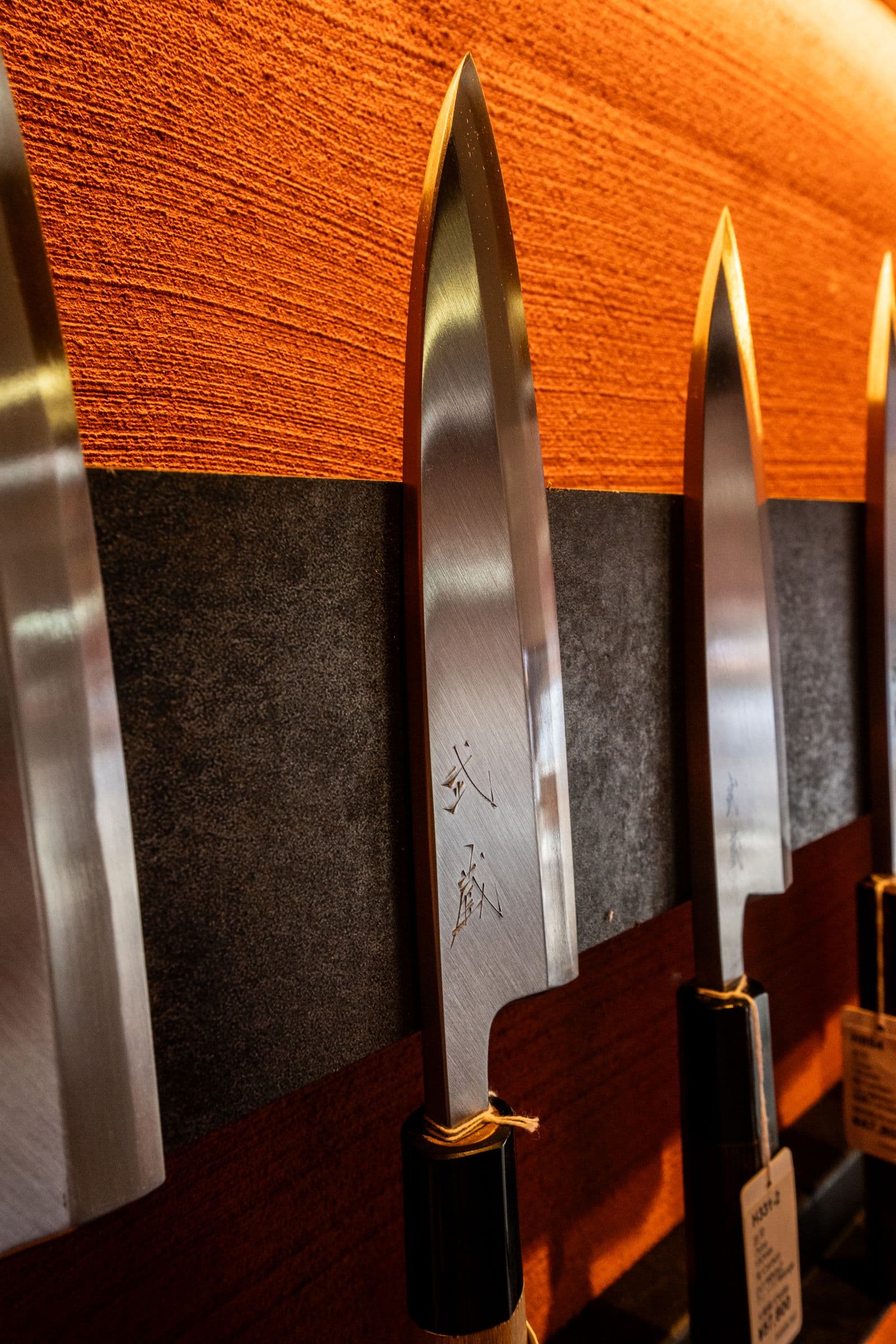
1. Harder steel
Japanese knives use harder steel — typically around 60–63 HRC, versus the low-to-mid 50s of a typical Western knife. Hardness is the enabler for everything else: a hard edge resists rolling, so it can be ground thin and acute and actually stay that way. Grind the same edge on softer steel and it rolls over almost immediately.
2. Thinner geometry
Beyond the edge itself, Japanese knives are usually thinner behind the edge and through the blade. A thin blade wedges less as it passes through food, so it feels like it's falling through an onion rather than being forced through it. That geometry is a big part of the "effortless" feel, separate from raw edge keenness.
3. A more acute edge angle
Japanese edges are sharpened to a more acute angle — roughly 15° per side (a 30° inclusive edge), against about 20° per side on a German knife. Single-bevel knives can be more acute still on their cutting face. A finer angle means less force to start and complete a cut — but a finer angle is also more fragile, which loops back to why the hard steel matters.
4. Fine grain & a polished finish
Good Japanese steels — especially powder steels and clean carbon steels — have a fine, even grain, which can be honed to a keener apex than a coarse-grained steel. Finished on fine whetstones rather than a quick machine grind, the edge is both keen and clean.
The trade-off: delicacy
Sharpness has a price. A hard, thin, acute edge is more fragile than a soft, thick Western one — it can chip on bone, frozen food, or from twisting and prying. It also wants proper care: hand-wash, a soft cutting board, and a whetstone. Accept that, and you get the sharpness; ignore it, and you'll chip the edge.
The bottom line
Japanese knives are sharp because hard steel lets them be ground thin and acute, then finished fine — four factors stacking up. The same package that makes them keen also makes them delicate. That's the deal.
Want the sharpness without the anxiety? A hard stainless like SG2 or VG10 gets you most of the way with easy care. Wondering if it's all worth it? See are Japanese knives worth it?
Frequently asked questions
Why are Japanese knives so sharp?
Four reasons combine. Japanese knives use harder steel (around 60–63 HRC), which supports a thinner, more acute edge without rolling. They're ground thinner overall, sharpened to a more acute angle (roughly 15° per side vs about 20° on a German knife), and often made from fine-grained steel that takes a keener apex. Finished on fine whetstones, the result is a noticeably sharper edge.
What edge angle are Japanese knives sharpened to?
Typically around 15° per side (a 30° inclusive edge), and single-bevel knives can be even more acute on their cutting side. Western knives are usually nearer 20° per side. A more acute angle cuts with less force but is more fragile — which is why the harder Japanese steel is what makes it possible.
Does harder steel make a knife sharper?
Indirectly, yes. Harder steel doesn't automatically arrive sharper, but it holds a thinner, more acute edge without rolling or denting, so it can be sharpened keener and stay that way longer. That's why Japanese makers can grind such fine edges: the steel is hard enough to support them.
Do Japanese knives stay sharp longer?
Generally yes. Harder, often fine-grained steel resists the rolling and micro-chipping that dull an edge, so a Japanese knife holds its keenness longer than a softer Western knife — provided you don't abuse it on bones or hard boards. The trade-off is that a hard, thin edge is more prone to chipping if misused.
What's the downside of such a sharp edge?
Delicacy. A hard, thin, acute edge is more fragile than a soft, thick Western one — it can chip on bone, frozen food, or from twisting and prying. It also needs proper care: hand-washing, a soft cutting board, and sharpening on a whetstone. If you want the sharpness, you accept a little more care and caution.
Can any knife be made this sharp?
You can put a very keen edge on many knives, but a softer steel won't hold a thin, acute edge for long — it rolls. The Japanese advantage is that the whole package (hard steel, thin geometry, acute angle, fine finish) lets the sharpness last. On soft steel the same edge would dull almost immediately.
Want that edge in your kitchen?
Find your match in four questions. Our curated shelf opens soon — join the waitlist to hear first.
Find your knife →