
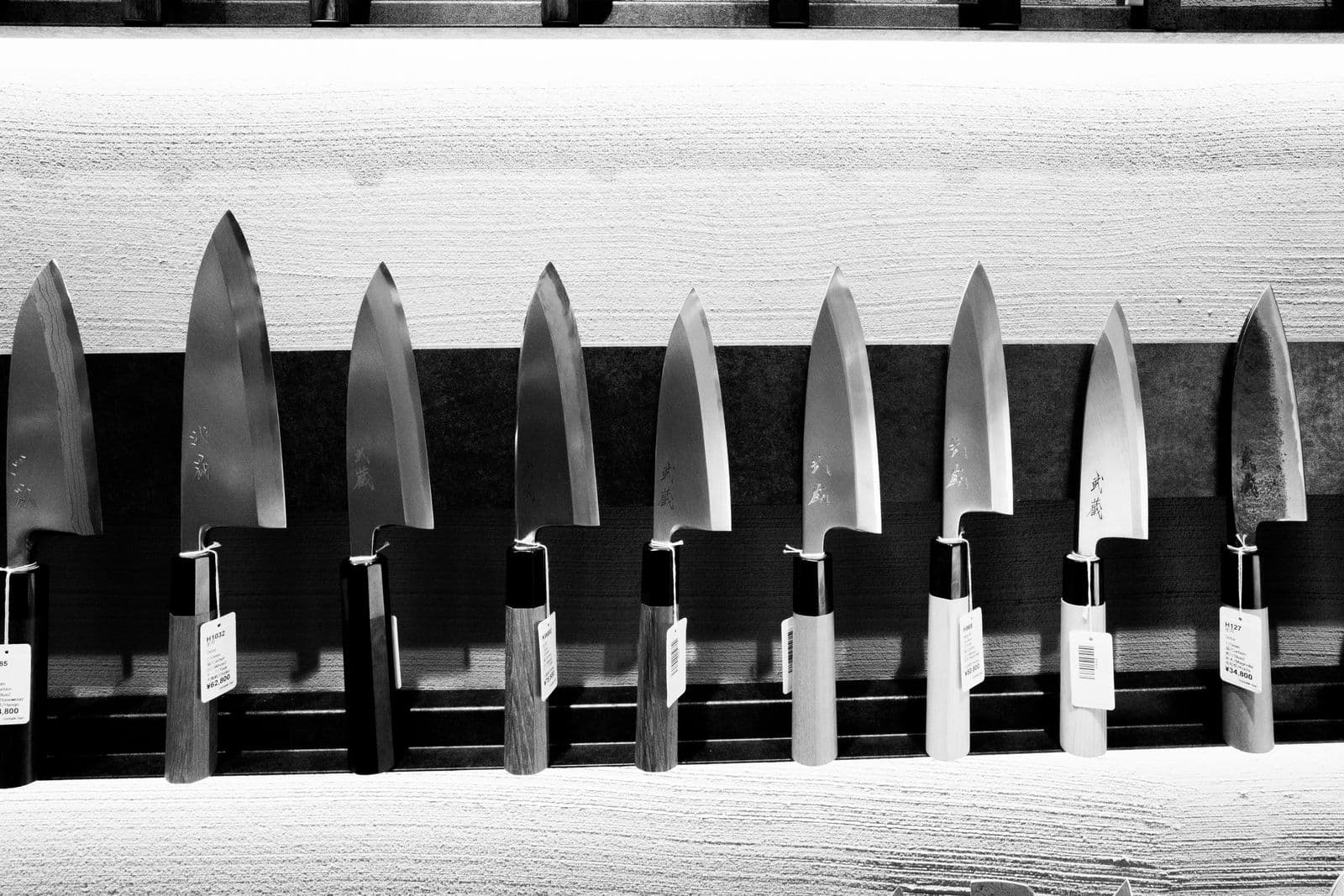
Why one knife wins
A good all-rounder handles the vast majority of kitchen work — vegetables, boneless meat, fish, herbs. Put your whole budget into one of those and you get better steel, a better grind and a knife that's genuinely a pleasure. That's the heart of it: a single knife you love and keep sharp does more, and does it better, than a drawer of compromises. It's also easier to maintain one edge than eight.
What a matched set really costs
A block set looks like value, but the count is padded: a handful of steak knives, a slicer or utility knife you'll rarely touch, a block and shears. Your money is divided across all of it, so the chef's knife you actually use every day is often worse than a single blade at the same price. You're paying for the furniture, not the cutting.
How to build a kit — by need
Grow the kit when a task feels awkward, not before. Start with the all-rounder. Add a petty for small in-hand jobs. Then add the specialist your cooking calls for — a nakiri if you do lots of vegetables, a bread knife for crusty loaves, a sujihiki for slicing roasts. Each earns its place by solving a real problem.
How many knives you actually need
The practical kit
- An all-rounder (gyuto or santoku)
- A petty for small tasks
- A serrated bread knife
- That's most kitchens, covered
Add only if you'll use it
- Nakiri — lots of vegetables
- Slicer — roasts, fish, carving
- Boning / fish knife — you break down protein
- Beyond that: enjoyment, not need
The bottom line
Buy one knife you'll love and keep sharp, not a block you bought for the count. Then grow the kit deliberately, one knife per real need. That's how you end up with knives you use, not knives you store.
Ready to choose that first one? Start with the best Japanese knife for beginners or take the quiz.
Frequently asked questions
Is it better to buy one good knife or a set?
For most cooks, one good knife. A single excellent all-rounder — a gyuto or santoku — handles the large majority of kitchen tasks, and one great knife you love beats a block of mediocre ones you don't. Sets spread your budget across knives you may rarely use and usually mean lower quality per knife for the price.
What's wrong with a matched knife set?
Nothing, if it's genuinely good — but most blocks include filler: a handful of steak knives, a knife or two you'll never touch, and a block and shears that pad the count. Your money is divided across all of it, so the chef's knife you actually use is often worse than if you'd spent the same on a single blade. Buy for use, not for a matching look.
What knife should I buy first?
A single all-rounder: a 210 mm gyuto or a 165–180 mm santoku. It does the vast majority of everyday cutting — vegetables, boneless meat, fish — and is the foundation everything else builds on. Get the best one your budget allows and learn to sharpen it, rather than spreading the money thin.
How do I build a knife kit over time?
Add by need, not by set. Start with one all-rounder. When a task feels awkward, add the knife that solves it: a petty for small in-hand jobs, a nakiri for lots of vegetables, a bread knife for crusty loaves, a slicer for roasts or fish. Three well-chosen knives cover almost everything most kitchens do.
How many kitchen knives do I actually need?
Most home cooks are fully covered by two or three: an all-rounder (gyuto or santoku), a small utility knife (petty), and a serrated bread knife. Add a specialist only if you regularly do the thing it's for. Beyond that, extra knives are about enjoyment, not necessity.
Are knife sets ever worth it?
Occasionally — if every knife in the set is one you'll use and the quality is genuinely high, a set can be convenient and coherent. But that's rare at typical set prices. More often you'll do better assembling a few individually chosen knives than buying a block for the count.
Buying the one that fits your hand?
That's our whole philosophy. Find your match in four questions — and join the waitlist for our curated shelf.
Find your knife →