
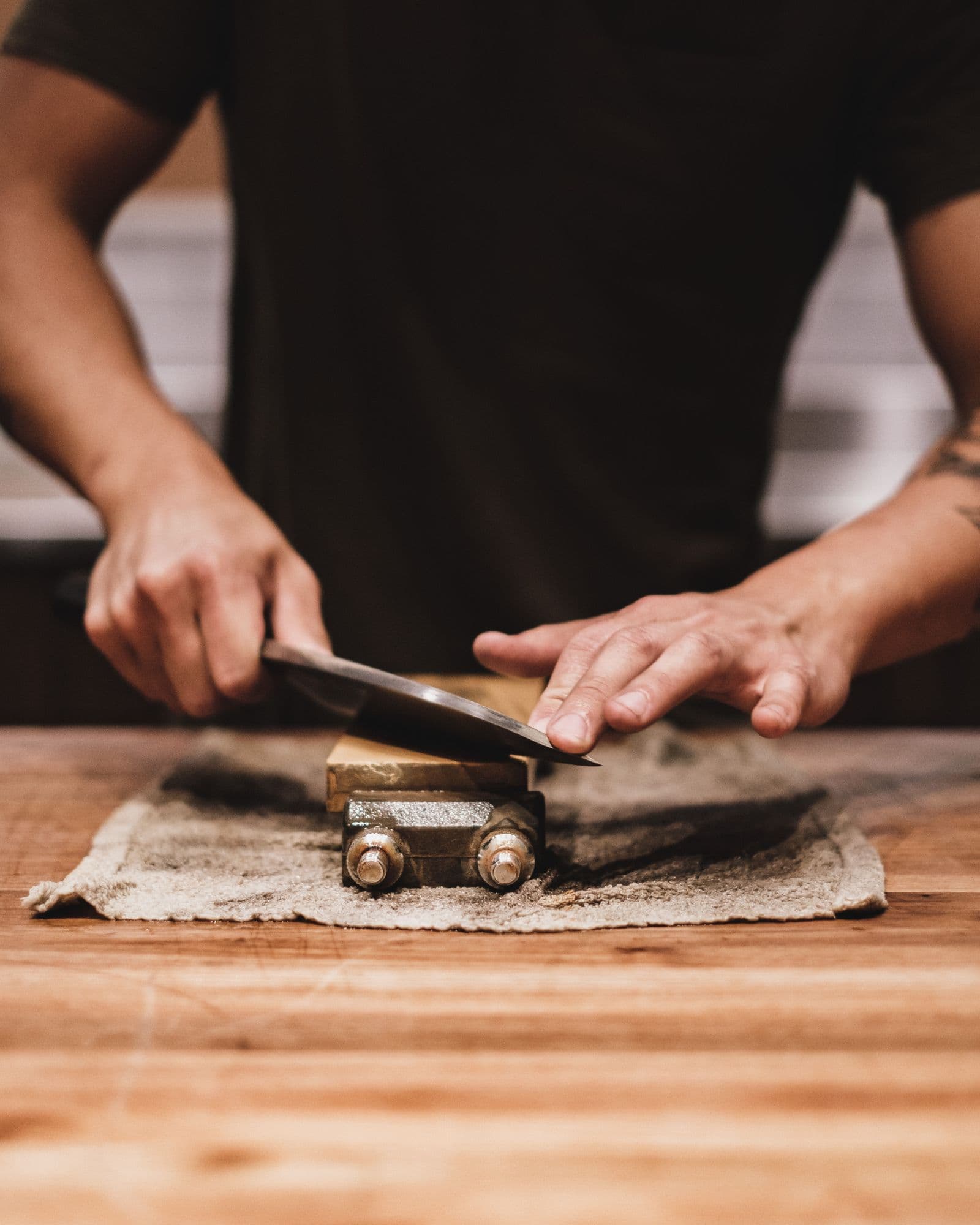
First, assess the chip
Not every chip needs a project. Micro-chips vanish over a few normal sharpenings. A visible chip up to a couple of millimetres is a simple home repair. A large chip, a cracked edge or a bent tip means removing a lot of metal or reshaping — worth handing to a professional rather than butchering the profile.
Fixing it, step by step
The principle: lower the whole edge until it meets the base of the chip, so the edge line stays smooth — then re-sharpen as normal.
Assess the chip
Look at the size. Tiny micro-chips will disappear over a few normal sharpenings. A visible chip up to a couple of millimetres is a straightforward home fix. A large chip or a bent tip may need a professional or heavy grinding — don't rush those.
Choose the right stone
You need to remove metal, so start on a coarse-to-medium whetstone (around 400 grit). Soak or wet the stone as its type requires. Trying to grind a chip out on a fine finishing stone alone will take forever.
Lower the edge to the chip
Sharpen along the whole edge at your normal angle until you've removed enough metal that the edge line reaches the bottom of the chip — i.e. the chip is gone. Work the entire edge evenly so the profile stays smooth, not just the chipped spot.
Re-form the edge
Once the chip is gone, raise a fresh burr along the whole edge on the coarse stone, feeling for it on the opposite side. This confirms you've created a new, continuous apex where the chip used to be.
Refine through the grits
Progress to a medium (~1000) and then a finishing stone (3000+), sharpening at your usual angle to refine and polish the new edge. Each grit removes the scratches of the one before.
Deburr and test
Remove the final wire edge with light alternating strokes or a gentle strop, then test on paper or a tomato. The repaired section should cut exactly like the rest of the edge.
When to see a professional
If the chip is deep (more than 2–3 mm), if there are several, or if the tip is broken or bent, the amount of metal to remove — and the reshaping needed to keep the profile right — is a lot to do by hand without changing how the knife performs. A sharpening service will fix it faster and better, and it's worth it on a knife you value.
Stop it happening again
Chips come from asking a hard, thin edge to do a tough job. Keep it off bone, frozen food and hard squash, never twist or pry with the tip, use a wooden or soft-plastic cutting board (not glass or stone), keep it out of the dishwasher, and store it so the edge is protected rather than rattling in a drawer.
The bottom line
A chipped edge isn't the end of a knife — it's an afternoon on the stones. Grind the whole edge down to the chip, re-form it, refine it, and it's as good as new. Then treat the edge gently and it stays that way.
Not confident on the stones yet? Learn the basics in how to sharpen a Japanese knife.
Frequently asked questions
Can you fix a chipped knife?
Yes. Small to moderate chips are removed by grinding the whole edge down on a coarse whetstone (around 400 grit) until the edge line reaches the base of the chip, then re-forming and refining the edge through finer grits. Very large chips or a bent tip may need a professional, but most chips are a straightforward home repair.
Do I need a special stone to remove a chip?
You need a coarse-to-medium whetstone (around 400 grit) to remove metal efficiently, then medium and fine stones to refine the edge. A fine finishing stone alone removes metal far too slowly to grind out a chip in reasonable time.
Why do Japanese knives chip?
Because they use hard steel with a thin, acute edge. That combination is what makes them so sharp, but it's more brittle than a soft, thick Western edge, so impact on bone or frozen food, twisting, prying, or a hard board or dishwasher can chip it. Treat the edge as a precision tool and chips become rare.
How do I stop my knife chipping again?
Never cut bone, frozen food or hard squash with force, don't twist or pry with the tip, use a wooden or soft-plastic cutting board rather than glass or stone, keep it out of the dishwasher, and store it so the edge is protected rather than knocking around loose in a drawer.
Looking after a Japanese knife?
Read the sharpening and care guides. Our curated shelf opens soon — join the waitlist to hear first.
The whetstone guide →