
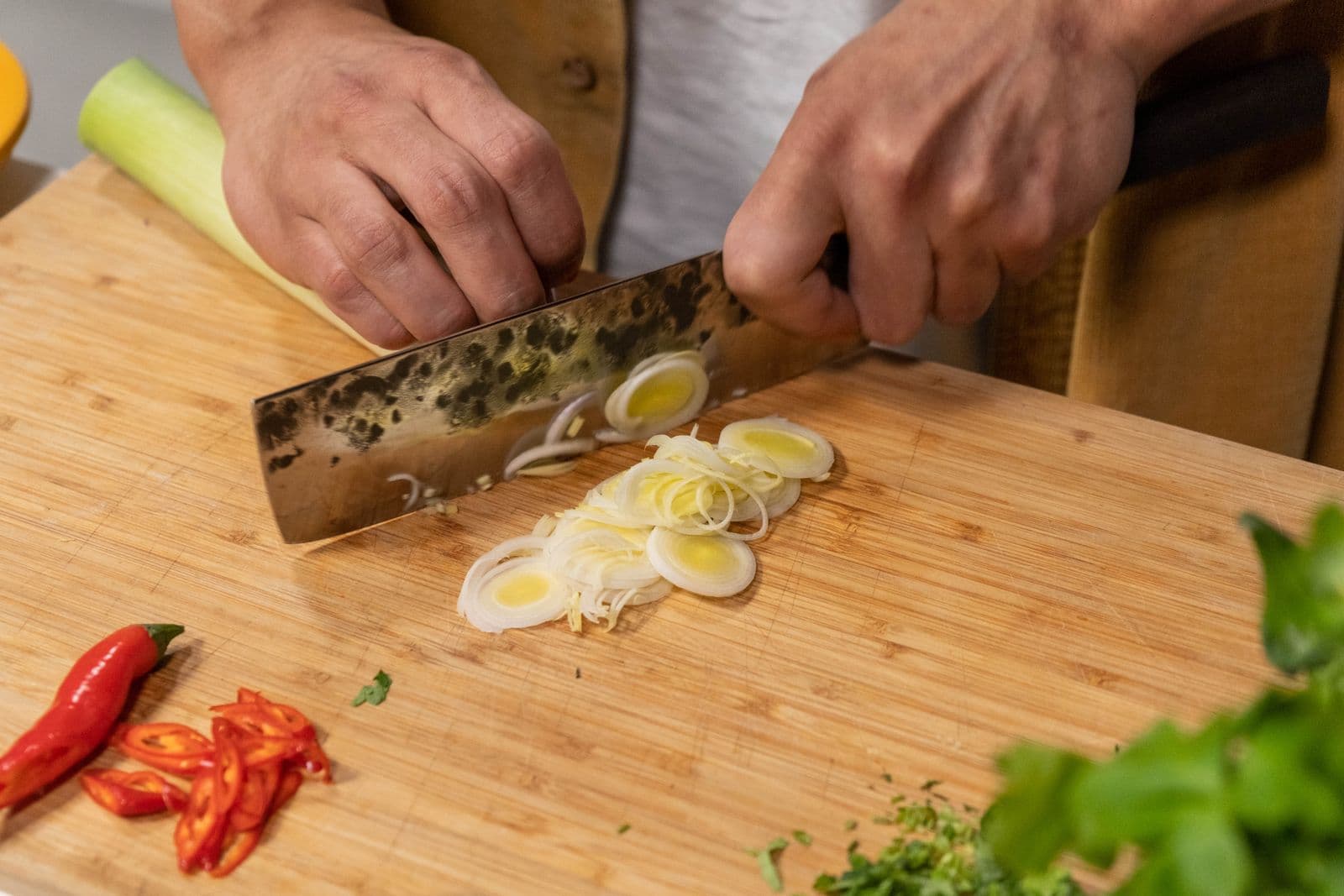
Why the nakiri is built for this
A nakiri has a dead-flat edge and a tall blade, which is exactly what clean vegetable cuts want. The flat profile keeps the whole edge in contact with the board on a straight push-cut, so nothing is left uncut at the ends of a stroke, and the height gives knuckle clearance and lets you scoop cut food off the board. It doesn't rock like a curved gyuto — and it doesn't need to.
Planks, julienne & brunoise, step by step
The progression is always the same: square off → planks → sticks (julienne) → cross-cut (brunoise). Each cut builds on the last.
Square off the vegetable
Trim the vegetable into a stable, rectangular block by cutting a thin slice off one side so it sits flat and won't roll. A flat base is the foundation of every even cut that follows.
Cut into planks
Using the nakiri's flat edge in a straight push-cut, slice the block into even planks — about 2–3 mm thick for julienne, thinner for a fine result. Keep the planks a consistent thickness; that thickness becomes one dimension of your sticks.
Stack and cut into sticks (julienne)
Stack a few planks, square them up, and cut down through the stack into matchsticks of the same width as the planks were thick. Even planks plus even cuts give you uniform julienne — thin, matchstick-like strips.
Cross-cut into dice (brunoise)
Line up the julienne sticks, then cut across them at the same spacing to produce tiny, even cubes — the brunoise. A brunoise is simply a julienne diced: the finer and more even your julienne, the finer the brunoise.
Let the flat edge do the work
Throughout, use the nakiri's flat profile with a clean straight-down push, keeping the whole edge in contact with the board. Guide the food with a claw grip, move your knuckles back between cuts, and let the sharp, tall blade fall through — no rocking needed.
Getting even cuts
Evenness comes from two habits: give the vegetable a flat, stable base before you start, and keep every cut a consistent thickness — since your planks set the width of your sticks, and your sticks set the size of your dice. Guide the food with a claw grip, moving your knuckles back a little between cuts, and keep the nakiri sharp so it falls cleanly rather than crushing.
The bottom line
Square off, plank, julienne, brunoise — the nakiri's flat edge makes each step a simple straight-down cut. Get even planks and the rest follows, no rocking required.
Want the full story on the knife itself? Read the nakiri guide, or its single-bevel cousin the usuba.
Frequently asked questions
What is a nakiri best at?
Vegetables. Its tall, dead-flat blade is made for a clean straight-down push-cut, so it slices, planks and dices vegetables efficiently with the whole edge touching the board. The height also lets you scoop cut food off the board. It's a specialist that does one job — vegetable prep — extremely well.
What is the difference between julienne and brunoise?
A julienne is thin matchstick strips; a brunoise is a fine dice made by cutting across a julienne. In other words, you cut planks, then sticks (julienne), then cross-cut the sticks into tiny cubes (brunoise). The brunoise is simply the diced version of the julienne.
Do you rock a nakiri?
No — a nakiri has a flat edge with no belly, so it's made for a straight up-and-down push-cut, not the rocking motion of a curved gyuto. Keep the whole edge in contact with the board and let the blade fall straight down. That flat profile is exactly what makes clean planks and even dice easy.
How do I get even julienne?
Start by squaring off the vegetable so it sits flat, cut even planks, then stack and cut sticks the same width as the planks were thick. Uniform planks plus uniform cuts give uniform julienne. A sharp nakiri and a claw grip to guide the food keep everything consistent.
Prepping a lot of vegetables?
Explore the vegetable knives. Our curated shelf opens soon — join the waitlist to hear first.
The nakiri guide →